Medical News Blog Information

Medical Education in Uganda - Rebecca Cook, MD, MSc

February 7, 2013


This week we visited Bugoye which is a town nestled in the hills of Southwest Uganda. The MGH Global Primary Care Program is partnering with Mbarara University of Science and Technology and Bugoye Health Center to improve primary care in the area, particularly focusing on under five mortality. It has been a refreshing change from the dark and overcrowded wards of the regional hospital to learn about healthcare in action at a completely different level: in the community.

We have traveled with the village health teams home-to-home through some of the villages in the catchment area of the health center; learning the realities of the social determinants of health and how they are being addressed at the grassroots level. Village Health Team members are community members who are elected by their communities to be health advocates and a liaison with the health care system. They go home to home educating households on the most basic fundamentals of health; such as hygiene measures like a proper latrine, hand washing, and a drying rack for dishes.

The �tippy tap� a hands-free way to wash hands without running water


A women's group we visited in Bugoye has also received education in how to make indoor stoves out of mud that are more energy efficient and where smoke goes outside -- addressing two important aspects of health -- exposure to indoor smoke and environmental degradation through deforestation which affects rain patterns and soil erosion ultimately effecting the food supply. Interestingly, these women, of their own accord have made building the stove and other such "household improvements" a requirement for membership in the women's group � here they model ownership and support to make positive changes.

The Village Health Team at Bugoye is in the early stages of a new initiative: community case management of common childhood illnesses. A spin-off of the WHO Integrated Management of Childhood Illnesses IMCI village health workers have been trained in identification of danger signs in children, and appropriate basic management including treatment with basic antibiotics and anti-malarial and appropriate referrals. This week at a health outreach, we had the privilege of witnessing the unveiling of a drama they have written and perform in to help sensitize the community to this new initiative.

Village Health Team performing a drama to sensitize the community to new health initiatives


Eva Tovar Hirashima
PGY3
Harvard Affiliated Emergency Medicine Residency
Mexico City, Mexico
Sexual Health of Migrant Women in Transit Through Mexico: What do they have to say about HIV/AIDS and Unwanted Pregnancy�

It�s the end of the road, at least for this trip. I didn�t get to do all the interviews that I thought I would but I was lucky enough to get a glimpse of a world that up until now was unscathed territory for me. The gap of women that I talked about on the prior blog was still there and seemed unfathomable throughout the trip but the world that I was introduced to taught me a new language, and led me to understand a new set of priorities and acquire a new sense of urgency. The irony of it is that what seemed novel to me is an ancient request: shelter, food and water, and basic healthcare.


Don Martin, a migrant himself in the 80s, decided to provide the migrants who travel on the train on their way up north with humanitarian aid by throwing bags of food, water and clothes to the clandestine passengers of the train.


He has been doing it for the last 12 years. His family helps him, including his 4 year old grand-son.

Sara, a migrant from Honduras, who I met in a shelter in Mexico City called Tochan, is helping Don Martin�s daughter pack bread that will later be placed in a bag with water and fruit. The bags will be thrown to the people who travel on the train.


Alex, a migrant himself, is choosing fruit that will be placed in the bags


We managed to get a donation of condoms and oral rehydration therapy that will be placed in the bags

Regarding health, Sara a migrant herself, and I held a workshop of HIV with the other residents of Tochan, the migrant shelter in Mexico City.
After the workshop a few of the attendees agreed on going to a clinic called "Clinica Condesa" in Mexico City, to get tested. The test is free and counseling is available regardless of migratory status.

Another task that I set myself to do was to strengthen inter-institutional collaboration among the different actors.


 In the photo, Gabriela, the coordinator of the shelter in Mexico City -Tochan- is meeting Dr. Florentino from the "Cl�nica Condesa". The clinic has an impressive sexual violence program, where PEP (post-exposure prophylaxis) and other STD management, birth control and OBGYN follow up is available for free. 


Unfortunately the clinic is exceptional in Mexico, in fact I was told that according to the Mexican norm, PEP can only be provided to a victim who was sexually assaulted by 2 or more individuals.

Sara receiving a donation of condoms from the �Clinica Condesa� that will be placed inside Don Martin�s bags.

As expected the health needs of the migrants in transit are diverse: diarrhea, URI, conjunctivitis, skin rashes, frost bite (when travelling thorough the center of Mexico), dehydration and heat stroke (when travelling through the desert) were the more frequent complaints. Unfortunately amputations and trauma after falling off the train were also prevalent. It was no surprise to hear, that during their journey migrants are reluctant to search for medical assistance either because of fear of deportation or because they were denied care in the public health care clinics in previous attempts. Based on the former, Doctors without Borders has established clinics in 3 shelters: Arriaga (Chiapas), Ixtepec (Oaxaca) and Huehuetoca (Edo. De Mexico). Medical assistance along the train tracks is also provided by the government funded group called �grupo beta�, however the demand for care seems to overwhelm the capacity of the existing resources.  

A few of the migrants with active health care needs I encountered in Tochan were:

He got shot in the train and required a splint and crutches for a few weeks.
He fell down from the train and suffered a clavicular fracture. Doctors without Borders transferred him to a local hospital where he got surgery and then transferred him to Tochan where he�s awaiting his recovery.  


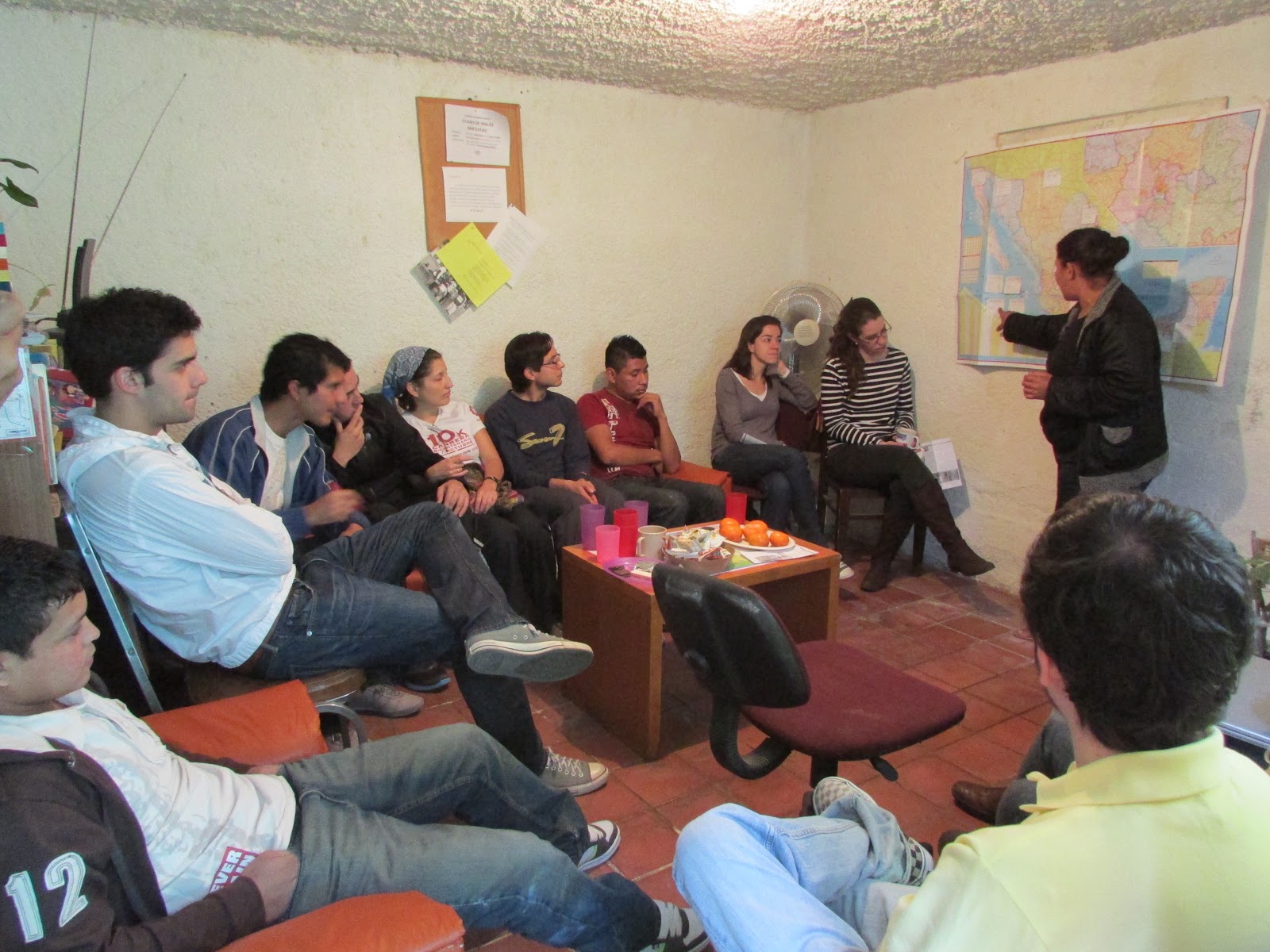
The need of a network of local physicians that can help out Gabriela regarding the healthcare needs of the migrants led me to organize a meeting. 


The turn-out was higher than expected, among the participants there were ID, renal, medicine and pediatricians.


Sara talked about the hardships they encounter during their journey and enumerated their health needs during the journey such as: NSAIDs, sun block, mosquito repellent, condoms, dressings, hydrogen peroxide, iodine, among others.


They listened, and at the end the conclusion was that once a month they were going to volunteer a day to provide the migrants and the community (to increase acceptance of the shelter among neighbors) with free health care; a facebook page, where Gabriela and other first contact providers, could get assistance and medical counseling would be created; and workshops regarding HIV as well as other medical topics would be organized.


At the end, I was reminded of Don Martin's words, and repeated to myself "No, they're not invisible".

�Sexual Health of Migrant Women in Transit Through Mexico: What do they have to say about HIV/AIDS and Unwanted Pregnancy�


Eva Tovar Hirashima
PGY3
Harvard Affiliated Emergency Medicine Residency
Mexico City, Mexico


I�ve been here for almost 3 weeks. On the second day of the trip, I was surprised to find out that one of the shelters I was intended to work in, located close to Mexico City in a town called Huehuetoca, had to be closed down 3 days before my arrival for security reasons. A shooting happened inside the shelter, it�s still unclear if it was the Maras or the Zetas, I�m an amateur to the violence and cannot understand the difference, but a bullet is a bullet regardless its origin.

To set the context, Mexico is a country of origin, transit and destination for migrants. In 2010, according to estimates derived from Mexico�s National Migration System 140,000 Central Americans entered Mexico without documents. Migrants face a variety of human rights violations and are at risk for extortion, abduction, rape, murder and forced recruitment into criminal gangs. Based on the official numbers, women constitute around 15-20%, however an interesting piece of unofficial information that I�ve come across during this trip is that the percentage of women, decreases the further north you travel; it�s unclear why they disappear, how it happens or where they go. Regardless or as a reflection of the former, women are especially vulnerable facing serious risk of abuse and sexual violence by criminals, other migrants and corrupt public officials. Accurate figures regarding the magnitude of sexual violence in migrant women are inexistent nonetheless human right organizations estimate that 6 in 10 women and girls experience sexual violence during their journey. The long term goal of the project is to figure out a way to provide victims of sexual violence accessible, appropriate and impartial medical management. I�m currently on the initial phases, and the objective of this trip is to gather qualitative data regarding the problem by interviewing migrant women in shelters.

Convenience store in Huehuetoca called "the border"...it starts before you know it!

I haven�t had much luck finding women, the initial closure of the shelter and the increase in security checks have been an obstacle for the interviews. I spent some time visiting the parish in Huehuetoca, where I had to relinquish my Harvard student ID, in order to speak with the priest about the project. The reason for the visit was because the shelter (as most migrant shelters in Mexico) is run by the Catholic Church. The first thing I was told was �No cameras, no photos of migrants, it�s too dangerous�.  After the necessary introductions, I found myself talking about female/male condoms, post-exposure prophylaxis (PEP) etc., and I have to admit that listening to my voice as it echoed in the office of high ceilings made me wonder if what I was saying could be interpreted as sacrilegious. But he and his assistant listened, and when it came to their turn to speak, the panoply of necessities, intermingled with specific anecdotes to stress their point, came pouring out: strengthening security measures, legal assistance, medical care, prenatal care (any type of medical care!) were but a few of their requests. I reemphasized that I was there to gather qualitative data. They understood and now I�m waiting for the approval of the bishop to gain entrance to the shelter.  
Serendipity led me to an exceptional man, who is not a priest, or a doctor, or a lawyer. He�s a simple man who in the 80s also became a migrant. He lived in the US and after saving enough money to build his house, returned to Mexico, his home-country. His town is close to the train tracks. The train, also known as �La Bestia� or �The Beast�, is one of the main modes of transportation because it�s free, and the railroad crosses the country from south to north. Migrants travel clandestinely on the train roofs. The journey can be tough, the lack of food and the changes in weather (cold in the mountainous regions, hot and humid in the tropics) are but two of the challenges they face in a daily basis. This exceptional man, that will remain nameless for now, understood this and for the last 12 years has been distributing plastic bags filled with bottles of water, oranges and bread. I witnessed his wife, daughters and grandsons prepping the bags, running to the tracks, signaling to let the rest know which train cars have people, and finally handing the bags to the migrants or throwing the bags into the train because most of the time the train will not stop and the bags need to reach their destination. At the end of that day, the exceptional man, smiled with his toothless smile and told me with pride that the cause of his missing teeth was not diabetes (which he has been diagnosed for a while but hasn�t received care for the last 2 years because of lack of money) but the multiple falls he�s suffered chasing �La Bestia�.

"La Bestia" approaches!


Distribution of food and water along the tracks

The lack of women to interview feels eerie but it has made me diversify.  I�ve been in contact with a small shelter in Mexico city (it only has 10 beds) and now I�m working on strengthening the alliances of it with a clinic in Mexico city which provides free care (including PPE for HIV when applicable) to victims of sexual violence. The clinic has agreed to manage migrants regardless of their migratory status in cases of sexual assault as long as they�re able to go to the clinic. 

Migrant shelter in Mexico City


Street performance organized by the shelter to raise awareness regarding gender violence


In addition, I�m working on establishing a network of local physicians that are available to the shelter for medical advice. Some days, things seem slow and unattainable, and I�m inclined to think that migrants are unreachable but I remember the words I just heard a few days ago: �People like to call them invisible, but I don�t think it�s accurate, I see them every day on the tracks.�


Tiffany Chao, MD, MPH  General Surgery Resident
  Massachusetts General Hospital
  Paul Farmer Global Surgery Research Fellow
  Program in Global Surgery and Social Change  Harvard Medical School / Children's Hospital Boston
JFK Medical Center
Monrovia, Liberia

---

My time in Liberia has come to an end and I am just returning to Boston from 5 weeks at JFK Hospital in Monrovia.

JFK Memorial Medical Center

Though time moved quite slowly there, I was able to accomplish my goal, which was to further develop the relationship between the JFK Surgical Department with Harvard Medical School's Program in Global Surgery and Social Change (PGSSC).  We accomplished this through a combination of educational initiatives, research infrastructure development, and clinical work.

From an educational perspective, I gave plenty of lectures to the medical students about all sorts of surgical topics.  I was even at JFK when the Department of Surgery was giving hospital-wide Grand Rounds, and, along with two of their surgical house officers, presented gastric ulcer disease:

Department of Surgery giving JFK Grand Rounds

From a clinical perspective, I was joined by my PGSSC colleague, clinical fellow Dr. Rowan Gillies, for a week at the end of my stay.  I was fortunate to join him for a couple of operations while the other local surgical house officers were busy.  Rowan, a Plastic Surgeon, has plenty of experience having been a former International Council President of the Nobel-Prize Winning M�decins Sans Fronti�res, so it was a real pleasure to get to work with him clinically!

Operating with Dr. Rowan Gillies

I made terrific friends out of the colleagues I met in Liberia.  In fact, one of the scrub nurses had actually worked with me before -- in 2008, when I was a medical student visiting Liberia from Mount Sinai Medical School!  In addition, there was even a scrub tech wearing scrubs that he had received from from Mount Sinai surgeons!  It is a small world.

 OR staff

While it was bittersweet to say farewell to JFK Hospital and Liberia, I look forward to returning -- hopefully, this spring!  We have research collaborations that are ongoing, and I plan to return with another one of the PGSSC clinical fellows as well.  I imagine that the cold New England winter will have me dreaming of the Liberian beaches!

Surgical Infrastructure and Operative Capacity in Liberia


Tiffany Chao, MD, MPH  General Surgery Resident
  Massachusetts General Hospital
  Paul Farmer Global Surgery Research Fellow
  Program in Global Surgery and Social Change  Harvard Medical School / Children's Hospital Boston
JFK Medical Center
Monrovia, Liberia
Ever since I visited Liberia in 2008 on a surgical trip with my medical school, I have wanted to return to this country.  Liberia, a small West African nation approximately the size of the US state of Virginia with a population of 3.5 million, at once demonstrates real health care capacity needs and the potential for considerable progress. A post-conflict nation recovering from a devastating 14-year civil war (1989�2003), Liberia is in the midst of critical period of stabilization.  Studies have begun to address the longstanding dearth of data regarding Liberian surgical capacity, and  the burden of specific disease entities and evaluation of particular interventions through outcomes monitoring are also of particular interest.


This year, I had the opportunity to work with Harvard Medical School's Program in Global Surgery and Social Change (PGSSC) as a research fellow, and I was extremely lucky that our program works in Liberia in addition to Partners in Health sites in Haiti and Rwanda.  Because of this, I have been able to come to Liberia for five weeks in October and November in order to teach medical students, contribute to clinical care, and develop research projects in conjunction with the local surgeons at JFK Medical Center, which is the country's only tertiary care hospital.
Here is a photo of me teaching medical students before rounds. My iPad has proven to be quite handy for this!

The current research project that I am working on with the entire surgical department involves developing a fundamental knowledge base about surgical demographics and operative capacity through a comprehensive operative log review and analysis at JFK Medical Center during 2009-2012. This data will guide the development of surgical capacity at the primary medical institution in the country in an epidemiologically-based and patient-centered way that can hopefully be replicated throughout the country. Once established, this knowledgebase can be used to focus direction of limited resources to provide high-quality care, improve efficiency and guide development of residency programs in the most crucial clinical areas.  

I have already been in this country for two weeks, and it is remarkable how much the infrastructure has advanced since 2008.  Back then, we had blackouts nearly every day and were often forced to operate in the dark with headlights.  Today, that would be unlikely, and the only time we ever lost power was in our dorms, at night, during a particularly bad storm.  That is progress!  
Of course, there are still significant resource limitations here, as in all developing countries.  


Here is a picture of a "wheelchair."

In particular, surgical capacity in Liberia is limited by human resources--in addition to the extremely limited numbers of physicians in this country, there are only four fully-trained surgeons working in this entire country, and only two of them operate full-time.  The good news is that there are plenty of medical students in the pipeline.  As you can imagine, I have been trying to encourage the medical students to go into the field of surgery!


Trends in HIV care in southern India and implications for future practice

Brian Chan
ID fellow, BWH/MGH

My time in Chennai is starting to draw to a close. Since I first posted, I have seen a variety of interesting cases, toured the state-of-the-art lab facilities, sat in on pre-ART and post-ART counseling sessions, gave a talk on HIV-associated neurocognitive disorders, and began hunkering down on some research proposals for the coming year and beyond.

First, the clinical stuff. I saw another interesting rash, affecting a middle-aged gentleman. CD4 count in the 200s. He had an itchy, nodular rash on his body, most prominent on his forearms, shins and dorsum of feet, posterior neck. He scratches them like crazy. Some of these feel papular, some of these feel nodular. He has some pus that he can express from these nodules (as seen in the photo of his L forearm). We had concern for nodular scabies, but we didn�t see anything under a microscope. Plan to empirically treat this for scabies anyway.


Have also had a great case of a man with a low CD4 count recently started on ART who had change in mental status. In the CSF, he was found to have cryptococcal ag +, + MTB PCR, and + HSV PCR! Not to mention VDRL + from the serum (though neg from the CSF). So potentially 3 infections in the CSF, not counting HIV itself! He is doing well (mental status has improved a lot) on high-dose fluconazole for the crypto (he bumped his creatinine to amphotericin), acyclovir for the HSV, anti-TB drugs, and continued ART. Also treating him for syphilis. There�s a question of whether he had an IRIS that unmasked these infections, but so far he has not needed any steroids.

Some pretty bad molluscum contagiosum:


This guy had a bullous lesion on his chest that popped, drained, and now remains open, but is now getting smaller on TB therapy.


Plenty more beyond these�CMV retinitis, lots of crypto meningitis, TB of the abdomen presenting as bowel obstruction, stavudine-induced pancreatitis.

Aside from these conditions that we don�t tend to see so commonly in the US, it�s become evident that chronic, non-communicable diseases are highly prevalent and morbid in this population. India is becoming wealthier, and the age of YRG CARE�s patients seems to be creeping higher (I saw a lot of folks in their 40s, 50s, and 60s). As a result, my research with YRG CARE going forward will focus on these chronic, non-infectious co-morbidities. We plan to start off with a relatively simple study looking at changing characteristics of patients presenting to care (are people presenting at higher or lower CD4 counts, are they presenting with OIs, are they presenting at an older age, etc.). We are also going to prepare a clinical series of patients hospitalized at YRG CARE with stroke. Next, we�ll get some prevalence data on comorbid diabetes, hypertension, and CAD/MI on the YRG CARE population. Ultimately, I also think that studying the prevalence -- and treatment � of depression in HIV+ patients will also be very fruitful, and I plan to delve into this in more depth after returning to Boston, and on my return trip to Chennai, which will be sometime in January or February.
Many thanks to the Partners COE for funding this trip and allowing me to gain this experience.

Like Us

Blog Archive