Medical News Blog Information

Outcomes, HPV status, and Attitudes among American Indians in South Dakota with Head and Neck Cancer


He Sapa Wacipi (Black Hills Powwow)
Our first community event was the Black Hills Powwow, a cultural gathering with dancing, singing, and socializing. I am working closely with the Walking Forward Program, which is a community based participatory research program working to increase cancer cure rates for American Indians. Over the course of three days we administered over 100 surveys and performed 41 head and neck screening exams. 

Grand Entry for the Powwow
My husband setting up the screening booth


Dr. Petereit, a radiation oncologist, and director of the Walking Forward Program and I


A participant and I in the screening booth
My son after all the hard work 


Sunshine Dwojak, MD, MPH
Harvard Program in Otolaryngology

An American Pathologist in Malawi: Settling into a Rhythm


            It is always just a matter of time for someone to get used to his or her surroundings.  Even far away from home, I�ve come to establish a routine for my days.  The Malawian sun rises around 5:30 AM, seemingly perfectly timed to the cacophony of cawing crows and barking neighborhood dogs.  After enjoying some local breakfast of �Jungle Oats� and coffee, I take the short walk to the College of Medicine and arrive around 8:00 AM.  On most days, the slides and paperwork await.  On other days, there are no cases in our inbox for one reason or another.  There have been a few days where the college has lost water or power (or both), leaving the histology technician helpless to prepare the daily cases.  Even if the cases are ready, we need electricity to power the light in the microscopes and the computers to generate our reports. 

I�ve come to consider these issues to be minor hiccups in the lives of pathologists here.  This is compared to pathology back in Boston, where losing water and power aren�t usually an issue.  However, the routine problems encountered in Malawi are replaced by a slough of other issues that exist in the majority of larger institutions with more equipment, staff and cases (misplaced slides, misplaced paperwork, crashing computer servers, etc.).  It is sobering to see that no institution is perfect, regardless of the size of the facilities.

Cutting surgical specimens with a
Malawian pathology registrar
            I have become used to other aspects of the Malawian department as well.  For example, I have settled into the method of teaching here.  There appears to be much more hands on training in the laboratory in the first years of medical training.  The medical students and rotating residents (called �registrars�) here are eager to learn, both at the grossing bench and the microscope.  I must admit it is quite enjoyable to watch them approach pathology with such enthusiasm. 

            By now, we have completely caught up with the backlogged workload, and are examining specimens that were taken just a few days ago.  Furthermore, my initial shock and awe at the severity of lesions biopsied here have subsided, allowing me to settle into a rhythm of diagnosing cases relatively comfortably.  We, as BWH pathologists, are very fortunate in that we have expertise available back home for unusual cases.  (We already have sent a few cases back to Boston to be looked at by the BWH subspecialty pathology services.)  For this reason, I have been afforded the opportunity to start an interesting teaching collection of rare cases to show my colleagues back home. 

            This has been once-in-a-lifetime experience so far.  I feel that my contribution here in Malawi has been worthwhile up to this point, and I have seen how much I can produce given the limited resources.  Accepting the challenges here and taking this worthwhile experience home will certainly help me overcome any challenges at home. 

Kevin Golden, MD/PhD
PGY-5, Surgical Pathology Fellow

Outcomes, HPV status, and Attitudes among American Indians in South Dakota with Head and Neck Cancer


Why does a trip to South Dakota qualify as Global Health?

Because certain populations within the United States have health outcomes that are as poor as those in the developing world. With average life expectancy five years lower than the average American, (72.6 years vs. 77.8 years), American Indians & Alaska Natives (AI/AN) suffer from significant disparities in health. Major medical centers, specialty care, and even primary care are frequently multiple hours away, effectively making this population as isolated and underserved as those observed in other parts of the world.

Cancer is one aspect of health where American Indians fare especially poorly. While cancer death rates for other Americans have been declining in recent years, AI/AN death rates have remained the same. In particular, American Indians in the Northern Plains (North and South Dakota, Nebraska and Iowa) have cancer mortality rates that are 30% higher than the rest of the US population.

My project is working to quantify these disparities for American Indians in South Dakota with head and neck (H&N) cancer via a chart review. Stage at presentation is one of the most important factors for cancer survival, and AI/AN historically present with later-stage cancers. To help understand why, I am also administering a survey at two large community events to gauge knowledge of the risk factors and early signs and symptoms of H&N cancer. Alongside the survey, we are offering a free head and neck screening examination.

Sunshine Dwojak, MD, MPH
Harvard Program in Otolaryngology


Landscape near the Pine Ridge and Rosebud Sioux Indian Reservations


Implementation of basic oral health care delivery systems in Haiti (Trois)

Cap Haitien, Haiti

Since the rocky start at the Justinian, I'm pleased to report that the rest of the clinic days were largely a success. As part of the mobile dental clinic program, we visited a variety of clinical sites including Limonade, a girls' orphanage, and Shada. The Tauzin Clinic in Limonade, a municipality about an hour from Cap Haitien, was accessible by tap-tap, the communal "taxis" in which passengers are transported in the bed of a sometimes decorated pick-up truck. We set up the clinic in a large barn used for a judo club, with four stations for patient care. A sterilization table was designated, and instruments were sterilized with a betadine soak and heated in a kitchen pressure cooker. Universal precautions were a bit of a reach, as we had no barriers and supplies were very limited. Patients were lined out the door, as they had arrived very early in the morning to take a number for treatment. It became quickly obvious that access to care was a major issue for the patient pool in this community, as many of them had extremely poor oral health care and presented with acute issues. We mostly performed extractions with this population, and a number of the children presented with abscesses and cellulitis. Pediatric care was quite a challenge in this clinic setting, as I could not employ the usual psychology and distraction techniques used in the States due to a gap in communication with my French and the locals' Creole. At one point, several of the Haitian dentists had to bolster down a screaming, kicking 7 year old as I extracted her grossly decayed teeth and drained her abscess to prevent it from manifesting into an airway-compromising submandibular space infection. Another point of contingency was the inability to check blood lab values before performing extractions, especially with patients that exhibited extensive post-op bleeding. With most of the adult population, who likely also suffered from multiple undiagnosed and uncontrolled systemic issues, I was uneasy to proceed with extraction without relying on my usual boundaries of INR and absolute PMN values. I have to admit that while we used Surgicel and sutured to obtain primary closure, I would have preferred to have some sort of follow-up with the patients. I wondered how they would get care if complications did occur, seeing that the hospital was over an hour away and transportation was oftentimes too expensive to afford.

Food For the Poor orphanage was another clinical site where we treated orphaned girls ages 3-13. Most of the children lost their families due to the 2010 earthquake or TB/HIV. We were informed that a number of the girls were affected with pre- or perinatal HIV. There were approximately 50 girls in the orphanage, divided into 4 buildings with one house mother per building. We set up in a similar manner with stations. For this demographic, I was surprised to find that most of the children were nourished, well cared for, and exhibited decent oral hygiene. Most of the treatment was through atraumatic restorative treatment and preventative sealants using a novel effective material- Fuji IX glass ionomer. This is a durable self-cure fluoride-releasing resin that I have only recently had experience with in using with our stem cell transplant and chemo patients who require elimination of all infection prior to admission. This method of restoration only required one instrument and a simple base-catalyst set up and resulted in efficient and effective outcomes. Hand instrumentation of decay was a elegant answer to a clinical setting with no access to water or electricity, much less a high speed turbine drill. Though this method does not remove 100% of the bacteria, the literature has shown that by sealing off the lesion with Fuji, the hope is that the oxygen required for the intraoral aerobic bacteria (namely S. mutans) would be eliminated and therefore demineralization arrested.

Perhaps the most poignant clinic site visited was the neighborhood of Shada, the most impoverished community in Cap Haitien and, in my experience, the worst living conditions that I have ever encountered in my travels. Children made up the large majority of the population, with a number of them exhibiting dental abscess and facial trauma. We treated over 70 patients, while having to turn down another 30 due to running out of essential supplies and materials by the end of the day. Walking through the village, one waded through excrement and trash, and were followed by a mob of children barely clothed. At one point I was looking into the river filled with the neighborhood waste, and noticed that all of our biohazard materials- contaminated gloves, gauze, sharps- were all dumped by the locals into the only source of drinking water in town. It was an appalling and moving sight, as I knew that there was no infrastructure for garbage removal nor way of dealing with sewage and sanitation. I remembered how I had been cautioned that the experience of Haiti would be a rollercoaster of highs and lows, wins and losses, and the recognition of how difficult life is in Haiti with the Creole saying: "beyond the mountain there is another mountain." It is with these observations that each of us must carefully construct our own framework and understanding of this country to share with the international community.


Ha�ti est une terre de grande beaut� et grande souffrance. Piti, piti, wazo fe nich li.
[Haiti is a land of great beauty and great suffering. Little by little the bird builds its nest.]

Transfusion Medicine in Africa: Johannesburg, South Africa

James Kelley, PhD, MD
Department of Pathology
Brigham and Women�s Hospital

Like most visitors to southern Africa, my first stop goes through Johannesburg � the �city of gold�. This megalith of 7 million people conjures images of apartheid and armed home invasions; however, the people are as friendly and warm as its summer weather. After all, this is the home of Nelson Mandela and the World Cup. Everyone I meet welcomes me to South Africa and seems genuinely interested that I enjoy visiting their country � even a man walking down my street with an AK47 on his shoulder did not rob me but simply said �whatzit� with a smile.


Jo�burg is a city of contrasts: I have visited townships where ninety families share one portable toilet and have browsed through shopping malls with Gucci and Prada. I am living in Sandton, a northern suburb that generates over 10% of the GDP for all of Africa. The wealth, quality of living, and flashiness here make Boston look like a poor provincial town. My guesthouse has a large garden with digital cable, wireless internet, and uniformed maids cleaning and cooking for me. Not the typical global health experience. However, it resembles a self-imposed prison situated behind a ten-foot concrete wall with electrified fence that hums like a mosquito zapper.

Of the multitude of things on offer in Johannesburg � transfusion medicine is one that is limited. It doesn�t really exist as a field in Africa. Physicians who specialize in blood banking are usually internists who took an interest in the subject and learned informally. There is only one postgraduate program in transfusion medicine on the continent, and it is a distance learning part-time course.

Given the paucity of formal blood banking expertise, I was curious as to how blood banks function given the financial constraints, government corruption, widespread transfusion transmissible disease prevalence, and cultural attitudes in Africa. I am lucky to be hosted by an organization, Safe Blood for Africa, a non-profit group based in Georgetown with their operational office located in Sandton. They have networked me with various hospitals and blood services throughout the continent to visit and experience the realities and challenges of operating a transfusion service in Africa. I am also working with them to help develop educational programs for training clinicians in proper blood banking practices.

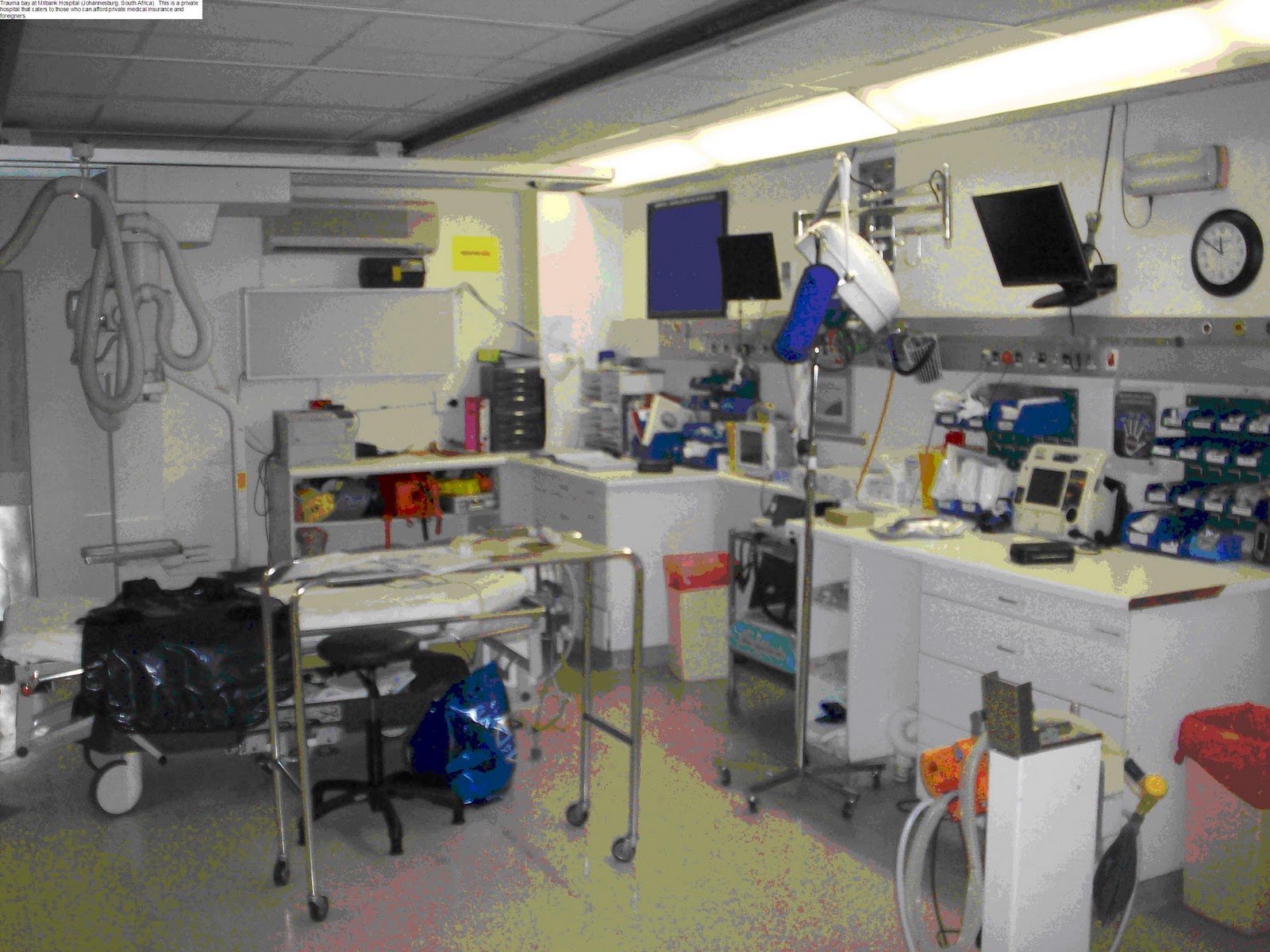
Trauma bay at Milbank Hospital (Johannesburg, South Africa).  This is a private hospital that caters to those who can afford private medical insurance and foreigners.


They have told me stories of aggressive surgeons barging into a blood bank and taking a unit for transfusion without appreciating that the ABO group did not match and of nurses hanging a bag of blood for a child, transfusing half the unit, putting it back in the refrigerator in non-sterile conditions, and then transfusing the rest of the unit to another patient later in the week. Both resulted in fatalities. Developing programs to educate clinicians could save numerous lives.

The first stop on my tour was the South African National Blood Service (SANBS). This organization has resources and expertise atypical of the rest of the continent. The medical director is a board certified internist trained in Washington. Their standard of care is more similar to what we offer in the US. They perform serological and nucleic acid testing for HIV, HBV, and HCV on all donors, reducing the risk of transmission to about 1:400,000 transfusions. (We advertise rates of 1:2,000,000 at the Brigham with our procedures; however, we don�t have a HIV prevalence of 20% in our general population.) They separate blood components and provide advice to clinicians across the country regarding transfusion reactions and blood products.

I was able to watch their testing and component processing and compare it to our procedures at BWH � all were very similar except their equipment was slightly older. Their physicians also remotely oversee therapeutic apheresis and stem cell collections, which will be driven back to their main offices, processed, and driven to the recipient�s hospital for infusion. I observed the apheresis clinics and again found their equipment and protocols almost identical to what we use at BWH. However, I am assured that the standard available in South Africa and Johannesburg in particular is not typical of the rest of the continent. I am excited to find out for myself �.

Therapeutic apheresis clinic in Auckland Park (Gauteng) South Africa.  We had just finished a hematopoietic stem cell collection.

Like Us

Blog Archive