Medical News Blog Information

Emergency Medicine in Colombia


GME Centers of Expertise Global Health Blog

David Beversluis MD MPH
Emergency Medicine PGY3
Characterizing Emergency Medicine in Colombia
(written 3/15/2013)

I'm now about 3 weeks into my 6 week elective here in Colombia and enjoying every minute.  And thrilled to get the news (even after I started) of support from the Centers of Expertise Travel Grant.  Thanks to all those working to provide this support to us residents committed to international work during residency!

I've split my elective time here in Colombia into two 3 week blocks.  First is a 3 week clinical experience working in several emergency departments in Bogota.  I'm just finishing this now and I'll write a bit more below about my impressions of working here below.  The second phase of my elective is to carry on the work of an ongoing survey of emergency medicine programs in several cities around the country.  This is work that was started by a few of my EM colleagues during a visit last year.  Much of this 'characterization' has already been done here in Bogota.  Our efforts during this trip focus on the other cities in the country that have active EM training programs.  I'll be flying north to Medellin tonight, and then next week to Cartagena to visit various hospitals, to lead some small group discussions with residents and to administer our surveys.   I'll also be meeting up with Dr. Christian Arbelaez one of the EM attendings at BWH, and the American College of Emergency Physicians (ACEP) Ambassador to Colombia.  His rich connections into the EM community here in Colombia are what is really making this project possible.  And I'm also very excited to be joined by Christina Wilson one of the HAEMR PGY2s for the next couple weeks in Cartagena.  So, more on that all in a future blog post...

During the last few weeks I've been spending my days at a couple of the emergency departments around Bogota.  Its been very interesting to see and observe the differences between our systems.  Emergency medicine in Colombia remains in a nascent phase, but is slowly expanding in influence and scale.  The first EM residency was started in Medellin in the mid-90s and there are now 5 programs total throughout the country.  This new specialty is still relatively unknown in Colombia however, with most urgent care provided by general practitioners with only 1 year of post-grad training.  Most Urgencias in the country are staffed exclusively by these doctors who consult surgery or internal medicine specialist for more difficult cases.  Several hospitals however are beginning to see the value of having EM trained staff and supervision, for patient care, throughput, cost-control and many other similar reasons.  The hospitals where I spent my time are all slowly making progress in also the transition and slowly advancing the field of EM here in Colombia.

During my first and second weeks I rotated at the Javeriana University San Ignacio Hospital in Bogota.  This is a large urban university hospital with access to plenty of internal resources but which is pushed to the limits by over-crowding issues.  The ED is designed for a quarter of the patients that it sees every day.  This leads to wait times for minor patients of up to 24 hours and to ED length of stay times of several days.  I spent time examining and speaking with patients who had been in the ED for 2-3 days sitting on rows of 8 or more chairs crammed into ED bays designed for one bed.  The amazing thing is how appreciative these patients remain despite this lack of space and staff to move them through the ED more quickly.  In the acute areas the flow and care is much better and patients are typically receiving top quality care from dedicated EM residents and physicians.  New patients are seen quickly and triaged to appropriate specialists as needed, for example I was impressed my first day there by a STEMI patient who quickly made it to the cath lab in under an hour.  Likewise, several septic and coding patients that I helped care for received great evidence based emergency care from the team.  Despite the overwhelming press of patients in the department these EM trained residents were successfully deploying and triaging their resources to address the most critically ill group.


For my final week of clinical work I switched to Mederi hospital.  This is another university based hospital in Bogota which takes residents from the San Rosario EM program.  The clinical care was similar with plenty of typical ED pathology including strokes, sepsis and coding patients.  Interestingly there was almost no trauma during my time in Bogota.  This is partly due to the hospitals and neighborhoods I was in, but also due to the overall development of Bogota.  Over the last 2 decades the city has become relatively safe.  So much so that the residents rotate for several months in Cali in the south to get a bit close to the FARC vs. military and urban poverty trauma which has mostly been resolved in the capital.  Despite the lack of trauma, I did get several procedures, which was one of the goals of my trip.  These hospitals are mostly still doing subclavian lines for central access which is something we've moved away from in Boston with our easy access to ultrasound; I got to put in plenty of these.  It was also great to intubate by direct laryngoscopy without the backup of our video assisted systems in Boston.

So, overall, my clinical experience was good from a procedures and clinical perspective, I'll definitely take some of these skills back to my work in Boston.  I can also feel my spanish slowly improving; I'll be using this ability in my work for the rest of my life.  Finally though, I'm glad to have this 3 weeks of experience and insight before I start the next phase of my work here.  Having seen Colombian emergency medicine from the inside will help me as I conduct interviews and site visits in Medellin and Cartagena and understand the emergency system as a whole.  I can't wait to see these places and keep up going with this fun work.


Medical Education in Resource-Limited Settings - Rebecca Cook, MD, MSc


February 19, 2013

For most of my time in Uganda I've been based at Mbarara University of Science and Technology MUST / Mbarara Regional Referral Hospital (MRRH) on the internal medicine team.

Every morning we start the day with "post-take" which is review of new patient admissions, followed by work rounds on patients already on the medical ward. These rounds are attended by the medical house staff, a large crowd of medical students and an attending physician. The structure and cadence is very similar to that of the inpatient medicine rounds at MGH, but the disease pathology, the physical space and human resources are vastly different. On an open long hall with 30 beds and extra patients lying on mats on the floor, we go bed-to-bed; vigilant to not step on a patient or family member who is lying on the floor. Despite the rather low-tech set-up on the wards, our patients are often quite sick and I am amazed at the ability of the medical staff here to provide advanced care with limited resources, such as managing cardiogenic shock on a medical ward, titrating IV drips of pressors in drops/minute. Aside from a huge burden of advanced infectious diseases such as advanced HIV/AIDS and every opportunistic infection one can imagine, disseminated TB, severe malaria, we also have patients with the sequealae of non-communicable diseases: strokes, diabetes, and heart failure.

Interns and nursing student after morning �post-take�

One of my favorite aspects of daily life on the medical ward has been learning from and teaching medical students. Unlike at MGH where we may have 2-4 medical students on a team, here there are 10-15 and form a core part of the workforce in patient care. These third year students who are in their infancy of exposure in the hospital not only have the usual intense experience of learning how of integration into clinical medicine; they are also an integral part of the patient care due to the overall low number of nurses and physicians in the hospital. They are frequently the only ones to check vital signs; are responsible for placing IV catheters, drawing labs and filling out forms for investigations and updating the patient and family members outside of rounds.

Because nursing and allied health workers are scarce, the family, as in many resource-limited settings are integrally involved in patient care; her they involved in providing nutrition (including supplying and administering food through nasogastric tubes), administering oral medications, and much more. For those without loved ones, there is great tragedy and inequity in a system that relies so heavily on a patient�s family for basic care. At the same time, for patients who do have family, especially those with ongoing nursing needs at discharge, the family are often well positioned to continue care at home. It is ironic that because of the lack of trained health care workers; the families are more organically equipped to provide home health care.

I have been fortunate to have my visit here coincide with the Department of Internal Medicine's First "International Medical Update Conference." The three days of sessions have been high-yield learning from both local and international speakers on areas of clinical medicine that are not common in Massachusetts such as TB meningitis, as well as practical and innovative solutions on how to care for non-communicable diseases like diabetes and cancer in resource-limited settings. Beyond the individual clinical learning; the conference has been yet another reminder of what a privilege it is to work alongside and learn from the Ugandan internal medicine residents at MUST. Many of them presented their own research or areas of interest at the conference; I am so impressed with not only their intelligence but also their dedication. They not only maintain tremendous clinical responsibilities but also are committed to medical scholarship to real-life bedside-to-bench and back again

A few of the stellar internal medicine senior house officers

As my time in Uganda draws to a close, I'm really humbled by the opportunities I've had and excited to continue to keep of both the professional partnerships and personal friendships. I�m excited to work with Ugandan housestaff and co-residents at MGH who visit MUST on a handbook of clinical protocols that will help both visiting and local clinicians improve uniformity and quality of care for key medical conditions

Medical Education in Uganda - Rebecca Cook, MD, MSc

February 7, 2013


This week we visited Bugoye which is a town nestled in the hills of Southwest Uganda. The MGH Global Primary Care Program is partnering with Mbarara University of Science and Technology and Bugoye Health Center to improve primary care in the area, particularly focusing on under five mortality. It has been a refreshing change from the dark and overcrowded wards of the regional hospital to learn about healthcare in action at a completely different level: in the community.

We have traveled with the village health teams home-to-home through some of the villages in the catchment area of the health center; learning the realities of the social determinants of health and how they are being addressed at the grassroots level. Village Health Team members are community members who are elected by their communities to be health advocates and a liaison with the health care system. They go home to home educating households on the most basic fundamentals of health; such as hygiene measures like a proper latrine, hand washing, and a drying rack for dishes.

The �tippy tap� a hands-free way to wash hands without running water


A women's group we visited in Bugoye has also received education in how to make indoor stoves out of mud that are more energy efficient and where smoke goes outside -- addressing two important aspects of health -- exposure to indoor smoke and environmental degradation through deforestation which affects rain patterns and soil erosion ultimately effecting the food supply. Interestingly, these women, of their own accord have made building the stove and other such "household improvements" a requirement for membership in the women's group � here they model ownership and support to make positive changes.

The Village Health Team at Bugoye is in the early stages of a new initiative: community case management of common childhood illnesses. A spin-off of the WHO Integrated Management of Childhood Illnesses IMCI village health workers have been trained in identification of danger signs in children, and appropriate basic management including treatment with basic antibiotics and anti-malarial and appropriate referrals. This week at a health outreach, we had the privilege of witnessing the unveiling of a drama they have written and perform in to help sensitize the community to this new initiative.

Village Health Team performing a drama to sensitize the community to new health initiatives


Eva Tovar Hirashima
PGY3
Harvard Affiliated Emergency Medicine Residency
Mexico City, Mexico
Sexual Health of Migrant Women in Transit Through Mexico: What do they have to say about HIV/AIDS and Unwanted Pregnancy�

It�s the end of the road, at least for this trip. I didn�t get to do all the interviews that I thought I would but I was lucky enough to get a glimpse of a world that up until now was unscathed territory for me. The gap of women that I talked about on the prior blog was still there and seemed unfathomable throughout the trip but the world that I was introduced to taught me a new language, and led me to understand a new set of priorities and acquire a new sense of urgency. The irony of it is that what seemed novel to me is an ancient request: shelter, food and water, and basic healthcare.


Don Martin, a migrant himself in the 80s, decided to provide the migrants who travel on the train on their way up north with humanitarian aid by throwing bags of food, water and clothes to the clandestine passengers of the train.


He has been doing it for the last 12 years. His family helps him, including his 4 year old grand-son.

Sara, a migrant from Honduras, who I met in a shelter in Mexico City called Tochan, is helping Don Martin�s daughter pack bread that will later be placed in a bag with water and fruit. The bags will be thrown to the people who travel on the train.


Alex, a migrant himself, is choosing fruit that will be placed in the bags


We managed to get a donation of condoms and oral rehydration therapy that will be placed in the bags

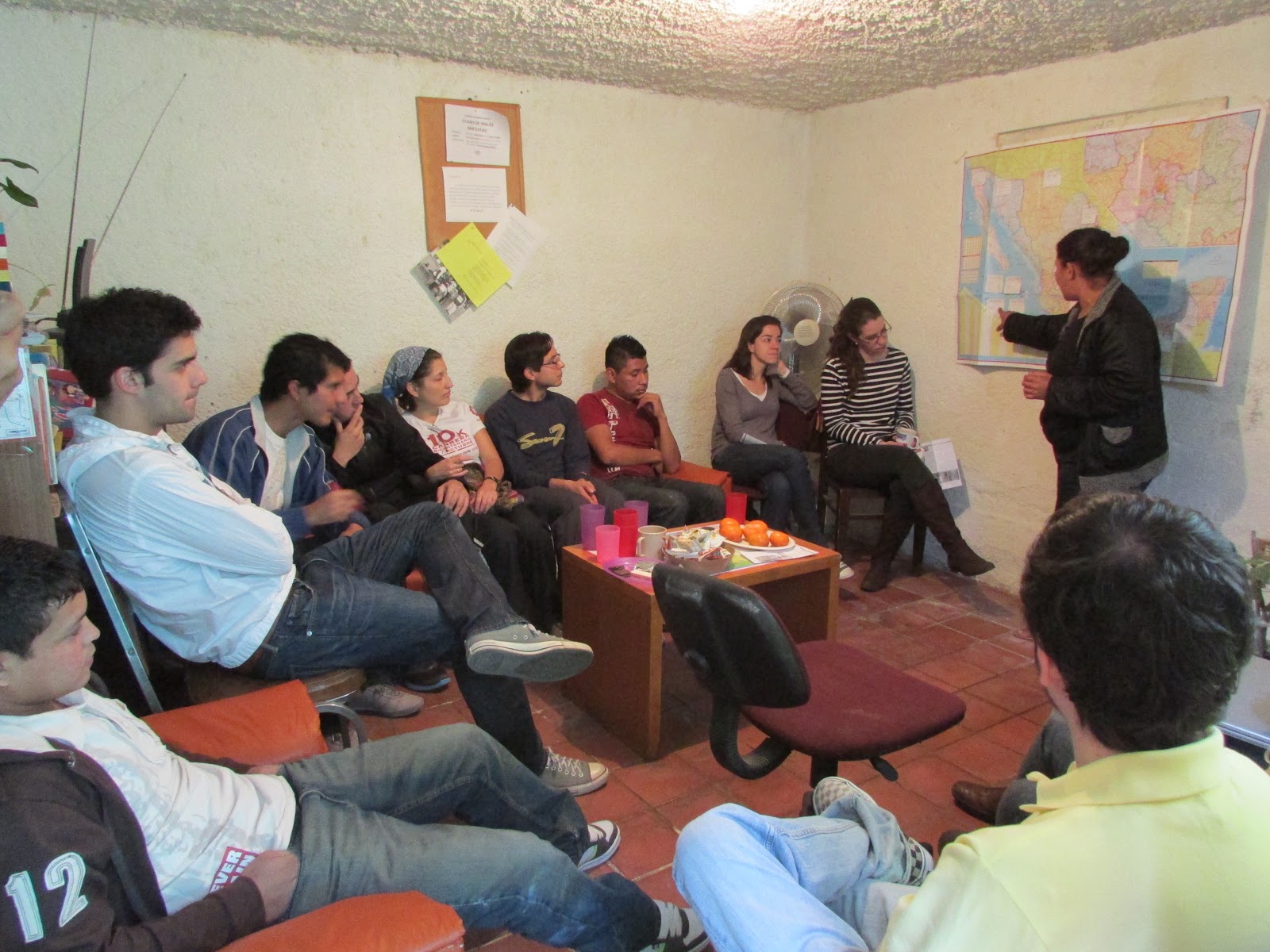
Regarding health, Sara a migrant herself, and I held a workshop of HIV with the other residents of Tochan, the migrant shelter in Mexico City.
After the workshop a few of the attendees agreed on going to a clinic called "Clinica Condesa" in Mexico City, to get tested. The test is free and counseling is available regardless of migratory status.

Another task that I set myself to do was to strengthen inter-institutional collaboration among the different actors.


 In the photo, Gabriela, the coordinator of the shelter in Mexico City -Tochan- is meeting Dr. Florentino from the "Cl�nica Condesa". The clinic has an impressive sexual violence program, where PEP (post-exposure prophylaxis) and other STD management, birth control and OBGYN follow up is available for free. 


Unfortunately the clinic is exceptional in Mexico, in fact I was told that according to the Mexican norm, PEP can only be provided to a victim who was sexually assaulted by 2 or more individuals.

Sara receiving a donation of condoms from the �Clinica Condesa� that will be placed inside Don Martin�s bags.

As expected the health needs of the migrants in transit are diverse: diarrhea, URI, conjunctivitis, skin rashes, frost bite (when travelling thorough the center of Mexico), dehydration and heat stroke (when travelling through the desert) were the more frequent complaints. Unfortunately amputations and trauma after falling off the train were also prevalent. It was no surprise to hear, that during their journey migrants are reluctant to search for medical assistance either because of fear of deportation or because they were denied care in the public health care clinics in previous attempts. Based on the former, Doctors without Borders has established clinics in 3 shelters: Arriaga (Chiapas), Ixtepec (Oaxaca) and Huehuetoca (Edo. De Mexico). Medical assistance along the train tracks is also provided by the government funded group called �grupo beta�, however the demand for care seems to overwhelm the capacity of the existing resources.  

A few of the migrants with active health care needs I encountered in Tochan were:

He got shot in the train and required a splint and crutches for a few weeks.
He fell down from the train and suffered a clavicular fracture. Doctors without Borders transferred him to a local hospital where he got surgery and then transferred him to Tochan where he�s awaiting his recovery.  


The need of a network of local physicians that can help out Gabriela regarding the healthcare needs of the migrants led me to organize a meeting. 


The turn-out was higher than expected, among the participants there were ID, renal, medicine and pediatricians.


Sara talked about the hardships they encounter during their journey and enumerated their health needs during the journey such as: NSAIDs, sun block, mosquito repellent, condoms, dressings, hydrogen peroxide, iodine, among others.


They listened, and at the end the conclusion was that once a month they were going to volunteer a day to provide the migrants and the community (to increase acceptance of the shelter among neighbors) with free health care; a facebook page, where Gabriela and other first contact providers, could get assistance and medical counseling would be created; and workshops regarding HIV as well as other medical topics would be organized.


At the end, I was reminded of Don Martin's words, and repeated to myself "No, they're not invisible".

�Sexual Health of Migrant Women in Transit Through Mexico: What do they have to say about HIV/AIDS and Unwanted Pregnancy�


Eva Tovar Hirashima
PGY3
Harvard Affiliated Emergency Medicine Residency
Mexico City, Mexico


I�ve been here for almost 3 weeks. On the second day of the trip, I was surprised to find out that one of the shelters I was intended to work in, located close to Mexico City in a town called Huehuetoca, had to be closed down 3 days before my arrival for security reasons. A shooting happened inside the shelter, it�s still unclear if it was the Maras or the Zetas, I�m an amateur to the violence and cannot understand the difference, but a bullet is a bullet regardless its origin.

To set the context, Mexico is a country of origin, transit and destination for migrants. In 2010, according to estimates derived from Mexico�s National Migration System 140,000 Central Americans entered Mexico without documents. Migrants face a variety of human rights violations and are at risk for extortion, abduction, rape, murder and forced recruitment into criminal gangs. Based on the official numbers, women constitute around 15-20%, however an interesting piece of unofficial information that I�ve come across during this trip is that the percentage of women, decreases the further north you travel; it�s unclear why they disappear, how it happens or where they go. Regardless or as a reflection of the former, women are especially vulnerable facing serious risk of abuse and sexual violence by criminals, other migrants and corrupt public officials. Accurate figures regarding the magnitude of sexual violence in migrant women are inexistent nonetheless human right organizations estimate that 6 in 10 women and girls experience sexual violence during their journey. The long term goal of the project is to figure out a way to provide victims of sexual violence accessible, appropriate and impartial medical management. I�m currently on the initial phases, and the objective of this trip is to gather qualitative data regarding the problem by interviewing migrant women in shelters.

Convenience store in Huehuetoca called "the border"...it starts before you know it!

I haven�t had much luck finding women, the initial closure of the shelter and the increase in security checks have been an obstacle for the interviews. I spent some time visiting the parish in Huehuetoca, where I had to relinquish my Harvard student ID, in order to speak with the priest about the project. The reason for the visit was because the shelter (as most migrant shelters in Mexico) is run by the Catholic Church. The first thing I was told was �No cameras, no photos of migrants, it�s too dangerous�.  After the necessary introductions, I found myself talking about female/male condoms, post-exposure prophylaxis (PEP) etc., and I have to admit that listening to my voice as it echoed in the office of high ceilings made me wonder if what I was saying could be interpreted as sacrilegious. But he and his assistant listened, and when it came to their turn to speak, the panoply of necessities, intermingled with specific anecdotes to stress their point, came pouring out: strengthening security measures, legal assistance, medical care, prenatal care (any type of medical care!) were but a few of their requests. I reemphasized that I was there to gather qualitative data. They understood and now I�m waiting for the approval of the bishop to gain entrance to the shelter.  
Serendipity led me to an exceptional man, who is not a priest, or a doctor, or a lawyer. He�s a simple man who in the 80s also became a migrant. He lived in the US and after saving enough money to build his house, returned to Mexico, his home-country. His town is close to the train tracks. The train, also known as �La Bestia� or �The Beast�, is one of the main modes of transportation because it�s free, and the railroad crosses the country from south to north. Migrants travel clandestinely on the train roofs. The journey can be tough, the lack of food and the changes in weather (cold in the mountainous regions, hot and humid in the tropics) are but two of the challenges they face in a daily basis. This exceptional man, that will remain nameless for now, understood this and for the last 12 years has been distributing plastic bags filled with bottles of water, oranges and bread. I witnessed his wife, daughters and grandsons prepping the bags, running to the tracks, signaling to let the rest know which train cars have people, and finally handing the bags to the migrants or throwing the bags into the train because most of the time the train will not stop and the bags need to reach their destination. At the end of that day, the exceptional man, smiled with his toothless smile and told me with pride that the cause of his missing teeth was not diabetes (which he has been diagnosed for a while but hasn�t received care for the last 2 years because of lack of money) but the multiple falls he�s suffered chasing �La Bestia�.

"La Bestia" approaches!


Distribution of food and water along the tracks

The lack of women to interview feels eerie but it has made me diversify.  I�ve been in contact with a small shelter in Mexico city (it only has 10 beds) and now I�m working on strengthening the alliances of it with a clinic in Mexico city which provides free care (including PPE for HIV when applicable) to victims of sexual violence. The clinic has agreed to manage migrants regardless of their migratory status in cases of sexual assault as long as they�re able to go to the clinic. 

Migrant shelter in Mexico City


Street performance organized by the shelter to raise awareness regarding gender violence


In addition, I�m working on establishing a network of local physicians that are available to the shelter for medical advice. Some days, things seem slow and unattainable, and I�m inclined to think that migrants are unreachable but I remember the words I just heard a few days ago: �People like to call them invisible, but I don�t think it�s accurate, I see them every day on the tracks.�


Tiffany Chao, MD, MPH  General Surgery Resident
  Massachusetts General Hospital
  Paul Farmer Global Surgery Research Fellow
  Program in Global Surgery and Social Change  Harvard Medical School / Children's Hospital Boston
JFK Medical Center
Monrovia, Liberia

---

My time in Liberia has come to an end and I am just returning to Boston from 5 weeks at JFK Hospital in Monrovia.

JFK Memorial Medical Center

Though time moved quite slowly there, I was able to accomplish my goal, which was to further develop the relationship between the JFK Surgical Department with Harvard Medical School's Program in Global Surgery and Social Change (PGSSC).  We accomplished this through a combination of educational initiatives, research infrastructure development, and clinical work.

From an educational perspective, I gave plenty of lectures to the medical students about all sorts of surgical topics.  I was even at JFK when the Department of Surgery was giving hospital-wide Grand Rounds, and, along with two of their surgical house officers, presented gastric ulcer disease:

Department of Surgery giving JFK Grand Rounds

From a clinical perspective, I was joined by my PGSSC colleague, clinical fellow Dr. Rowan Gillies, for a week at the end of my stay.  I was fortunate to join him for a couple of operations while the other local surgical house officers were busy.  Rowan, a Plastic Surgeon, has plenty of experience having been a former International Council President of the Nobel-Prize Winning M�decins Sans Fronti�res, so it was a real pleasure to get to work with him clinically!

Operating with Dr. Rowan Gillies

I made terrific friends out of the colleagues I met in Liberia.  In fact, one of the scrub nurses had actually worked with me before -- in 2008, when I was a medical student visiting Liberia from Mount Sinai Medical School!  In addition, there was even a scrub tech wearing scrubs that he had received from from Mount Sinai surgeons!  It is a small world.

 OR staff

While it was bittersweet to say farewell to JFK Hospital and Liberia, I look forward to returning -- hopefully, this spring!  We have research collaborations that are ongoing, and I plan to return with another one of the PGSSC clinical fellows as well.  I imagine that the cold New England winter will have me dreaming of the Liberian beaches!

Like Us

Blog Archive