Medical News Blog Information

Showing posts with label Age bias. Show all posts

Middle East respiratory syndrome coronavirus (MERS-CoV): Age and Sex [UPDATED]

THIS PAGE IS NO LONGER UPDATED

This data visualization has been added to the single
MERS-CoV page now be found at..
http://newsmedicalnet.blogspot.com.au/2014/07/middle-east-respiratory-syndrome_17.html

A new static page on which I will update the MERS-CoV numbers as they relate to the age and sex of the people laboratory confirmed as infected.


Jeddah changed the MERS-CoV age:sex landscape...

Note. Not every death or case is listed.
See bottom-left corner for breakdown.
Click on charts to enlarge.
I've broken down the age and sex in these charts.

As usual, it's mostly about males and older people until we get to the Jeddah outbreak.

In the top pair of charts (note the different scale used here compared to that used in the charts below) we see the breakdown for all MERS-CoV detections to date on the left and the fatal cases from among those on the right. 
An apple in terms of people shapes.

In the middle pair of charts we look at all cases form 2012 up until the day before the Jeddah outbreak. The total case pyramid shows an older age bulge but the deaths look very similar to those for all fatal outcomes. M:F is similar to the total case charts above.

In the bottom pair of charts we're looking at what happened from the beginning of the Jeddah outbreak until now. We see a marked change in distribution with many more younger adults being positive for MERS-CoV. We also see a major shift towards more females than we'd seen beforehand. All the result of more widespread testing and a greater healthcare worker contribution I presume. Strangely though, given the younger adult demographic here, we see no accompanying jump in numbers of children. Are they not subject to testing? Are the younger adults often foreign workers who do not have children/children with them with them? There is no reason for children to test any less frequently MERS-CoV-positive and they are also just as likely as healthy adults to get mild or asymptomatic disease (as far as we know). If positive, children will have an important potential role in the MERS-CoV transmission story, especially when visiting elderly relatives.

The recent Al Qunfudhah teacher who is MERS-CoV just reinforces that children are shaping up to be a strange data gap. Yeah. I know. Another one.


Snapdate; MERS-CoV and the thickening age/sex pyramid..

Click on image to enlarge.
No, it's not the title for an epidemiologist's detective novel. It's a comparison of my previsou and my latest age/sex pyramids.

And it really looks like MERS needs to go on a diet. Its "waist" has broadened quite a bit as a sign of younger cases becoming part of the rogue's gallery of infected, if not afflicted, people. 

Also note the axis along the bottom has changed a lot between mid-April and now. So we have more total numbers but also more detections of virus in the under-50s age band.

And as always, males predominate in MERS-world.


MERS-CoV by sex, week and age...

Two quick charts on the Middle East respiratory syndrome coronavirus (MERS-CoV; which I verbalize as "murrs coronavirus" just fyi )data.

The first chart shows a rise in the proportion of females (pinked dashed line; right-hand axis) during the Jeddah outbreak over recent weeks. But this does not change the fact that males still make up the majority of humans positive for MERS-CoV. For camels - I don't know sex, but juveniles seem to more often have RNA detected and less often have MERS-CoV antibodies present.

It's interesting that a similar rise in the proportion of positive females occurred in April-2013 when there was another healthcare-related outbreak around Al-Ahsa.

It would be nice to know what the sex breakdown is when comparing index cases to non-index cases. Does human-to-human spread involve more females as it goes along than does acquisition from camels - these presumably being a more common source for the sporadic cases that trigger each smaller cluster? Could a rise in the proportion of females be useful as a marker for an impending extended outbreak? Do men have most of the contact with camels? A few question marks there.


The sex distribution, by week, of MERS-CoV positive people and the proportion of those,
each week, who are female (shown using a 6-day moving average).
Click on image to enlarge.

The second chart plots the average age each week (an orange dot) and plots a 10-day moving average. The moving average continues to show the cyclical pattern I alluded to in my last post of this chart - whatever it means or doesn't mean. 

During the Jeddah outbreak, the average age appears to have dropped compared to prior to just the outbreak. But there is a lot of movement in the average age over time. Although, there does seem to be a downward trend after the Apr-2013 outbreak as well and another after something happened in October. Do we know of an outbreak in Oct-2013? Could this mark one that occurred but that we didn't hear about? Am I wearing my tinfoil hat again? So many questions.

Age drops among the tested population may be another marker of the wider or differently composed population that is being infected during human-to-human spread compared to when cases are sporadic and perhaps more closely camel-contact related. 

The average age, each week, of MERS-CoV positive people and a trend shown 
using a 6-day moving average.
Click on image to enlarge.

Or it may be nothing but noise from the incomplete data we have to play with here.

H7N9 Snapdate: some quick charts...

Click on image to enlarge.
I don't have a lot of time tonight so this is just a quick post of some updated charts with a few summaries of some key features of the influenza A(H7N9) virus situation in south-eastern China. At writing it was at 432 detections with media reporting 128 deaths

Click on image to enlarge.
Guangdong is where H7N9 is still most active and it is this province that is the source of the continued cases trickling off Wave 2's peak.

Most H7N9 cases overall have been in Zhejiang and Guangdong provinces but lately, post-peak of Wave 2, there has been continued activity in Jiangsu province including a recent healthcare worker with no mention of "contact with poultry"; the absence of which stands out in World Health Organisation (WHO) reports because most cases are followed by affirmation of that phrase.

Click on image to enlarge.

In  the  survival chart above we see that most of the fatal cases, shown in red, are defined by an older age. Unfortunately, a lot more of the fatalities have been reported through the media without identifying details (48 of 128), than have come through official Chinese channels and out via the WHO. This lack of detail makes it impossible to clearly link a lot of the deaths to the case announcements. Only the custodians of these data know what this chart should really look like. NB: Since making the chart this morning I've found a handful more case details at FluTrackers, but public detail on fatal cases remains the weakest of any of the H7N9 data.

Click on image to enlarge.
We can see in the weekly chart on the right that the two H7N9 waves differed in timing, the width of their bases (more cases in Wave 2) as well as how "tight" their peaks were. Wave 2 has tailed off, but continues to spit out cases, while Wave 1 comprised both a steep climb and a steep decline in human cases.
Click on image to enlarge.

If we zoom in on Wave 2 we can see by looking at cases per day in the chart on the left, that between 0-4 illness onsets per day are being reported, as they have been since late Feb-2014. 

Is this the legacy of those regions whose live bird markets remained open or were only shut temporarily for disinfecting and restocking? Those regions with markets that were shut for much longer, or for good, do not seem to have contributed much to the continuing leak of H7N9 infections despite being key contributors during the peak periods before markets were closed.

Click on image to enlarge.
In zooming in on Wave 2's cases by week, but this time based on the region of likely acquisition of infection, we see that Guangdong province (brown line) has been the most consistent contributor of human H7N9 infections both late during the 2nd of the Wave 2 peaks, but also after the peak's decline almost everywhere else in south-east China. There was considerable publicised unwillingness from poultry producers to permanently close markets in this Province, a location with a major role in the nations poultry production. And so this little experiment incubates further and I have little doubt we will see the impact of that unwilingness late in 2014. 

Click on image to enlarge.
As noted above, public H7N9 death data do not allow good linkage with official case announcement data for about 48 fatalities, so my second-last chart tonight uses both public and media-release numbers to try and illustrate how the proportion of fatal cases (PFC) has changed across both Waves. The PFC seems to be holding fairly steady now between 17% and 30% (depending on source of numbers).


Click on image to enlarge.
And finally we see that the age and sex distribution across all cases (both Waves) is skewed to wards older males. Same as usual. If we look at this distribution (ran out of time to put in here) for the fatal cases, it is much more tightly grouped around the >60-year olds, but that females appear to dominate males in deaths during Wave 2, whereas it was the other way around for Wave 1.

MERS-CoV case age over time...[UPDATED]

The top chart uses a 10-day moving 
average (Excel)  shown as a dashed orange 
line. Sub-charts A, B and C are data taken from 
the identically boxed sections in the top 
chart with a simple linear trendline added 
in (dashed orange line).
Click on image to enlarge.
The next in my quest to answer myself is a look at the average age of Middle East respiratory syndrome coronavirus (MERS-CoV) cases over time.

I've made a new chart (top) showing the average age (orange dots) of MERS-CoV cases for each week (Week 1 being that which begins 19-Mar-2012) from 2012 until now. 

A couple of things strike me about the top graph.

  • There is a very small downward trend in the average age of MERS cases in 2014 (not shown but much more subtle slope than seen in the sub- charts, A, B and C) but nothing that screams "change in age of cases"! 
  • There does, at least by eyeballing the chart, seem to be an occasional cyclical nature to the ages of MERS-CoV cases. There are at least a couple of these apparent cycles (boxed as B and C) in which there seems to be a high'ish average age in a particular week, followed by weeks of mostly declining age. What could be causing this - if it's not just an observational bias [or influence from the cases lacking age data; thx @dspalten]? My hypothesis for this pattern is that index cases in clusters are older (comorbidities and older males have been a hallmark of severe MERS cases) and that the people they infect, or that form part of any human-to-human transmission chain in some way, are younger (healthcare workers and family) so the average age drops as infection spreads. To look at this in more detail I selected 3 sub-groups of the data and re-charted them in separate graphs (A, B and C). A was chosen because it did not obviously look the same as B & C to me, but I wanted to check. The linear trend lines for B & C support an overall decline in age in these 2 "cycles", but not for A.
  • In 2014 the pattern seems to have changed from one of cycles to what looks like a more consistent spread about an average age.
  • The average age for MERS-CoV cases from 2012-today is 52-years
    • It was 50-years, 12-Sept-2013 and 53-years, 26-July-2013.
    • In 2013 the average of all cases was 51.9-years; in 2014 so far its 52.2-years.
Age pyramid of all confirmed MERS-CoV cases.
Click on image to enlarge.
There are a few ages missing for some of the recently announced batches of cases, so it will be interesting to see how they impact on 2014, if we see those details come out. 

Someone with much better statistical skills than mine should possibly test these data and see if there is anything to this. From a pattern like this we just may learn what to look for to uncover the source, the mode of acquisition or routes of MERS-CoV transmission among clusters.

Or not.

An update on avian influenza A(H7N9) virus cases in humans: Week 56

As we currently stand (this minute), there are 389 laboratory confirmed human cases of infection including perhaps 122 deaths (31% PFC). 

H7N9 cases are mostly noted in older males (Average age 54-years; Wave 1 57-years; Wave 2 53-years) with the major risk being exposure to birds and "poultry markets" (commas because it is not just poultry being sold at these markets). No sustained human-to-human transmission has been noted and no specific vaccine exists although one is coming soon apparently. Oseltamivir or zanamivir are useful antivirals while adamantanes are of no use because H7N9 is resistant. to them. The second wave has peaked but we are still seeing a shoulder off the main peak from Wave 2; smaller numbers of cases each week (no longer occurring every day), often from regions other than those with closed poultry markets or with only recently closed or temporarily closed markets.


First chart.
Click on chart to enlarge.
First chart: where is H7N9? It's in Southeast China, most cases having been acquired in Zhejiang province (139/389 cases; 36%) during both Waves of human infection and Guangdong province is currently a very close second place (95/389 cases; 24%).


Second chart.
Click on chart to enlarge.
Second chart: where has H7N9 been focused over time? We can see from this chart that Zhejiang and Guangdong provinces have accrued H7N9 cases most rapidly. While Zhejiang featured in both waves, Guangdong is of Wave 2. It will be interesting to see what happens if there is a Wave 3; without finding and controlling the source of human acquisitions and if the birds with the virus continue to have the virus, I expect we will see future waves.


Third chart.
Click on chart to enlarge.
Third chart: the waves of an outbreak. Wave 1 was 2013 while Wave 2 started in Oct-2013 but really kicked off in Jan-2014. Cases dived in Feb-2014 but there are still sporadic cases being reported each week. The Week (#53) beginning 17-Feb-2014 saw 8 cases followed by 7, 4 and 0 for subsequent weeks. Keeping in mind that there are around 4-12-days (currently averaging 8-days overall) between onset of illness and when a case get confirmed by a laboratory (or reported publicly if no specific lab date is available), we may see a few more cases assigned to the last week of February yet.


Fourth chart.
Click on chart to enlarge.
Fourth chart: Age and sex of H7N9 cases. The age pyramid shows a decidedly upside down pyramid indicating that H7N9 disease is one of the older age bands. It also shows that it is a disease of men morseo than women.


Fifth chart.
Click on chart to enlarge.
Fifth chart: age by week and proportion female. This is an interesting one. There was a dip in the proportion of female cases for the week the week beginning in 3-Feb (right hand y-axis) which bounced back up a week or two later. 

Sixth chart.
Click on chart to enlarge.
Sixth chart: H7N9 cases per day and the rolling average. The decline in Wave 2 cases continues with multiple recent days recently in which no new cases occurred.

Looking at the age and sex difference between H7N9 Wave 1 and Wave 2...

Thanks to CIDRAP's Dr. Nicholas Kelley for asking the question of whether I'd looked at the epidemiology of the H7N9-related deaths between Waves 1 and 2.

So that led to the charts below.


Click on image to enlarge.
Only laboratory confirmed cases and the fatal cases with enough data to identify them are shown.
Wave 1 was defined as from weeks beginning 18-Feb-2013 to 20-May-2013.
Wave 2 as from Week beginning 7-Oct-2013, until today.
Top row: total cases; surviving and fatal.
Bottom row: fatal cases. Approximately 17 are missing sufficient data to identify.
If we look at numbers, because eyeballing these charts can be misleading we see some differences, although not huge.

The average age (in years) is divided as below:

  • Wave 1
    • All cases: 56.9
    • Fatal cases: 64.5
  • Wave 2
    • All cases: 52.8
    • Fatal cases: 63.0
The proportion of Males (%) is divided thus:
  • Wave 1
    • All cases: 72.0
    • Fatal cases: 75.0
  • Wave 2
    • All cases: 66.3
    • Fatal cases: 82.1

H7N9 snapdate; the number of surviving and fatal human cases...

Click on image to enlarge.
A quick resurrection of a chart which hasn't been updated in 4-months. 

Interesting that the average/median values have not changed too much except perhaps that the deaths have slid a little further towards the older age band. You can still see the older version on my dedicated H7N9 page here for comparison. 


But please note: there are a number of fatal cases not listed here because they could not be identified. 


I currently have data for 58 fatal cases since Feb-2013. This value is roughly supported by a recent ECDC report so clearly we're all in the dark. But the list may be missing at least 19 cases. Some of those are definitely missing as the total comes from official China sources in 2013 which is not supported by public case data. But in 2014, China's media report have reported a higher fatal case load than we can see from released numbers. 31 deaths in 2014 and 46 deaths in 2013 = 77 total deaths; written 2-days ago in the South China Morning Post


No-one seems to be making consistent note of H7N9 deaths in 2014. 


Sporadic mentions of this total or that total flutter around but little is being confirmed officially and regularly. 


Similarly, toward the end of H7N9's Wave 1, identification of fatal cases became hit-and-miss and they became detached; cases were initially identified by sex, age and locale at illness onset, but not linked to their deaths. 


Apparently the World Health Organisation can only take a passive role here as it awaits case information to be collated form the Provinces and municipalities and passed to Beijing and then it. That;s not a criticism of WHO, but I cannot understand why fatality data are so hard to consistently extract when all the other information is available. 


Its not as though no fatality data are available; there are linked data for 19 deaths in 2014, so why not the rest? 


Why not an assertion that there are not more deaths? 


It's really just about linkage and defining the outcome of the infection. 


Cases don't have to be identifiable to be reported on. 


Cases have already been laboratory confirmed as H7N9 positive. 


And why not summarize hospital discharges while we're about it? That's key to understanding the true case fatality ratio (CFR) rather than the proportion of fatal cases (PFC defined here) which, unlike the CFR, does not require knowledge of the entire course of the clinical disease to be calculated.


It is always about data and communication thereof when we seek to understand emerging infectious diseases and outbreaks. Don't have it, can't fully understand what's happening.


Sources...

  1. South China Morning Post article
    http://www.scmp.com/news/china/article/1425289/january-worst-month-chinas-human-h7n9-outbreak

H7N9 snapdate: age and sex pyramid for 227 laboratory confirmed cases

Click on image to enlarge.
Disease due to H7N9 infection is still most severe among males, as it was from very early on in the outbreak in 2013. 

Males comprise 68% of all cases.

The median age is 58-years and the median 54-years.


Click on image to enlarge.
If we follow some age bands with time we can see that since the last update 5-Feb, the 50-69-year age band has settled in as the most frequent source of H7N9 cases in China and a spike in younger cases occurs in the last week of Jan and 1st week of Feb.

H7N9 update on some trends: 2013 vs 2014

As I'd previously predicted (it was a very safe bet) and as CIDRAP's excellent coverage confirmed, H7N9 Wave 2's peak month surpassed Wave 1's in total number of cases. Quite a few more cases in Jan-204 than Apr-2013.

The total case number alone is no reason to run around like a headless chicken of course; it is what it is. It surprises me that there haven't been more cases given the live animal market culture, the number of people in the affected regions (see below for a rough population tally) and the number of times those two things intersect.

What does give me pause though is any change in the way cases are presenting. 

We are not seeing a great decline in the rate at which new cases are announced. I had expected some impact from the market closures since tomorrow (my time) represents the end of 2-weeks (a good incubation period for bird-to-human acquisitions; see my earlier post on this) since Zhejiang province markets started closing. I would had thought numbers would be declining before reaching the most distant likely incubation period. Still, we have reporting delays to account for as well. 

Of course, person-to-person spread would not be affected by market closures. If we don't see dropping average case/day numbers soon, one will have to ask more questions about market acquisitions versus human acquisitions.

Each time the World Health Organization "fine tunes" the case detail announced by FluTrackers in the preceding day(s), we see that case onsets occurred as many as 16-days prior to confirmation/announcement. So we are still seeing cases being distributed into Weeks 48 and 49 even though it is Week 51 when we hear about them.  

You can see the impact of this if you compare the numbers in this post from those on 26-Jan with the latest list of cases by week below (with 2  extra weeks added on)...

  • Week 45: 6 cases
  • Week 46: 26 cases
  • Week 47: 39 cases
  • Week 48: 33 cases
  • Week 49: 28 cases
  • Week 50: 8 cases
  • Week 51: 18 cases

Week 45 and 46 have now settled (black) but all other weeks increased (in red to indicate "moving" totals). Let's look at the rate at which cases have been accruing based on date of onset (DOO) or reporting (if DOO not available)...
  • Week 42-46: 8 cases per week
  • Week 47-51: 25 cases per week
  • Week 5-9: 23 cases per week [2013 Spring peak]
Differences.

Some overall averages by day (red numbers will change)...
  • 0.9 cases per day across all 51 weeks of H7N9 human cases
  • 0.7 cases per day for all cases in 2013
  • 2.1 cases per day was the 2013 peak average, occurring on 18-April-2013
  • 4.0 cases per day for all 2014 cases to date
  • 6.0 cases per day is the 2014 peak average, occurring 01-Jan-2014
It seems a bit unfair to list 2014 only since Wave 2 was already well underway on 1-Jan, but not in 2013. But these are the numbers, yours is the interpretation.
Click on image to enlarge.

We have not seen double-digit DOO days, except 04-Feb, but I expect that day will also settle below 10 once the WHO fine-tuning data arrives.

As I've written recently and as Helen Branswell (@HelenBranswell) noted on Twitter recently, the rate at which H7N9 cases are piling up outstrips that for that other avian influenza virus, H5N1. It took 16 or 17 years to reach its 650 cases; H7N9 will likely pass halfway to that tally well within 1-year; in only 1 (admittedly huge) country.  

So let's exclude for a moment that changes to averages may simply be due to testing or reporting issues which may be affected by the following:

  • Something having changed in the type or amount of detail provided publicly 
  • Changes to the screening methods used
  • Altered screening criteria/protocols
  • Increased availability of testing
  • Media reporting impacting on parents, driving them to doctors out of increased concern for kids with less severe acute respiratory illnesses which they may not normally have visited a Doctor for
  • School holidays and changed levels of contact with poultry and older relatives
  • Season - humidity, rain, temperature
  • Prevalence of respiratory viruses with a flow-on in the changed levels of virus:virus and virus:bacteria interactions
  • Testing focus has changed to be more "family-friendly"
As I noted last night (my time), we are seeing more young children at the moment. There has also been a tiny trend away from mentioning "farmer" in the recent case posts (only 4 of the last 45 continuous cases [FT#274-#310] - see FluTracker's list for detail compared to 15 of the previous 45). 

These might just be blips that average out as more cases are announced. But it could be that within such a blip emerges an H7N9 strain with characteristics that differ somewhat. Let's hope molecular virology is also keeping track of these changes at the viral level.


Anything related to change in spread of an emerging virus should be watched, charted and discussed. After all, H7N9 was just a blip when we heard about 3-cases. Now we have 10-times as many. H10N8 has now been found in 2 human cases. I should probably start an Excel sheet on that one if I'm to practice what I preach!


Population tallies...
In millions; from Google/National bureau of Statistics, China
In provinces and municipalities reporting local acquisition of human H7N9 cases


  • Shanghai: 14
  • Anhui: 60
  • Zhejiang: 55
  • Jiangsu: 79
  • Beijing: 12
  • Henan: 94
  • Shandong: 96
  • Jiangxi: 45
  • Fujian: 37
  • Hunan: 66
  • Hebei: 72
  • Guangdong: 105
  • Guangxi: 46
TOTAL POPULATION: 781

Many thanks to Lisa Schnirring (CIDRAP) and Katherine Arden for added input and ideas.

H7N9 snapdate: age with time

Click on image to enlarge.
Age groups selected to convey clearest trends
without too many lines.
A quick look at some age bands followed each week during the course of both waves of the avian influenza A( H7N9) virus outbreak.

The interesting line to watch is that of the youngest age group (0-19-years) which has lifted to comprise 50% of cases in the week beginning 27-Jan. Also, the proportion of cases in the oldest age group (70->90-years) has dropped down in the past 2 weeks. 

There have been a rash of children in recent announcements; 8 of the last 45 cases have been <10-years of age. For a virus with a median case age sitting at 58-years, this is quite a departure. 


Is this due to an increase in familial clusters? Does it herald a shift in the way the virus is spreading? Intrafamilial transmission may provide a hint at increasing transmission efficiency. It might also be a sign of increased testing augmenting clinical observation of close contacts of ill family members. 


It bears watching closely whatever is happening because its different for some reason. Also worth watching is the downward creeping age. In 2013 the median age was 55.5-years and in 2014 it is 53.5-years. Among the past 45 cases it sits at 52.0-years


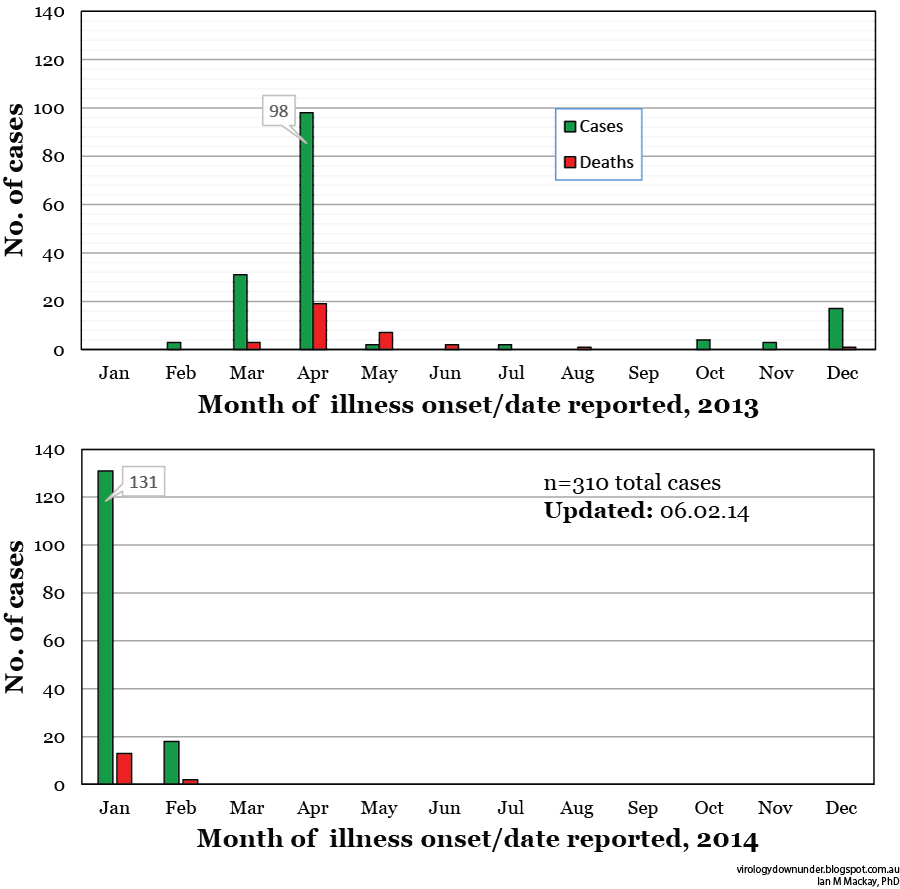
Tonight we have 310 H7N9 cases ( a third in Guangxi province bordering Vietnam has just popped up while I was writing this paragraph and I've altered the numbers above), with at least 50 deaths (that can be accounted for using public data).

H7N9 age with time: is a younger adult demographic emerging this time around?

This is a big graphic - sorry for that - but I thought it best to show the distribution of age bands (this is updated from the paper I co-authored recently with Joseph Dudley) alongside the shifting age in total numbers and proportion of cases each week. The data are all publicly sourced and verified against the WHO and scientific literature whenever possible and of course, against FluTrackers excellent case list.

1 case is lacking age data.

The chart below (click on it to enlarge and see much more clearly) then some comments underneath. Keep the previous sex/week chart in mind (it's trend has not changed much with the latest cases; these charts also result from a question from CIDRAP's Lisa Schnirring last Saturday) when looking at this. Is any effect seen below due to the increased female representation?


Click on image to enlarge.
It's probably more technically correct to use a line graph for (c) 

since a linked line implies that we know what happens in between 
each data point, but bars just don't show up clearly enough.

  1. The median age of all H7N9 cases (surviving and fatal) is currently at 59-years; the mode is at 54-years.
  2. The median age since Week 33 (see earlier post for why this number) is 54-years whereas from Week #1 to Week #32 it was 60-years. Is this a significant lowering of the median age in wave 2 or just because we're coming into Marc-April, where things may even out?
  3. 74% of all cases are aged 40-years or older (M:F 1:2.36); 48% are 60-years of older (M:F 1:2.23); 6% are 20-years or younger (M:F 9:1)
  4. The age band graph (a) looks very similar to that which we published in late 2013 using 136 avian influenza A(H7N9) virus cases (not at 175 cases)
  5. The total numbers in graph (b) show that patients 20-years of age or younger have not yet shown up among the new wave of H7N9 cases, and if we look at the proportion of each age band each week (c), we can see that a younger than 60-year old demographic is predominating from December, as it did back in March and April 2013.

H7N9 and the skewed age issue.

We are reading much about the older than expected ages of those infected by H7N9 (current average case age of 58 years). Why? One school of thought is that the elderly have weaker, or perhaps "less experienced" immune defences. 

But there are many other risk factors for severe complications arising after influenzavirus infection including heart and other organ disease, things which may accumulate with age.

This shift is not uncommon among pandemic influenzaviruses - those settling in to a new host. Also worth noting: (1) seasonal influenza is commonly regarded as having its worst impact in those over 65 years of age, (2) influenza A(H5N1) virus (the other bird flu) has had its biggest impact in pre-adults and young adults (15-39)(3) the influenza A(H1N1)pdm virus (swine flu) had its greatest impact on children and young adults and(4) influenza A(H7N7) virus was confirmed in 89 people (average age 30 years among mostly workers culling chickens), mostly mild, including conjunctivitis.

That' a lot of diversity. Begs the question of whether we can predict too much about H7N9 until we've lived with it a bit longer.

Like Us

Blog Archive