Medical News Blog Information

Showing posts with label MERS-CoV. Show all posts

MERS simmers down in South Korea...did we learn anything this time?

No new cases reported in 8 days and the most recent known date of illness onset now 10 days ago, are good indications that the Middle East respiratory syndrome coronavirus (MERS-CoV) hospital-driven outbreak in South Korea is pretty much over. At the least, it's contained. Finally.

Roughly speaking - based on the data from the South Korean Ministry of Health and Welfare, the World Health Organization and KBS news - there were four rounds of infection. In all, 186 cases of MERS have been reported, with 36 (19.4%) resulting in death up until the 13th July AEST:
MERS case spread among hospitals in South Korea
between the 11th May and the 19th June.
Cowling et al. Eurosurveillance Vol 20,
Issue 24, 25-JUN-2-15.
[4]
Click on image to enlarge.

  • the 1st round was the person who flew into South Korea after visiting all over the Arabian Peninsula - he became ill on the 11th of May.[1,2]
  • the 2nd round included approximately 45 cases.[3] This group started becoming ill on the 19th of May, continuing until the 4th of June.[5]
  • the 3rd round included approximately 108 cases.[3] These people started showing signs and symptoms of disease between the 27th of May and the 13th of June.[5] 
  • the 4th round included approximately 22 cases.[3] This group became ill between the 5th of June and the 2nd of July.[5]
We've learned a few things (perhaps "relearned"?) and had a few things reinforced (even more) during this latest successful test of our healthcare systems ability to defend against a case becoming an outbreak...successful from the coronavirus' point of view that is. 

For example we saw that..
MERS-CoV detections, deaths, sex and age distribution in
the South Korean hospital outbreak.
From my MERS-CoV in South Korea page.
Click on image to enlarge
  1. MERS-CoV doesn't spread efficiently between humans - over 16,100 contacts did not develop MERS.[6] 186 did.
    While there were probably more infections among contacts (and future studies from South Korea will hopefully investigate and answer this), disease did not develop among many of those exposed to infected people.
  2. Closing schools, wearing masks in public, putting thermal imaging cameras in office buildings and quarantining zoo camels when not a single case has been acquired without link to a hospital was an exercise in failed communication between government and public.
    There was no indication that any of these costly, high profile measures prevented any transmission. There was also no point to them, precisely because transmission outside the hospital setting did not occur.[3]
    We have to learn to talk more, more often, and more clearly to our populations about the realistic risks of a new and scary virus when it shows up on our shores. We need to build trust here. Trust and respect takes time to build. In these outbreaks, we're always forced to rush because we seem incapable of investing in this before an event. Gods forbid we'd teach these concepts at school. We need to make a bigger deal about educating and informing our public about virus transmission. That is best done if the materials and the processes to roll the messages out to the public are already in place
  3. Holding back information that you have already collected doesn't build confidence in you.
    Whether that is not releasing the name of a hospital or the detailed data about deidentified cases, or presenting a list without discussion, engagement or correction when necessary 
  4. Hospitals are great places to spread infections, if infection control is not constantly running.
    Viruses aren't big on forgiving. Neither are zombies. The undead really suck that way. But the truth may well be that hospitals need to be on guard, cleaning surfaces and in PPE 24 hours  day, 7 days a week if they are dealing with cases of infectious disease that can be expelled from a human in the form of coughing, sneezing, bleeding or vomiting. Judging whether to use "standard precautions", "droplet precautions" or "airborne precautions" at some point after a coughing and sneezing patient has been sitting in the waiting area for hours, is going to be too little too late to stop new healthcare worker infections
  5. Allowing the public - that is, the otherwise healthy - to co-care for patients within hospitals and to sleep in rooms or wards with infected people expelling virus (as per #4) - is a bad idea if trying to contain an acute viral infection
  6. People with other underlying diseases get more seriously sick after MERS-CoV infection.
    Adult health in richer nations is not in a good way. When a wimpy spreader like MERS-CoV comes to town, it may do little damage to the young and otherwise healthy population, but we are not all healthy. 
We all have a role to play in protecting those among us who will suffer more greatly from an otherwise simple acute viral infection by even a rare and obscure camel-cold virus. Whether that is getting a vaccine to prevent us from becoming a hijacked virus production facility, being mindful of others when we cough and sneeze, or seeking out information from trustworthy sources to learn about the realistic threats from a new (or old) virus when it comes to town, we can all make some difference here. 

At some point, one of these viruses may well be better at hopping between us and may cause severe disease not just in those who have an existing ailment. If that day comes, we have proven yet again, that no facet of our response will be up to the task of halting its spread. 

We're not ready.  

But hey - that virus' arrival is probably many, many cycles of leadership change, war, and petty bickering away yet. We'll be ready by then. Right?

References..

Matching MERS case identification numbers from two differing sources...

Update #1 27JUNE2015
Update #2 28JUNE2015
Sometimes people work from different playbooks.
Figure 1. MERS in South Korea. Most cases now plotted
on graph using their dates of illness onset.
An outbreak in decline. This is up-to-date - 3 new cases
from 21JUN2015 added (column at right hand side -
onset dates unknown)
Click on graph to enlarge

In this instance, the data from the World Health Organization's (WHO) new list of Middle East respiratory syndrome (MERS) cases - with extra detail - uses a case identification key that's out of synchrony with that produced by the South Korean (SK) Health Authority which can be found in each of its posts announcing new MERS cases and deaths. 

Attempting to link the two lists has mostly been an exercise in pedantry, but sometimes it is useful to know which case one is talking about when discussing an outbreak or cluster of disease....'Hey Bill, what didja think of that 70 year old MERS case who drove the ambulance carrying that infected 75 year old MERS case and then those others got MERS as well..?' doesn't really roll off the tongue does it?


Embedded image permalink
Figure 2. What the graph above looked like before
we had dates of illness onset. Many cases
were 'moved' to earlier time points because
report dates always follow onset of illness dates
and they can follow by varying periods of time -
sometimes a day, sometimes a week or more.
Two file formats are in the folder I've linked to below. This is my first attempt - yes, it is a work in progress - to match up the new WHO case list from the 19th June which includes the highly prized date of illness onset (DOOs) for most cases - with that of the South Korean (SK) Health Authority. They do differ. Quite a bit. And in several ways. For example, the numbering scheme is off by one or more, SK69 seems to be missing from the WHO list, there is a question mark hanging over SK152 & SK156 and the WHO data seem to have a number of different ages from the SK data- mostly differing by one year (presumably someone is rounding up or down). 

If I've stuffed anything up or if you can solve my problem cases - please pass that info along and I'll update the files on this page. Hopefully the next WHO version will have addressed all of this anyway (it didn't but perhaps a future one will).

These are publicly available and you can download them for your own interest.


There is a download arrow at the top of the Google Drive page.

  1. Google Drive folder with MERS data files
    https://drive.google.com/open?id=0B5sEcTjB5Ailfm1PcU1oNDF6M2hiaDduUDgzQUdxNlZxeHBkU0FHeVBRRFJkbHIxTmdjX3c&authuser=0
Updates...
  1. With the help of FluTrackers updated line list to cross check against, the first half of my list has been updated - some bugs fixed. 
  2. After about 5 hours - on and off - FluTrackers helped me sort out a few errors and the latest version of my list has been uploaded into the the folder linked above. Some typos corrected.

MERS-CoV in South Korea - other data formats for data provided by WHO...

The following links take you to different version of the PDF if you want to harvest those data...

  1. Excel version, Office 2010
    https://drive.google.com/open?id=0B5sEcTjB5Aila3c5WXI4bzlkLWc&authuser=0
  2. MS DOS CSV file
    https://drive.google.com/open?id=0B5sEcTjB5AilTHRub1FRZnhpQmM&authuser=0
  3. Original WHO PDF
    https://drive.google.com/open?id=0B5sEcTjB5AilWlo0UDZwVzRpdVE&authuser=0
Its taken a week to get these data, and its unclear why detail data dried up from the 12th June to the 19th, or why the data have appeared now, but they are here at last and that's great.

Middle East respiratory syndrome (MERS) coronavirus: Outbreak in South Korea

This data visualization was created using data from FluTrackers, the World Health Organization and the Korean Broadcasting System (KBS).

Wherever possible, the dates are those for a case's onset of illness, but if that is unavailable then the date for hospitalization or if that is unclear, the date that case was reported.


Because the WHO obviously have more detailed information, I recommend you keep an eye on their site, so long as it is being maintained, for more accurate epidemic curves.


.
References...

3.  World Health Organization pages
Main landing page on MERS and MERS-CoV (includes link to WHO line list under General Information)
http://www.who.int/emergencies/mers-cov/en/
Disease Outbreak News pages
http://www.who.int/csr/don/don_updates/en/
 
News on the current situation
http://www.wpro.who.int/outbreaks_emergencies/wpro_coronavirus/en/
Summary of Korean statistics-rapidly updated

http://www.wpro.who.int/outbreaks_emergencies/summary.of.MERS.stats/en/

Tracing the MERS-CoV cases in South Korea...

The Korean Broadcasting System (KBS) News channel has made an awesome "bump map" or force diagram (thanks @Casillic) showing the layout of cases and the hospitals they passed through or were admitted to or transferred to.[1] It shows sex, deaths (9 across multiple facilities), profession, rounds of transmission and some dates (written as month.day)

Unfortunately for some of us, it's in Korean. If you, like me, are having trouble remembering your grade school Korean, I'm here to help (a little).

I've put together a screenshot of this awesome map as of today's count of  - no doubt the values will change tomorrow - and added onto it the hospital names in English. I highly recommend you visit the actual site though - the map is scalable and interactive. This snapshot does not do it justice and won't be updated like the map seems to be.

I've interpreted the hospital names by eye from the Hong Kong Centre for Health Protection's (CHP) excellent multi-lingual list of all the "MERS hospitals" released by the Korean health authority.[2,3] They may not be perfect and I'd be happy to take any suggestions and corrections (including what is in the orange boxes).

The index case, #1, is shown in green and is linked here to 2 clinics and a hospital - which differs a bit from the WHO story which includes a final move..."whereupon he was transferred to the nationally designated treatment facility for isolation".

The most recent additions seem to have a pulsing arrow (only visible at the source).

Made using a combination of sources. [1,2]
Click on image to enlarge.

References...

  1. http://dj.kbs.co.kr/resources/2015-06-04/
  2. http://www.chp.gov.hk/files/pdf/distribution_of_mers_cases_en.pdf
  3. http://www.chp.gov.hk/files/pdf/korean_hospital_list.pdf

MERS-CoV and opportunity to spread...

1,500 people were exposed via direct or indirect contact, to one Doctor who was already ill and later tested positive for the Middle East respiratory syndrome coronavirus (MERS-CoV).[1]

So what?

If this were measles virus - that sort of exposure could spell disaster for infection control and measles containment. In measles, every infected person can infect about 18 other people...but that's an average of course and on an individual basis, the number of new cases can move around that value depending on the number of contacts each person has...and the type of contact...and how much virus the index case sheds... and everyone's their immune function...etc, etc, etc.

But MERS-CoV ain't no measles virus. 

Time and again we've seen that MERS-CoV does not pass easily to new people. Around 4% of household contacts were deemed infected, across 26 households,  in a study from 2014.[2] About 2-3% in some other analyses.[3] And by 'easily' I mean lots and lots of contact becoming ill from each case they are exposed too. If 4% of those 1,500 hundred contacts of the South Koran Doctor had been exposed to an infectious dose of MERS-CoV from this Doctor - who really does get around - and the incubation period is as short as the 3 or 4 days it has been in some cases in South Korea...then any minute now, we'll expect to see 60 more cases in the community and in hospitals, all with links to this health professional. 

I'm not holding my breath (pardon the pun) for this though, because I doubt the contact was often very close. I also won't go into the fact that there maybe no actual testing of contacts happening - we have no idea of that aspect of the South Korean incident. I really hope the South Koreans are testing. It would be a great study producing some valuable transmission data outside of Saudi Arabia. And not just PCR testing but collecting blood for serology (antibody studies) testing later too.

Google tells me that South Korea has a population of 50,220,000 in 2013. So there have been 87 cases of MERS since May...about 0.0002% of the population are infected. At this point, perhaps we should start assembling a list of how many people went through the hospitals with the most cases, that did not acquire MERS-CoV...just to provide some added context to the cluster. In other words - the past few days have seen case numbers growing day on day - but infections are still contained within the hospital setting. Close contact. No community spread. No camels infected in zoos.

Tomorrow is another day and we'll see what is added to the tally resulting from the arrival of a single infected traveller.

References..

  1. http://www.koreaherald.com/view.php?ud=20150604001315 
  2. MERS-CoV around the house-yes, it does transmit at home
    http://newsmedicalnet.blogspot.com.au/2014/08/mers-cov-around-house-yes-it-doers.html
  3. If this is what MERS-CoV detections look like with more testing...what is the "normal" community level of virus?? [UPDATED]
    http://newsmedicalnet.blogspot.com.au/2014/04/if-this-is-what-mers-cov-detections.html

Middle East respiratory syndrome coronavirus (MERS-CoV): unhappy trails...

An updated map of the countries that have had a visit from, and in 52% of those, had some local transmission of, the MERS-CoV.

South Korea is the first country I have seen that has jumped three colour levels between updates. No mean feat.

So we have 25 countries that have hosted a MERS-CoV infected person, and 13 of those have gone on to have local transmission - new cases from that case on their soil.

Click on it!
It gets bigger!!!
In the meantime, 7,000,000 pilgrims are expected in Saudi Arabia to perform Umrah between mid-May (around the 19th May) and mid-July.[1] Over 2,000,000 had already performed the Umrah pilgrimage to The Holy City of  Makkah in Makkah province, between November 2014 and May 2015.[1,2] We're in the second phase of Umrah now - in the lead-up to the fasting month of Ramadan which begins on the 18th June 2015. 

Remember Saudi Arabia? That's where over 80% of all MERS-CoV cases have originated. That percentage has dropped a little of late thanks to the clusters in South Korea. Given the amazingly, incredibly, ultra-tiny (yes, that small) number of cases that have reportedly arisen during Umrah or Hajj (Septembee 21-26 in 2015)  in previous years, there is absolutely no reason to think 2015 will differ. Even if there have been recent cases in Makkah province. And a hospital cluster in Ash Sharqiyah (eastern province).

Clearly, MERS-CoV is not easy to catch even when so many different people, so many different states of underlying chronic disease, immune compromise, pre-existing infection, height, weight, age all come into contact within the zone of hotness that is Saudi Arabia.  

Which leaves me with one comment after a large batch of 23 cases was announced this morning - bringing the total to 87 from South Korea....look to the infection control South Korea!

References..

  1. http://english.alarabiya.net/en/News/middle-east/2015/05/19/7-million-Umrah-pilgrims-expected-in-Saudi-in-next-2-months.html
  2. http://english.alarabiya.net/en/News/middle-east/2015/01/28/Over-one-million-Umrah-pilgrims-pass-through-Jeddah.html

South Korean MERS cluster keeps growing..

version 3.
This cluster of hospital-related infections in South Korea has now reached 64 Middle East respiratory syndrome (MERS) cases. And no camel meat or milk, no route of ingestion yet fond in fact not even a camel to be seen - except the ones quarantined in the South Korean zoo - I can't even....

Anyway, thanks to a week long internet outage in my house (yes, I do these blogs from home) I've been unable to blog on any of this. 

Surprisingly though, after a week, the cluster is still going pretty strong. The recent tallies include 6 cases then 5, then 5, then 6, 9 and last night 14. These include 5 deaths (10%). 

As you'll see from the first 11 cases I've plotted below, this is similar to a bunch of incidents we've followed in Saudi Arabia in 2013 to today (Hafoof seems to have a pretty good cluster going at the moment). They have usually been the result of poor infection prevention and control creating a perfect storm of circumstance for viral spread. 

Timelines of the first 11 cases of MERS-CoV infection in South Korea.Click on image to enlarge based on World Health Organization and  FluTrackers information with help from this timeline. Hospital names have been published here and here - I'm not sure if this is how they are ordered so please consider this a work in progress.
Click on image to enlarge

It's looking like this will be the case in South Korea too. 

A couple of interesting things to note:

  1. Cases are still popping up - a month later
  2. A viral genome sequenced in China (ChinaGD01), from a South Korean case that flew out of South Korea to Guangdong, does not show any obvious genetic differences compared to other MERS-CoV genome sequences. Its sequence identity falls in the range that we can fit around all the MERS-CoV genomes - whether from humans, camels, from Saudi Arabia, Qatar or the United Arab Emirates, 2012 or 2015.
  3. MERS cases in South Korea are tightly linked to hospitals - healthcare workers feature prominently as do other "close contacts" including relatives who stay at the hospital to help care for their loved ones. There are no indications of escape outside those hospitals so the closing of schools, the wearing of masks (which don't cover eyes) and the increased border measures offered to North Korea have no support from science or facts
  4. Some incubation times are pretty short - just 3 or 4 days between exposure (in whatever form that is taking) and symptom onset - yet we haven't seen any not-so-close contacts come down with infections, despite that same time frame having passed long ago for them.
    Spread of virus is not very different to what we've observed in Saudi Arabia for 3 years
  5. A few people have called the index case a "super-spreader" because of all the contacts he's had that have developed MERS (what about those who haven't developed disease by the way, are they being tested?) - I've come to loathe that term. It lazily defines the person as super-spreader while ignoring the context in which that person has been managed - namely whether infection control measures are well used, or in place at all. A super spreading event I like a little more - but even that makes something, special scary or different  out of what may be something completely normal in infectious disease biology
  6. Testing times are all over the place - in just those first 11 cases it could be 9 days before a test result confirmed MERS-CoV infection. Therein may lie a reason for why MERS cases are still appearing now - no-one knew then, nor for a decent while, what they had. Although...they did know that they had an acute respiratory infection and I can't for the life of me work out why these viruses seem to get away from us time and time, and time again. Well, yeah I do - it's because people.

"Are we ready for the next pandemic?" is a question that has been asked a lot since the peak of the peak of Ebola virus disease epidemic in West Africa. The answer is that there is no way in a million years we're ready.

Version history.
  • v2-fixed graphic's transparent background & changed case tally from 50 to 64
  • v3-added in hospital names and a few more cases.


A good week for viruses...not so great for humans...

Edited for clarity 25MAY2015
Middle East respiratory syndrome coronavirus (MERS-CoV) managed to get out for some sightseeing - travelling to South Korea this week - and Ebola virus|Makona was given a helping hand to spread to new people in Guinea and Sierra Leone with a small splurge of new confirmed cases.

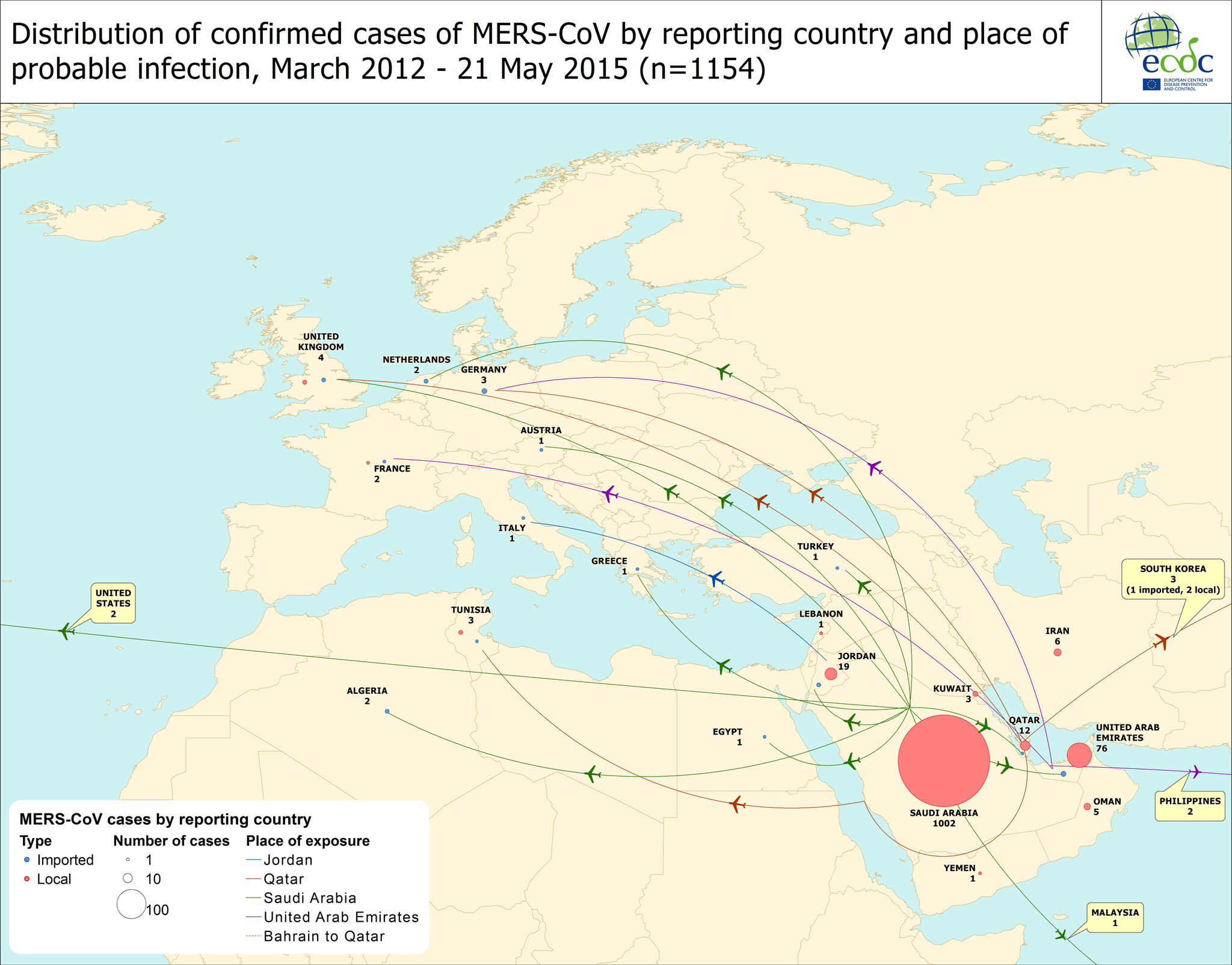
MERS has now trickled into 24 countries world wide as shown in the European Centre for Disease Prevention and Control's (ECDC) epic 'travel-by-plane' map.

Media preview
The original of this is created by the ECDC and is presented here.
Click on image to enlarge.
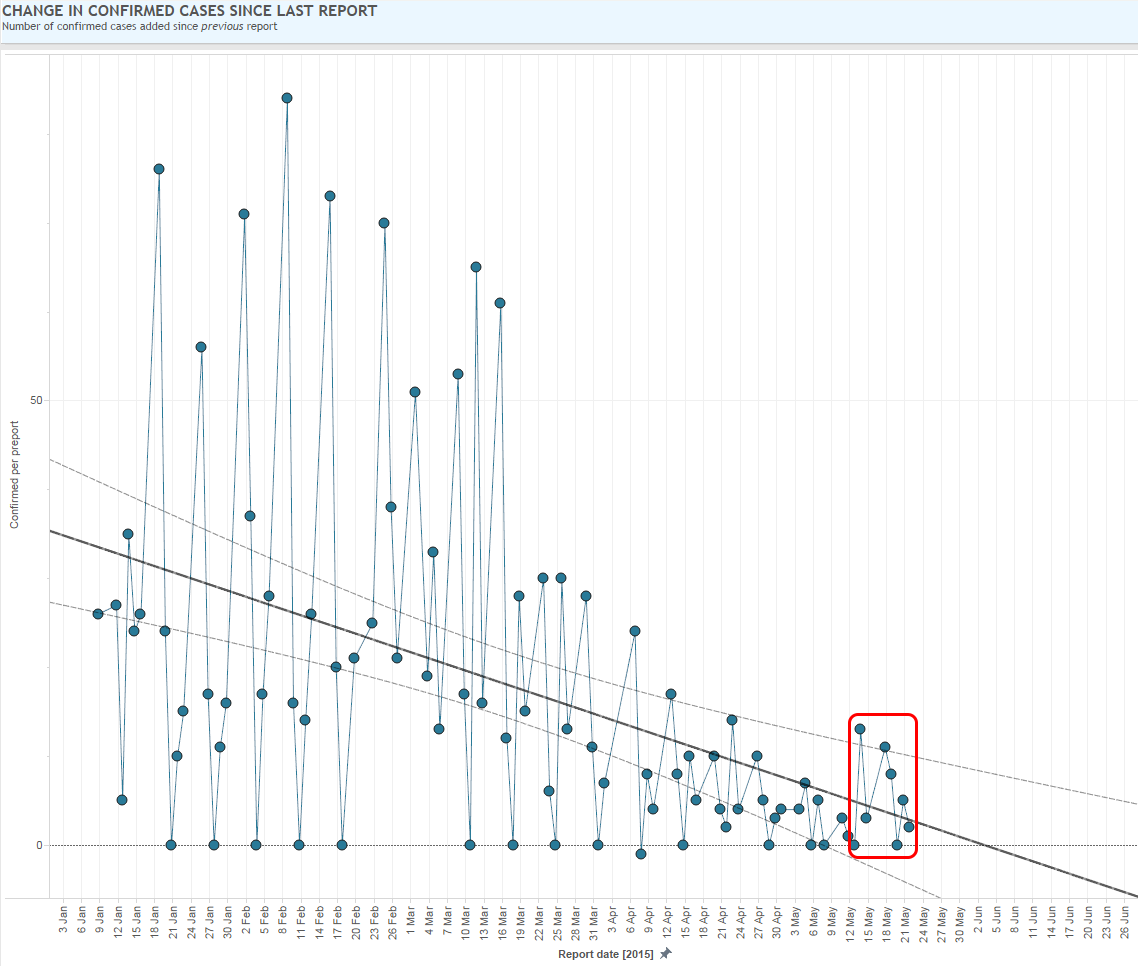
Meanwhile, a crude extrapolation from current Ebola virus disease (EVD) case numbers saw the predicted date when we might reach zero cases, move further into June. 

This could pull back again or it could move further away if the EVD clusters and sporadic cases continue to spread. We can't model that because it's entirely down to unpredictable human variables. We can list what those are, we can better prepare for them, we can educate about them and how to prevent them and we can acknowledge that they are real, but we cannot know when and in what mix they will come into play.

Extrapolation of the public data for confirmed Ebola virus disease cases from
WHO. The most recent week is boxed in red and bucked the trend of declining
 cases. To see how I made this please visit here.
Click on image to enlarge. 
The newest EVD cases remain mostly clustered around the Forecariah prefecture of western Guinea, on the north west border with Sierra Leone but also 5 new cases appeared in the north west of Guinea in Boke prefecture, which borders Guinea-Bissau. 

Geographical distribution of new and total confirmed cases
From the World Health Organization's Ebola virus disease Situation Report, 20MAY2015.
Click on image to enlarge.
Since the last EVD SitRep, two days of reporting have seen fewer cases than in the same two days of the week before. 

So there's that. 

Quickly reporting what is actually happening is invaluable for all sorts of reasons. Modelling and prediction allow us to get ahead of the virus. But having the data, and having them available publicly remains a challenge for every country and for every outbreak. 

Public health data are about the public's health. If it has been considered worth collecting and collating, why not communicate it too?

MERS-CoV jumps a flight to South Korea...but from where?

It could be Qatar, Bahrain, the United Arab Emirates (UAE) or the Kingdom of Saudi Arabia (KSA). Any of these may have been the country of origin for the infected person who returned with a bunch of microscopic passengers, to the 24th country to host a case of Middle East respiratory syndrome coronavirus (MERS-CoV) infection - South Korea

The infected man then passed the spiky parasites on to his 63-year old wife and to a 76-year old man with whom he shared his hospital room. Close contact. From what we know of the MERS-CoV - it's a pretty ineffective transmitter among us humans types, preferring instead to give the hump to dromedaries.

Qatar seem less likely as it appears to have only been an airport transit point. If it's Bahrain, then we have 25 countries as Bahrain has not yet reported a MERS-CoV positive person. Both the people and the camels of the UAE and KSA are well known to this virus both in humans and camels. 

We await the clarity of the World Health Organization's analysis in a Disease Outbreak News (DON) article - although this might be a tough one to unravel.

Click on image to enlarge.

Where did the MERS-CoV comorbidity and animal contact fields go...? [UPDATED]

Is this the work of the US CDC and other visitors helping the Kingdom of Saudi Arabia (KSA) Ministry of Health (MOH) resolve their Middle East respiratory syndrome coronavirus (MERS-CoV) problem? Is it an arbitrary reporting change by the Command and Control Center (CCC)? Is it someone forgetting to unhide the relevant columns in their spreadsheet?
Changes to the KSA MOH MERS-CoV public 
reporting detail after 17-March-2015.
1. The MERS-CoV graph changed scale and caught up.
2. Three fields disappeared: pre-existing disease, 
animal exposure and contact with a known cases 
within a hospital setting
3. The promise of weekly updates was dangled-
without reference to a host site.
Click on image to enlarge.

I don't know why, but since 17th March, the KSA MOH MERS-CoV reports have stopped posting information about whether each newly announced MERS case had a comorbidity and whether they had animal contact. Granted, the last field was almost always "No" or "Under Investigation" - and thus of little use (we rely almost exclusively on the World Health Organization reports to provide useful animal data) - but I wonder why the MOH has chosen to stop posting even the heading this month? 

The much more epidemiologically significant description of whether the case was an "expat" or a "Saudi" citizen remains - whew! 

And the MOH has continued to do away with all of that pesky detail that might allow an observer to link a death to a previously announced case. Thank goodness we don't have that clutter to deal with - or the details from the found113 which I presume are now completely lost in the sands of time. 

I guess the removal of these latest 2 data fields is just all part of providing the world with more of that full transparency and up-to-date information about this emerging pathogen - like the MOH "News" page - all the latest info you could want from August and earlier is to be found there. 

Oh well, at least you can get the latest from the weekly updates...if Google Translate's efforts can be understood.

It really isn't as hard as it is being made to look to get the reporting aspects right.

Editor's Note #22: Two years old today..

On March 27 2013, around the time of Easter and the school holidays, I gave in to the urgings of my wife, to try this blogging thing. 

And today it's two years later and now very clear to me that writing for fun, but based around what I know in science, will be something I do for many years to come. 

At times it's been tough - or maybe other pressures made it feel tougher than it was - and I've considered stopping and have at times paused. As hard as it was though, I found myself wanting to chime in on stuff and could not stay away. I still find that weird, but it must have been a part of me all along - I just hadn't noticed it until after I turned 40'ish. I'm a bit slow sometimes. 

Turns out that I enjoy writing and I needed a hobby that I enjoy and that helped inform and generated such unexpected positive feedback. Everyone needs that I think. Bit of a shame that the typos don't get fewer but such is life. 

It also turns out that blogging made me resign from my job of 23 years - which just so happens to co-occur with this very date. No, of course my resignation was not for such a simplistic reason, but blogging was one of a few major factors that set the process in motion. In particular, blogging about outbreaks of Middle East respiratory syndrome coronavirus (MERS-CoV), avian influenza A(H7N9) virus and the Ebola virus disease epidemic in West Africa. It was that last one that really had the greatest impact on me though. 

From blogging has come more interactions with the media (something I am now a firm believer in more scientists needing to do-communicate what we do to our stakeholders), new collaborations, papers, strange discussions with affiliate Institutes about why they'd rather me not link them in print or press to this press or these papers since I had no research funding for these viruses, friendly discussions with very high ranking Health officials, advice to documentary makers and then an invited role helping out my State's public health team. That one was the kicker. The feeling that the virology information and patterns I'd spent years accruing and piecing together in my head, and now blogging about and drawing graphs and graphics to describe, could be used for the greater good completely ruined me. But in a good way. It triggered many realisations about my current role, some were familiar to me as I had been living with them daily for years, others I had felt in the corners of my mind but they were too intangible and just wouldn't coalesce into anything that would describe itself to me and yet others that were patterns I simply didn't see. Told you I was a bit slow sometimes.

You could of course dismiss all of this as the rantings of a failed scientist who - despite an h-index of 32, 80 papers (15 with >100 citations), >400 citations per year for the past 9 years, 14 book chapters, roles as an Associate Editor at the Journal of Clinical Virology, a Section Editor at Biomolecular Detection and Quantification and an Editorial board for Viruses as well as having continuous competitive research grant funding since he was awarded his PhD in 2003 until 2014 - had missed out on achieving most of his recent grant applications. Go right ahead.

I wanted to use what I'd learned for the greater good. Yeah - as a comic nerd that makes even me cringe a little. But that's where I've been heading, knowingly or not, for some years now. Well, soon I'll be a part of a team that cam help me to do that. 

So I wish you a Happy 2nd birthday little VDU. You've helped me to grow and to learn at the rate of a human two year old. And in doing so, I've met and made friends with a lot of great people around the world. For such tiny things, viruses can have such an impact on us. Quite the hobby.

MERS in the UAE...

Over my weekend, the Robert Koch Institute (RKI) in Germany reported that they had a Middle East respiratory syndrome case (65 year old returning German) under their care, imported from the United Arab Emirates (UAE).[1,2]

There have been two other MERS cases hospitalized in Germany - 1 from Qatar and the other originating from the UAE, where infections are presumed to have been acquired.

This latest case is nothing astonishing but it does act as a warning that there most likely are other MERS cases circulating in the UAE. Alternatively, this person may have visited the Kingdom of Saudi Arabia (KSA) before travelling to Germany, acquiring an infection there. 

When cases emerge in other countries they can be very telling. They speak of what might be happening in the host country. The UAE has only reported (this is the important word for any outbreak observation) a single case since July last year. Was RKI just "lucky" to pick up the only other MERS-CoV case in the UAE over the past 8 months? Highly doubtful. In the absence of other information (WHO detailed data will surely follow soon), it is much more likely that MERS-CoV is circulating in the UAE, as it is in the KSA and possibly neighbouring countries, but that cases are going either undetected or unreported.


When animals were described alongside human cases.
Click on graph to enlarge.
Taken from MERS number page.
Current MERS-CoV circulation would be in keeping with the popular theory that MERS is a seasonal zoonosis (animal infection that spills over to humans causing disease on occasion), and that more primary human cases, although still relatively rare, emerge during periods when more infections are occurring in camels - which seems to occur around this time of year. That seasonality in camels has not really been established yet and still it is one popular theory among those who do not completely deny any involvement of camels in MERS whatsoever. Also worth repeating is that MERS-CoV appears to be inefficient at transmitting between people - at least so far as the testing done to date has revealed.

From the rare spillover cases acquired by humans from camels, humans proceed to do the lion's share of the work in continuing to spread MERS-CoV among humans. Yay us. 

In recent WHO disease outbreak news reports [3,4], the detailed information reveals multiple instances of cases having shared wards with laboratory-confirmed MERS-CoV cases - and despite assurances that the same healthcare workers did not attend both people, some form of contact has apparently occurred somewhere, somehow. The precise details of what that contact was, still seem to be beyond the capacity of the Saudi disease detectives to capture. But in that detail lies some important hospital (or community) transmission clues - even if those clues are as simple as revealing that the wring question are being asked, too few contacts are being tested, healthcare workers movements are not being tracked sufficiently, or finding that people (patients, contacts and healthcare workers) do not answer the question fully. 

A little thing called infection prevention and control is apparently still not being adequately adhered to in some parts of the region. 

In other words, MERS is a rare but preventable disease.

References...

  1. Flutrackers post
    https://flutrackers.com/forum/forum/novel-coronavirus-ncov-mers-2012-2014/germany-coronavirus/726247-germany-reports-3rd-imported-mers-cov-case?_=1425773133137
  2. Robert Koch Institute [German]
    http://www.rki.de/DE/Content/InfAZ/M/MERS_Coronavirus/MERS-CoV.html
  3. WHO MERS DON 06MAR
    http://www.who.int/csr/don/6-march-2015-mers-saudi-arabia/en/
  4. WHOMERS DON 23FEB
    http://www.who.int/csr/don/23-february-2015-mers-saudi-arabia/en/


A new Middle East respiratory syndrome coronavirus (MERS-CoV) table of graphs stacks up...

My new favourite graphic. 

This shows MERS-CoV detection by month since the virus was identified in 2012. Detections are further broken down by each region of the Kingdom of Saudi Arabia (KSA) in which they were reported  by the KSA Ministry of Health website here.

At the moment its highlights that the KSA has a real problem in the Eastern region (Ash Sharqiyah) and growing issue in Ar Riyad (as always with MERS-CoV detections) but that Al Quassim region is also of growing concern.

This table of graphs is part of my MERS-CoV static page to be found at... http://newsmedicalnet.blogspot.com.au/2014/08/mers-cov-daily-monthly-and-cumulative.html

I try and update these data as often as possible - at the moment detection are rising and February is currently the 4th largest month for new detections - updates occur every day or two.


References...
  1. Kingdom of Saudi Arabia Ministry of Helath MERS-CoV data http://www.moh.gov.sa/en/CCC/pressreleases/pages/default.aspx

Societal change and H7N9..

The importance of societal change for controlling infectious disease outbreaks really cannot be over-stated. 

For Ebola virus disease, it came down to stopping the tradition of direct contact with the body of those who have died and dircet contact in general. For MERS it
seems that occasional camel contact triggers insertion of the MERS-CoV virus into hospitals where lax infection prevention and control practices add to the case load. 

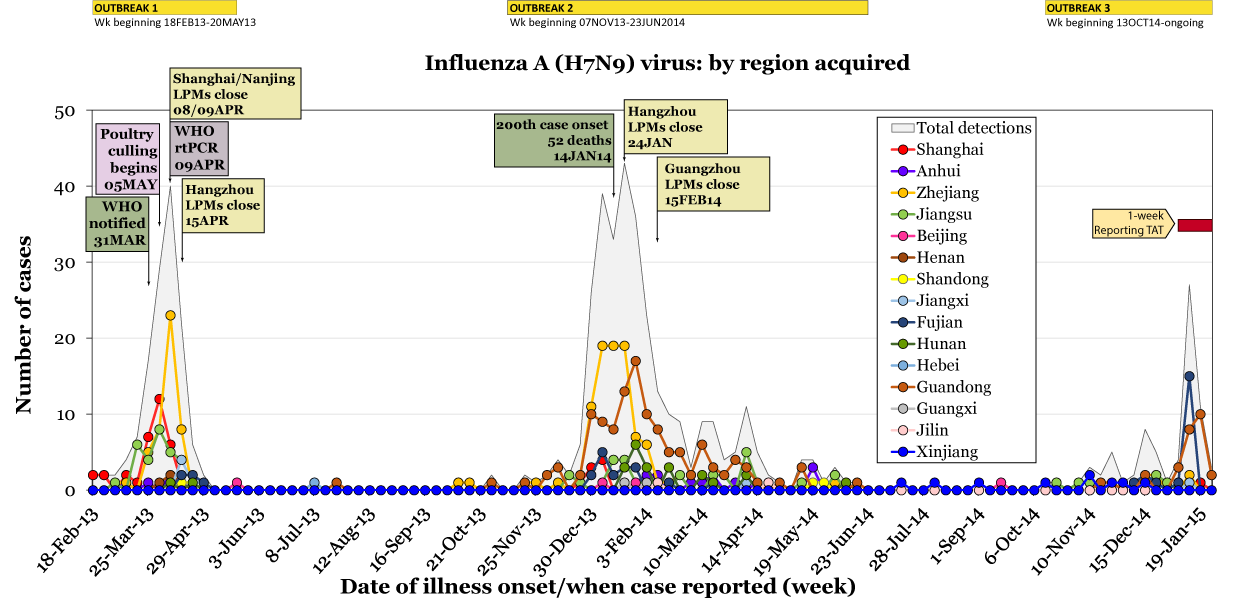
For influenza A(H7N9) virus cases, it is the habit of obtaining live poultry from retail markets where rare virus-laden chooks are culled and handed over because of a desire to see, choose and purchase the tastiest fresh chicken. 

There is a common thread among these stories about direct contact or inefficiently droplet-transmitting virus infections: we can stop their spread. 

But we also amplify and prolong their spread. 

However, when it comes to human-adapted, efficient droplet-spread or airborne-transmitted viruses - well, then we're in trouble. Of course we could all just lock ourselves in a room for a few weeks but that won't ever happen.

So its very important to head off these "emerging" viruses while we still have a modicum of control over them. Once they get away from that control, and theoretically that could happen in the blink of an eye-right now even-no amount of fancy infra red cameras, poorly donned surgical masks or fancy hospitals laden with machines that blink and go ping, will stop them from spreading globally.

Cheery.

In the meantime - here's hoping China speeds up the closure of those live poultry markets. Habits can be changed but death is forever.

Click on image to enlarge.

Like Us

Blog Archive