Medical News Blog Information

Showing posts with label World Health Organisation. Show all posts

Matching MERS case identification numbers from two differing sources...

Update #1 27JUNE2015
Update #2 28JUNE2015
Sometimes people work from different playbooks.
Figure 1. MERS in South Korea. Most cases now plotted
on graph using their dates of illness onset.
An outbreak in decline. This is up-to-date - 3 new cases
from 21JUN2015 added (column at right hand side -
onset dates unknown)
Click on graph to enlarge

In this instance, the data from the World Health Organization's (WHO) new list of Middle East respiratory syndrome (MERS) cases - with extra detail - uses a case identification key that's out of synchrony with that produced by the South Korean (SK) Health Authority which can be found in each of its posts announcing new MERS cases and deaths. 

Attempting to link the two lists has mostly been an exercise in pedantry, but sometimes it is useful to know which case one is talking about when discussing an outbreak or cluster of disease....'Hey Bill, what didja think of that 70 year old MERS case who drove the ambulance carrying that infected 75 year old MERS case and then those others got MERS as well..?' doesn't really roll off the tongue does it?


Embedded image permalink
Figure 2. What the graph above looked like before
we had dates of illness onset. Many cases
were 'moved' to earlier time points because
report dates always follow onset of illness dates
and they can follow by varying periods of time -
sometimes a day, sometimes a week or more.
Two file formats are in the folder I've linked to below. This is my first attempt - yes, it is a work in progress - to match up the new WHO case list from the 19th June which includes the highly prized date of illness onset (DOOs) for most cases - with that of the South Korean (SK) Health Authority. They do differ. Quite a bit. And in several ways. For example, the numbering scheme is off by one or more, SK69 seems to be missing from the WHO list, there is a question mark hanging over SK152 & SK156 and the WHO data seem to have a number of different ages from the SK data- mostly differing by one year (presumably someone is rounding up or down). 

If I've stuffed anything up or if you can solve my problem cases - please pass that info along and I'll update the files on this page. Hopefully the next WHO version will have addressed all of this anyway (it didn't but perhaps a future one will).

These are publicly available and you can download them for your own interest.


There is a download arrow at the top of the Google Drive page.

  1. Google Drive folder with MERS data files
    https://drive.google.com/open?id=0B5sEcTjB5Ailfm1PcU1oNDF6M2hiaDduUDgzQUdxNlZxeHBkU0FHeVBRRFJkbHIxTmdjX3c&authuser=0
Updates...
  1. With the help of FluTrackers updated line list to cross check against, the first half of my list has been updated - some bugs fixed. 
  2. After about 5 hours - on and off - FluTrackers helped me sort out a few errors and the latest version of my list has been uploaded into the the folder linked above. Some typos corrected.
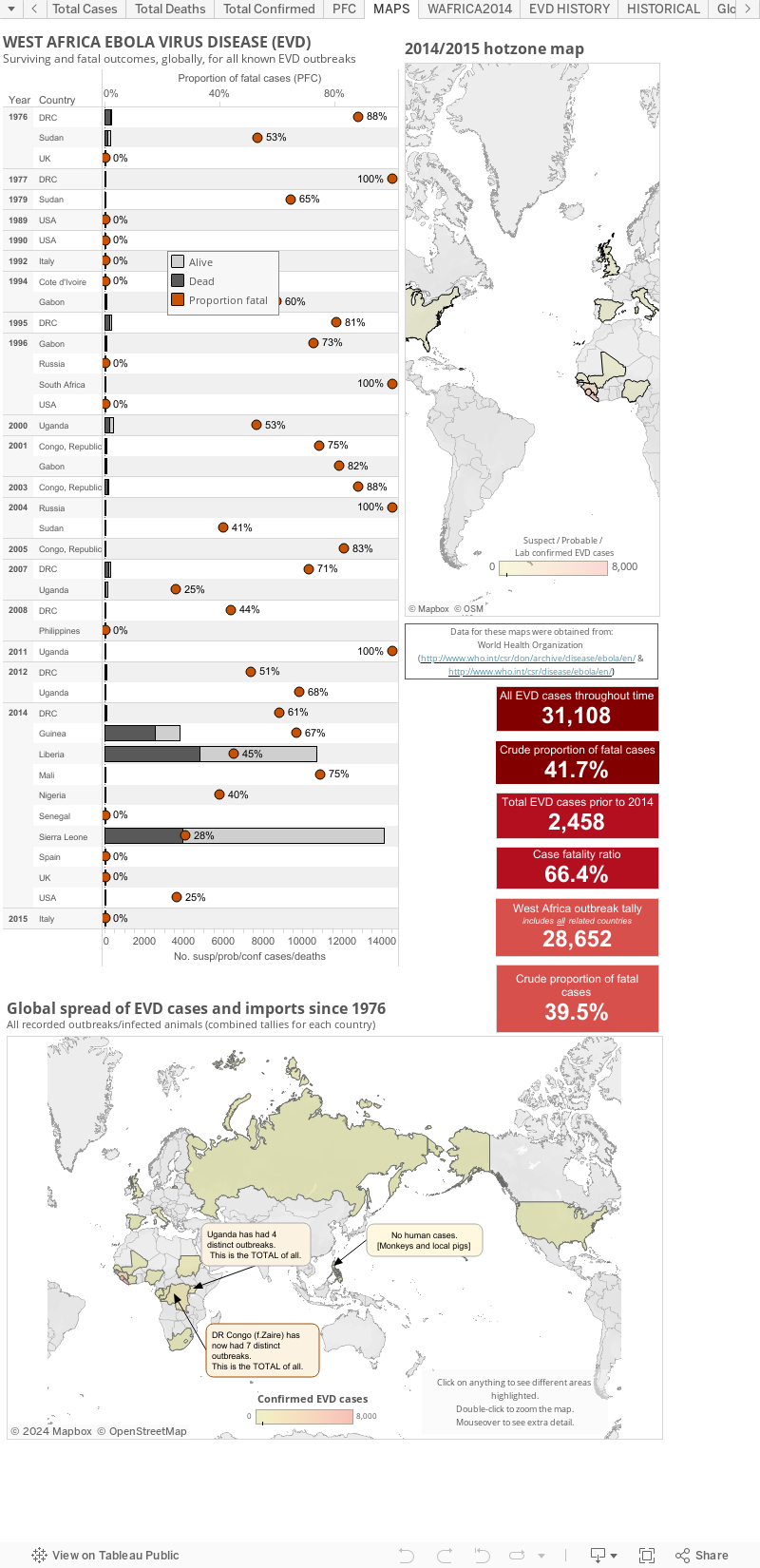
Ebola virus disease (EVD) cases, clusters and outbreaks mapped out...

The West African region epidemic (top map), including countries with imported cases and the totals from past Ebola virus disease outbreaks and the few imported monkey cases (the US & Philippines [hence zero human cases]) plotted by total numbers and country (bottom map).

These maps are best viewed alongside my Ebola virus disease numbers page found here.


The WHO create multi-page Situation Reports [2] and brief Situation Summaries.[3] They are currently presented on Wednesday and "additional updated figures" will be posted "as they become available any day of the week" (via eMail to journalists from WHO).

My totals include all countries that have hosted a case in, or sourced from, a West African nation. Countries include Guinea, Liberia, Sierra Leone, Nigeria (now EVD-free), Senegal (now EVD-free), the United States of America, Spain and Mali.

This is a static page but as of 21-Jan-2015 (AEST) I have copied the maps to the bottom of my main EVD EBOV|Makona (west African Zaire ebolavirus variant) outbreak page at:  http://newsmedicalnet.blogspot.com.au/2014/07/ebola-virus-disease-evd-2014-west.html


A note about the proportion of fatal cases (PFC): 
On these graphs, my PFC calculations for West African countries and the DRC are based on dividing the total number of suspect/probable/confirmed deaths by the number of total suspect/probable/confirmed cases for the same date. This is crude and may be a sizable underestimate of the true PFC.

It may be better to use the deaths at the most recent date divided by the total cases from 9-16-days  earlier (this number is not precisely known) to better account for the lag in time between presenting to a treatment facility and dying (for those who do not recover). 


Some estimates suggest the true PFC may be closer to 70%-80%. I don't have enough data (or smarts) to be able to calculate the lag for now so please be aware that the PFC above is likely an underestimate.


  • The figure above, as with all on VDU, is made for general interest only. It is also freely available for anyone's use, just cite the page and me (Dr. Ian M Mackay, PhD) please. It may be that I have misinterpreted the language in the reports (sometimes a little tricky to wade through) or miscalculated some totals based on the way data have been presented. 
  • Sometimes there are very country-specific differences in what gets presented to/via the World WHO DONs/SitReps which make this process less clear than it could be. I recommend you have a read and compare the data from each of the countries for yourself to understand these issues. 
  • As I've talked about previously,[1] these numbers are all volatile for a variety of reasons, some Ebola-specific, so regard this chart for its trends only.
  • I am only able to plot what is publicly available. To date, this does not include granular data with dates of onset, or daily data of any kind. The WHO have these data and you will see them become more available through their Situation Reports found here http://www.who.int/csr/disease/ebola/situation-reports/en/
References... 
  1. Ebola virus disease and lab testing...
    http://newsmedicalnet.blogspot.com.au/2014/04/ebola-virus-disease-and-lab-testing.html
  2. Ebola virus disease outbreak Situation Reports (SitRep)
    http://www.who.int/csr/disease/ebola/situation-reports/en/
  3. Ebola virus disease outbreak Situation Summaries (SitSumm)
    http://apps.who.int/gho/data/view.ebola-sitrep.ebola-summary-latest?lang=en

The International Health Regulations (IHR) 2005...

I've heard a lot about the IHR but I have not read the entire document. 

This post is just to note which States are considered to be a party to them and what they mean in general terms.

 A blog-friendly reformatted excerpt from the Foreward (highlighting is mine)...

"The purpose and scope of the IHR (2005) are �to prevent, protect against, control and provide a public health response to the international spread of disease in ways that are commensurate with and restricted to public health risks, and which avoid unnecessary interference with international traffic and trade.� The IHR (2005) contain a range of innovations, including: 

  • (a) a scope not limited to any specific disease or manner of transmission, but covering �illness or medical condition, irrespective of origin or source, that presents or could present significant harm to humans�; 
  • (b) State Party obligations to develop certain minimum core public health capacities; 
  • (c) obligations on States Parties to notify WHO of events that may constitute a public health emergency of international concern according to defined criteria; 
  • (d) provisions authorizing WHO to take into consideration unofficial reports of public health events and to obtain verification from States Parties concerning such events; 
  • (e) procedures for the determination by the Director-General of a �public health emergency of international concern� and issuance of corresponding temporary recommendations, after taking into account the views of an Emergency Committee; 
  • (f) protection of the human rights of persons and travellers; and 
  • (g) the establishment of National IHR Focal Points and WHO IHR Contact Points for urgent communications between States Parties and WHO."


This was taken from the PDF of the IHR2005 [1]

References...

  1. International Health Regulations 2005
    Second Edition
    http://whqlibdoc.who.int/publications/2008/9789241580410_eng.pdf?ua=1

Like Us

Blog Archive