
Showing posts with label WHO. Show all posts
Showing posts with label WHO. Show all posts
Editor's Rant: Communicating the data and about the data...


When it is, it may be available in unfriendly formats. It may not be made public at all. When it is available, it is often slow to appear or it may have random reporting gaps, or be partially incomplete. The style of the released data can change overnight as well, sometimes going from detail to summary.
So why bother about trying to get hold of these numbers at all? It's not like I work in the field. Well, that is a question I'm increasingly asking myself of late too. My personal reason has been because I think there need to be more voices in the vacuum between the numbers being reported and the often dry public health reports. I think scientists, even if they are not lifetime experts on a given virus or outbreak, still have much to offer when they come out from behind their manuscripts and apply their skills to interpreting what's happening. Well, many do anyway. And they should do it more. Now, perhaps more than ever, science needs steer away from its cold, dense and boring niche writing to a chattier, more helpful and community-based style of engagement. It astonishes me how often the public's interpretation of outbreak numbers must come from the media or from hobbyists, or even professionals who work in other areas and give of their own time to help explain something to us in their personal time. Helpful and engaging information and better access should come from the source of the data.
So it becomes really annoying (you would have to know me quite well to know how many times I just rewrote those words) when data are given out for public use that are a total mess...and there is not one tiny mote of explanation for it. I called it appalling on Twitter tonight. And at other times there are no explanations for why there are gaps, why data are delayed, why the format may have changed today compared to last week, why a line list is missing a case, using a new and totally independent numbering scheme or suddenly reshuffled, why there is no news about a new outbreak. No word. No contact. No-one taking the lead. No...communication.

Matching MERS case identification numbers from two differing sources...
Update #1 27JUNE2015
Update #2 28JUNE2015
Sometimes people work from different playbooks.Update #2 28JUNE2015
 |
| Figure 1. MERS in South Korea. Most cases now plotted on graph using their dates of illness onset. An outbreak in decline. This is up-to-date - 3 new cases from 21JUN2015 added (column at right hand side - onset dates unknown) Click on graph to enlarge |
In this instance, the data from the World Health Organization's (WHO) new list of Middle East respiratory syndrome (MERS) cases - with extra detail - uses a case identification key that's out of synchrony with that produced by the South Korean (SK) Health Authority which can be found in each of its posts announcing new MERS cases and deaths.
Attempting to link the two lists has mostly been an exercise in pedantry, but sometimes it is useful to know which case one is talking about when discussing an outbreak or cluster of disease....'Hey Bill, what didja think of that 70 year old MERS case who drove the ambulance carrying that infected 75 year old MERS case and then those others got MERS as well..?' doesn't really roll off the tongue does it?
 |
| Figure 2. What the graph above looked like before we had dates of illness onset. Many cases were 'moved' to earlier time points because report dates always follow onset of illness dates and they can follow by varying periods of time - sometimes a day, sometimes a week or more. |
If I've stuffed anything up or if you can solve my problem cases - please pass that info along and I'll update the files on this page. Hopefully the next WHO version will have addressed all of this anyway (it didn't but perhaps a future one will).
These are publicly available and you can download them for your own interest.
There is a download arrow at the top of the Google Drive page.
- Google Drive folder with MERS data files
https://drive.google.com/open?id=0B5sEcTjB5Ailfm1PcU1oNDF6M2hiaDduUDgzQUdxNlZxeHBkU0FHeVBRRFJkbHIxTmdjX3c&authuser=0
Updates...
- With the help of FluTrackers updated line list to cross check against, the first half of my list has been updated - some bugs fixed.
- After about 5 hours - on and off - FluTrackers helped me sort out a few errors and the latest version of my list has been uploaded into the the folder linked above. Some typos corrected.
MERS-CoV in South Korea - other data formats for data provided by WHO...
The following links take you to different version of the PDF if you want to harvest those data...
- Excel version, Office 2010
https://drive.google.com/open?id=0B5sEcTjB5Aila3c5WXI4bzlkLWc&authuser=0 - MS DOS CSV file
https://drive.google.com/open?id=0B5sEcTjB5AilTHRub1FRZnhpQmM&authuser=0 - Original WHO PDF
https://drive.google.com/open?id=0B5sEcTjB5AilWlo0UDZwVzRpdVE&authuser=0
Its taken a week to get these data, and its unclear why detail data dried up from the 12th June to the 19th, or why the data have appeared now, but they are here at last and that's great.
Translating from the Korean for MERS epidemiology...
I absolutely love the graphic the Korean Broadcasting Service (KBS) have been putting up. Love 'em. Great job! I just wish they were in English too. I understand that the first priority is to your own population - totally get that. But I do wish that, like the Saudi Ministry of Health, every country could do an English version as well as the native language.
But processes, time money and stuff...
Anyway - to help me try and get more detail on the South Korean clusters I have added some translation to one of the KBS pages which, when you click on the icon of a person, gives you a popup box with some detail. I've added translation to the contents of that box (see the figure below).
I don't know how accurate the "Date of infection" field is but will be comparing it to the World Health Organization (WHO) data from earlier to see if it can be useful. This is all because the date of reporting is almost always different from the date of illness onset - and the latter are much better to plot to get an idea of whether an outbreak is rising, peaking or slowing. Having the ability to crowd-plot these numbers is great and (I think) useful to inform the public and our clinical and scientific peers when included alongside some discussion about trends and reason for changes, risk etc. Often (always?) more personable banter, and engagement, seems to be lacking from 'bigPublicHealth' sources.
This sort of data mining seems essential if the recent WHO publication of a minimalist 33-word summary of the last 62 cases is now the norm - or perhaps the provision of information from the South Korean health authority to the WHO has changed in format. And that has become acceptable to the WHO, who have not commented on the change. Such summaries, and lack of comment, are also business-as-usual for 'updating' us on human cases of influenza A(H7N9) virus in China.
References...
But processes, time money and stuff...
Anyway - to help me try and get more detail on the South Korean clusters I have added some translation to one of the KBS pages which, when you click on the icon of a person, gives you a popup box with some detail. I've added translation to the contents of that box (see the figure below).
I don't know how accurate the "Date of infection" field is but will be comparing it to the World Health Organization (WHO) data from earlier to see if it can be useful. This is all because the date of reporting is almost always different from the date of illness onset - and the latter are much better to plot to get an idea of whether an outbreak is rising, peaking or slowing. Having the ability to crowd-plot these numbers is great and (I think) useful to inform the public and our clinical and scientific peers when included alongside some discussion about trends and reason for changes, risk etc. Often (always?) more personable banter, and engagement, seems to be lacking from 'bigPublicHealth' sources.
 |
| Click on image to enlarge. Adapted from http://dj.kbs.co.kr/resources/2015-06-08/[1] |
This sort of data mining seems essential if the recent WHO publication of a minimalist 33-word summary of the last 62 cases is now the norm - or perhaps the provision of information from the South Korean health authority to the WHO has changed in format. And that has become acceptable to the WHO, who have not commented on the change. Such summaries, and lack of comment, are also business-as-usual for 'updating' us on human cases of influenza A(H7N9) virus in China.
References...
Liberia gave Ebola the boot...and a virus may soon be removed from the wild
The people of Liberia have earned our respect, some time for national celebrations and frankly any other rewards that may flow from denying the Makona variant of Ebola virus any hosts among their community.
The world considered this viral species to be one of the list-toppers when it came to ranking the causes of the most scary acute infectious diseases. Ebola virus has been the basis for all sorts of 'end-of 'the-world' mutating virus horror movies, books, and TV shows. It's not at all surprising that the public view of an Ebola virus infection had long been one of blood, fear and terror.
Behavioural change was a major factor in reducing virus transmission in Liberia. Alongside that was a broad range of aid given from within and beyond Africa's nations. By working together, a widespread outbreak that was not initially thought likely to happen at all, was routed.
For now.
Liberia is not immune to new cases of Ebola virus disease (EVD) crossing its borders or popping up due to a new animal-to-human jump (a zoonosis). That could happen any day - it might be happening now. But those who are still on watch will be searching out new cases while the remaining sites of transmission - Guinea and Liberia - do their best to deny Ebola virus a chance to replicate and spread. The people of Liberia will keep watch help because they have learned very tough lessons about viruses, epidemiology and communication. At least 10,604 suspect, probable and confirmed EVD cases, 4,769 deaths and way too many stories of sadness and families destroyed are a very strict teacher.
The crude prediction in Figure 1 suggests that zero cases across all three countries could happen at the end of May, but many stars must align for that to be a real event.
Human factors - the causal and sustaining variables of any outbreak of infectious disease in humans and sometimes animals - remain very much in play. But once that tri-country zero case value is attained, we have 42 days of watching and waiting - from the time the final case tests negative.
New cases may arise from sources as-yet-unknown. But even if they do keep popping up, it seems very unlikely that widespread transmission will amplify to earlier levels (see the steep slopes in Figure 2) unless a major lapse in attention occurs. Hence,the need for continued vigilance - and Liberia remains on alert for a further 90 days. That more recent figure comes about because we know that infectious Ebola virus can persist in some body sites for many weeks after signs of disease have passed. Whether that virus reservoir is present in every person and whether it actually does cause new Ebola virus infections remain unproven. When you consider what can happen when one person gets infected by an Ebola virus in a tiny remote village in a country that is ill prepared to cope with it and has traditions that lend themselves to its spread...even minor risks rightly come under more intense scrutiny.
What next for this particular virus though? The only place where the Makona variant of this member of the Zaire ebolavirus species will soon exist, is in the freezer of (hopefully) very biosecure laboratories in the US, UK, Africa, Russia, China and probably other laboratories in countries that hosted, evacuated or repatriated cases of EVD.
There is no sign at all - and this is because of the continued efforts and focus of many currently working throughout west Africa - of the fabled "endemic Ebola" becoming a reality. Unless you mean enzootic 'Ebola'- in which case , it already is, I suspect. It seems very, very likely that the forests of west Africa continue to shelter animal hosts with less mutated versions of this and other ebolaviruses (and filoviruses and who-knows-what else). The host species and route(s) of transmission to humans are yet to be confirmed but for now, we are not too far off eradicating one unwanted viral scourge from the wild. Impressive what we can do when we pull together.
The world considered this viral species to be one of the list-toppers when it came to ranking the causes of the most scary acute infectious diseases. Ebola virus has been the basis for all sorts of 'end-of 'the-world' mutating virus horror movies, books, and TV shows. It's not at all surprising that the public view of an Ebola virus infection had long been one of blood, fear and terror.
 |
| Figure 1. The decline of the Makona variant of Ebola virus in Guinea, Sierra Leone and Liberia (now free of EVD transmission). Click on image to enlarge. |
For now.
Liberia is not immune to new cases of Ebola virus disease (EVD) crossing its borders or popping up due to a new animal-to-human jump (a zoonosis). That could happen any day - it might be happening now. But those who are still on watch will be searching out new cases while the remaining sites of transmission - Guinea and Liberia - do their best to deny Ebola virus a chance to replicate and spread. The people of Liberia will keep watch help because they have learned very tough lessons about viruses, epidemiology and communication. At least 10,604 suspect, probable and confirmed EVD cases, 4,769 deaths and way too many stories of sadness and families destroyed are a very strict teacher.
 |
| Figure 2. The number of confirmed EVD cases (yellow) grinds to a standstill. Only 9 cases in the week to 10th May 2015. Click on image to enlarge. |
Human factors - the causal and sustaining variables of any outbreak of infectious disease in humans and sometimes animals - remain very much in play. But once that tri-country zero case value is attained, we have 42 days of watching and waiting - from the time the final case tests negative.
New cases may arise from sources as-yet-unknown. But even if they do keep popping up, it seems very unlikely that widespread transmission will amplify to earlier levels (see the steep slopes in Figure 2) unless a major lapse in attention occurs. Hence,the need for continued vigilance - and Liberia remains on alert for a further 90 days. That more recent figure comes about because we know that infectious Ebola virus can persist in some body sites for many weeks after signs of disease have passed. Whether that virus reservoir is present in every person and whether it actually does cause new Ebola virus infections remain unproven. When you consider what can happen when one person gets infected by an Ebola virus in a tiny remote village in a country that is ill prepared to cope with it and has traditions that lend themselves to its spread...even minor risks rightly come under more intense scrutiny.
What next for this particular virus though? The only place where the Makona variant of this member of the Zaire ebolavirus species will soon exist, is in the freezer of (hopefully) very biosecure laboratories in the US, UK, Africa, Russia, China and probably other laboratories in countries that hosted, evacuated or repatriated cases of EVD.
There is no sign at all - and this is because of the continued efforts and focus of many currently working throughout west Africa - of the fabled "endemic Ebola" becoming a reality. Unless you mean enzootic 'Ebola'- in which case , it already is, I suspect. It seems very, very likely that the forests of west Africa continue to shelter animal hosts with less mutated versions of this and other ebolaviruses (and filoviruses and who-knows-what else). The host species and route(s) of transmission to humans are yet to be confirmed but for now, we are not too far off eradicating one unwanted viral scourge from the wild. Impressive what we can do when we pull together.
Ebolaradication around the corner..?
The downward trend for new, confirmed, Ebola virus disease (EVD) cases continues as we can see in the graph below.
This graph plots the number (each blue data point or dot) of newly confirmed cases in each World Health Organization situation report of summary. The joining lines don't mean anything (the WHO doesn't provide any numbers to place between dots)- they just make it cleared how think go up and down. You can see a little about Monday'itis and its role in the bumpy road to zero cases here.
I've zoomed in the graph to highlight distinct data points (thanks to Ramon i.e. @HlthAnalysis for helping me learn to make the separately coloured dots I missed so much from my Excel graphs). Without the zooming we can see from the full dataset that it's getting a bit hard to see each data point as time goes by, and case numbers shrink (yay!).

Below is part of one of the charts from my Ebola virus disease numbers page - you can get to it from any page on this blog by clicking on that tab up there^.
 |
| The line indicating the linear trend of fewer cases over time has a p-value of 0.023 and was calculated within Tableau Public Edition v9.0 Click on image to enlarge. |
I've zoomed in the graph to highlight distinct data points (thanks to Ramon i.e. @HlthAnalysis for helping me learn to make the separately coloured dots I missed so much from my Excel graphs). Without the zooming we can see from the full dataset that it's getting a bit hard to see each data point as time goes by, and case numbers shrink (yay!).
WHO reconsiders openly wanting to be a new organization
Yesterday I stumbled across this statement by the World Health Organization (WHO). It's reprinted in full below, but the original version is no longer on the WHO site (more on that in a minute).
It was a powerful human, feeling, mea culpa on the Ebola response along with a very strong and detailed plan to move forward and a fiery desire to be the group that keeps the world safe. I tweeted a few bits of it and stated my respect.
I'm disappointed.
While I won't delete my tweets from yesterday, I would not have tweeted my respect for this version. Whomever you are that wrote that version - well done. I feel the retention of some of your key parts would have been better received by the world and they show you are indeed ready to move forward, acknowledging that everyone made and makes mistakes, or errors in judgement - that is to human - but that you own those and will seek to do better.
Original Statement It was a powerful human, feeling, mea culpa on the Ebola response along with a very strong and detailed plan to move forward and a fiery desire to be the group that keeps the world safe. I tweeted a few bits of it and stated my respect.
Hey @WHOIf we all admitted our mistakes & openly spoke of ways 2do better-what a wonderful world it wouldB! #Respecthttp://t.co/a7NjzH70Ou
� Ian M Mackay, PhD (@MackayIM) April 20, 2015
"Hold us to account" Joint statement on the #Ebola response and @WHO reforms http://t.co/ihVLWLDcZ7
� Ian M Mackay, PhD (@MackayIM) April 20, 2015
"there were shortcomings in risk communications" via @WHO #EbolaResponsehttp://t.co/a7NjzH70OuThen I noticed some tweets, including this from @cymeaton indicating that the WHO had released a new and different version.. (also story with more details of the changes, here).
� Ian M Mackay, PhD (@MackayIM) April 20, 2015
The WHO released and then redacted their statement on the Ebola response and WHO reforms. I preserved the original: http://t.co/N3mr4mQJ6eThis new revision (copied below the original version) has some nice general changes, removal of contractions, removal of the numbering etc., but is weakened by the deletion of some other phrases leaving it feeling colder and covered by the fingerprints of bureaucracy - something that the first version felt like it was climbing above.
� Caitlin Rivers (@cmyeaton) April 20, 2015
I'm disappointed.
While I won't delete my tweets from yesterday, I would not have tweeted my respect for this version. Whomever you are that wrote that version - well done. I feel the retention of some of your key parts would have been better received by the world and they show you are indeed ready to move forward, acknowledging that everyone made and makes mistakes, or errors in judgement - that is to human - but that you own those and will seek to do better.
At time of writing it was found here; some remove but humanising words are underlined
Joint statement on the Ebola response and WHO reforms
Statement by WHO Director-General, Deputy Director-General and Regional Directors, on the Ebola outbreak and response, and reforms to the work of WHO in outbreaks and humanitarian emergencies.
- The Ebola outbreak which started in Dec 2013 became a public health, humanitarian and socioeconomic crisis, with devastating impact on families, communities and affected countries. It also served as a reminder that the world, including WHO, is ill prepared for a large sustained disease outbreak.
- We welcome the recommendations of the Special Session of the WHO Executive Board, in particular the proposed assessment of all aspects of the WHO response. Based on the lessons learnt, we commit ourselves to reforms that will enable WHO to play its rightful place in disease outbreaks, humanitarian emergencies and in global health security.
What have we learned? - We have learned lessons of humility. We have seen that old diseases in new contexts consistently spring new surprises. We have taken serious note of the criticisms of the Organization that, inter alia, the initial WHO response was slow and insufficient, we were not aggressive in alerting the world, our surge capacity was limited, we did not work effectively in coordination with other partners, there were shortcomings in risk communications, and there were was confusion of roles and responsibilities at the three levels of the Organization.
- We have learned lessons of fragility. We have seen that health gains �fewer child deaths, malaria coming under control, more women surviving child birth � are all too easily reversed, when built on fragile health systems, which are quickly overwhelmed and collapse in the face of an outbreak of this nature.
- We have learned the importance of capacity. We can mount a highly effective response to small and medium-sized outbreaks, but when faced with an emergency of this scale, our current systems � national and international � simply have not coped.
- We have learned lessons of community and culture. A significant obstacle to an effective response has been the inadequate engagement with affected communities and families. This is not simply about getting the right messages across; we must learn to listen if we want to be heard. We have learned the importance of respect for culture in promoting safe and respectful funeral and burial practices. Empowering communities must be an action, not a clich�.
- We have learned lessons of solidarity. In a disease outbreak, all are at risk. We have learned that that the global surveillance and response system is only as strong as its weakest links, and in an increasingly globalised world, a disease threat in one country is a threat to us all. Shared vulnerability means shared responsibility and therefore requires sharing of resources, and sharing of information.
- We have learned the challenges of coordination. We have learnt to recognise the strengths of others, and the need to work in partnership when we don�t have the capacity ourselves.
- We have been reminded that market-based systems do not deliver on commodities for neglected diseases � endemic nor epidemic. But we have been encouraged by the desire of the scientific community, manufacturers and regulators to work together in this crisis to develop effective diagnostics, drugs and vaccines for Ebola.
- Finally, we have learned the importance of communication � of communicating risks early, of communicating more clearly what is needed, and of involving communities and their leaders in the messaging.
What must we do? - We will intensify our advocacy with national authorities to keep outbreak prevention and management at the top of national and global agendas.
- We will develop the capacity to respond rapidly and effectively to disease outbreaks and humanitarian emergencies. This will require a directing and coordinating mechanism to bring together the world�s resources to mount a rapid and effective response. We commit to expanding our core staff working on diseases with outbreak potential and health emergencies so we will have at least [1,000] skilled staff always available at the three levels of WHO. We will also create surge capacity of teams of trained and certified staff so that we have at least [1000] additional staff available as a reserve force in the event of an emergency.
- We will create a Global Health Emergency Workforce � combining the expertise of public health scientists, the clinical skills of doctors, nurses and other health workers, the management skills of logisticians and project managers, and the skills of social scientists, communication experts and community workers. This Global Health Emergency Workforce will be made up of teams of trained and certified responders who can available immediately. A key principle must be to build capacity in countries, with training and simulation exercises.
- We will establish a Contingency Fund to enable WHO to respond more rapidly to disease outbreaks. We must ensure adequate resources � domestic and international � are available BEFORE the next outbreak. We welcome the proposal to create a pandemic financing facility.
- We will change our way of working. Disease outbreaks demand a command and control approach � very different from the consensus building culture of most of our work in global public health. We commit to clarifying our roles and responsibilities within health emergencies, and organize ourselves to deliver on these roles. We will develop new systems for human resources, planning, logistics, information management and other areas that are so critically important in health emergencies.
- We will establish partnerships with other organizations such as OCHA, UNICEF and WFP and other partners, to create a scalable operational response capacity for large scale disease outbreaks
- We will strengthen the International Health Regulations � the international framework for preparedness, surveillance and response for disease outbreaks and other health threats. We commit to strengthening our capacity to assess, plan and implement preparedness and surveillance. We will scale up our support to countries to develop the minimum core capacities to implement the IHR. We will establish mechanisms for independent verification of national capacity to detect and respond to disease threats.
- We will develop expertise in community engagement in outbreak preparedness and response. We will emphasise the importance of community systems strengthening and work with partners to develop multidisciplinary approaches to community engagement , informed by anthropology and other social sciences.
- We will communicate better. We commit to provide information on disease outbreaks and other health emergencies as they occur, rapidly and transparently. We will strengthen our capacity for risk communications and for community engagement.
We call on world leaders to take the following steps - First, take disease threats seriously. We don�t know when the next major outbreak will come or what will cause it. But history tells us it will come.
- Second, remain vigilant. This Ebola outbreak is far from over, and we must sustain our support to the affected countries until the outbreak is over, in the face of increasing complacency and growing fatigue. We must continue to maintain a high level of surveillance. Ebola has demonstrated its capacity to spread � it may do so again.
- Third, engage to re-establish the services, systems and infrastructure which have been devastated in Guinea, Liberia and Sierra Leone. This recovery must be country-led, community-based, and inclusive � engaging the many partners who have something to contribute � bilateral and multilateral partners, national and international NGOs, the faith community, and the private sector.
- Fourth, focus on prevention. This means investing domestically and internationally in essential public health systems for preparedness, surveillance and response, which are fully integrated and aligned with efforts to strengthen health systems, and included in the scope of development assistance for health. It means working across sectors � health and agriculture in particular. These resources will be substantial, but as the well-known aphorism goes, prevention is better (and less costly) than cure.
- Fifth, be transparent in reporting. Accurate and timely information is the basis for effective action. Speedy detection facilitates speedy response and prevents escalation.
- Sixth, invest in research and development for the neglected diseases with outbreak potential � diagnostics, drugs, and vaccines. This will require innovative financing mechanisms, and public-private partnerships.
- Finally, hold us to account. We commit ourselves to ensuring that WHO is reformed and well positioned to play its rightful role in disease outbreaks and in global health security generally. Some have said the world needs a new organization to be created. We agree, and we want WHO to be that organization.
New version
At the time of writing it was found here
WHO leadership statement on the Ebola response and WHO reforms
The Ebola outbreak that started in December 2013 became a public health, humanitarian and socioeconomic crisis with a devastating impact on families, communities and affected countries. It also served as a reminder that the world, including WHO, is ill-prepared for a large and sustained disease outbreak.
We, the Director-General, Deputy Director-General, and Regional Directors of WHO, are making this commitment of collective leadership to Member States and their peoples in line with recommendations made by the Special Session of the Executive Board on Ebola held in January 2015. We have taken note of the constructive criticisms of WHO�s performance and the lessons learned to ensure that WHO plays its rightful place in disease outbreaks, humanitarian emergencies and in global health security.
What have we learned?
We have learned that new diseases and old diseases in new contexts must be treated with humility and an ability to respond quickly to surprises. Greater surge capacity contributes to a flexible response.
We have learned lessons of fragility. We have seen that health gains � fewer child deaths, malaria coming under control, more women surviving child birth � are all too easily reversed, when built on fragile health systems, which are quickly overwhelmed and collapse in the face of an outbreak of this nature.
We have learned the importance of capacity. We can mount a highly effective response to small and medium-sized outbreaks, but when faced with an emergency of this scale, our current capacities and systems � national and international � simply have not coped.
We have learned lessons of community and culture. A significant obstacle to an effective response has been the inadequate engagement with affected communities and families. This is not simply about getting the right messages across; we must learn to listen if we want to be heard. We have learned the importance of respect for culture in promoting safe and respectful funeral and burial practices. Empowering communities must be an action, not a clich�.
We have learned lessons of solidarity. In a disease outbreak, all are at risk. We have learned that the global surveillance and response system is only as strong as its weakest links, and in an increasingly globalized world, a disease threat in one country is a threat to us all. Shared vulnerability means shared responsibility and therefore requires sharing of resources, and sharing of information.
We have learned the challenges of coordination. We have learnt to recognise the strengths of others, and the need to work in partnership when we do not have the capacity ourselves.
We have been reminded that market-based systems do not deliver on commodities for neglected diseases � endemic nor epidemic. Incentives are needed to encourage the development of new medical products for diseases that disproportionately affect the poor. The scientific community, the pharmaceutical industry, and regulators have come together in a collaborative effort to vastly compress the time needed to develop and approve Ebola vaccines, medicines, and rapid diagnostic tests. In future, this ad hoc emergency effort needs to be replaced by more routine procedures that are part of preparedness.
Finally, we have learned the importance of communication � of communicating risks early, of communicating more clearly what is needed, and of involving communities and their leaders in the messaging.
What must we do?
We will engage with national authorities and request them to keep outbreak prevention, preparedness and response management at the top of national and global agendas.
We will develop the capacity to respond rapidly and effectively to disease outbreaks and humanitarian emergencies. This will require a directing and coordinating mechanism to bring together the world�s resources to mount a rapid and effective response. We commit to expanding our core staff working on diseases with outbreak potential and health emergencies so we will have skilled staff always available at the three levels of WHO. We will also create surge capacity of teams of trained and certified staff so that we have a reserve force in the event of an emergency.
We will create a Global Health Emergency Workforce � combining the expertise of public health scientists, the clinical skills of doctors, nurses and other health workers, the management skills of logisticians and project managers, and the skills of social scientists, communication experts and community workers. This Global Health Emergency Workforce will be made up of teams of trained and certified responders who can be available immediately. A key principle must be to build capacity in countries, with training and simulation exercises.
We will establish a Contingency Fund to enable WHO to respond more rapidly to disease outbreaks. We must ensure adequate resources � domestic and international - are available before the next outbreak.
We recognize that emergency situations demand a command and control approach and we commit to seamless collaboration between headquarters, regional offices, and country offices. Better WHO systems for rapid staff deployments, data collection and reporting, expansion of laboratory services, logistics, and coordination were developed as the outbreak evolved. These systems will be institutionalized.
The massive international response revealed the unique strengths of multiple partners, including UN agencies. We will build on these partnerships, concentrating on capacities that are most critically needed under the demanding conditions of emergencies.
We will strengthen the International Health Regulations � the international framework for preparedness, surveillance and response for disease outbreaks and other health threats. We commit to strengthening our capacity to assess, plan and implement preparedness and surveillance measures. We will scale up our support to countries to develop the minimum core capacities to implement the IHR. We will establish mechanisms for independent verification of national capacity to detect and respond to disease threats.
We will develop expertise in community engagement in outbreak preparedness and response. We will emphasise the importance of community systems strengthening and work with partners to develop multidisciplinary approaches to community engagement , informed by anthropology and other social sciences.
We will communicate better. We commit to provide timely information on disease outbreaks and other health emergencies as they occur. We will strengthen our capacity for outbreak and risk communications.
We call on world leaders to take the following steps
First, take disease threats seriously. We do not know when the next major outbreak will come or what will cause it. But history tells us it will come. This means investing domestically and internationally in prevention and in essential public health systems for preparedness, surveillance and response, which are fully integrated and aligned with efforts to strengthen health systems, and included in the scope of development assistance for health.
Second, remain vigilant. This Ebola outbreak is far from over, and we must sustain our support to the affected countries until the outbreak is over, in the face of increasing complacency and growing fatigue. We must continue to maintain a high level of surveillance. Ebola has demonstrated its capacity to spread � it may do so again.
Third, engage to re-establish the services, systems and infrastructure which have been devastated in Guinea, Liberia and Sierra Leone. This recovery must be country-led, community-based, and inclusive � engaging the many partners who have something to contribute; including bilateral and multilateral partners, national and international NGOs, the faith community, and the private sector.
Fourth, be transparent in reporting. Accurate and timely information is the basis for effective action. Speedy detection facilitates speedy response and prevents escalation.
Fifth, invest in research and development for the neglected diseases with outbreak potential � diagnostics, drugs, and vaccines. This will require innovative financing mechanisms, and public-private partnerships.
This is our commitment; together we will ensure that WHO is reformed and well positioned to play its rightful role in disease outbreaks, humanitarian emergencies and in global health security.
The weakening pulse of the Ebola monster...
As of this post, some of the most comprehensive publicly available data on an emerging virus is coming out of the Kingdom of Saudi Arabia in relation to the Middle East respiratory syndrome coronavirus (MERS-CoV). Yeah-that's what I said. Even with all the issues I complain about, its more detailed than for other current outbreaks.
In 2015, China became a major disappointment in its poor publication of data for the avian influenza A(H7N9) virus's 3rd outbreak - choosing to release bulk updates and little to no detail on who, where or when.
The continuing avian influenza A(H5N1) virus outbreak in Egypt is also a mystery to all but a very few. Something that is a concern I think, for a much larger number.
Data from the Ebola virus hotzone countries in western Africa has also had many ups and downs. This is not at all surprising given the conditions, the extent of mobile communications, the history of the region, the political and social issues, the poor health infrastructure and the speed with which Ebola virus disease (EVD) spread through Guinea, Liberia and Sierra Leone in 2014. Many different patterns have emerged over the past year among these numbers.
One pattern is the "heartbeat" of EVD cases - the difference in number between update and summary tallies - seen when plotting the data reported by the World Health Organization.
The peaks (Wednesdays and Mondays) and troughs in this chart both hide and reveal all sorts of tales. Principal among these is that the pulse is slowing. The life of the EVD epidemic monster is steadily draining away as the courageous aid workers in western Africa, those from within and from outside each afflicted nation, track the monster to its every hideout and starve it of its avenues for escape and further spread.
It is perhaps the slowest and most painstaking of the phases of this epidemic, but the process still moves forward towards the goal of zero cases and the complete eradication of these particular variants of Zaire ebolavirus, from the planet.
In 2015, China became a major disappointment in its poor publication of data for the avian influenza A(H7N9) virus's 3rd outbreak - choosing to release bulk updates and little to no detail on who, where or when.
The continuing avian influenza A(H5N1) virus outbreak in Egypt is also a mystery to all but a very few. Something that is a concern I think, for a much larger number.
Data from the Ebola virus hotzone countries in western Africa has also had many ups and downs. This is not at all surprising given the conditions, the extent of mobile communications, the history of the region, the political and social issues, the poor health infrastructure and the speed with which Ebola virus disease (EVD) spread through Guinea, Liberia and Sierra Leone in 2014. Many different patterns have emerged over the past year among these numbers.
One pattern is the "heartbeat" of EVD cases - the difference in number between update and summary tallies - seen when plotting the data reported by the World Health Organization.
 |
| Click on image to enlarge. |
It is perhaps the slowest and most painstaking of the phases of this epidemic, but the process still moves forward towards the goal of zero cases and the complete eradication of these particular variants of Zaire ebolavirus, from the planet.
Ebola virus disease: obliterating a variant and stalled case decline...
We've seen the words vigilant and vigilance used widely in recent weeks, ever since we entered a "new phase" of the Ebola virus disease (EVD) battle/fight/war.
The reason for vigilance in all things to do with this campaign has become obvious as the weeks have passed; the reduction in cases has stalled.
I've very crudely drawn in some trends below. Whether you agree with them or not, it is clear that since the fast fall in confirmed cases reported between November-January, it seems to have become very difficult to stamp out the last fires of EVD.
Liberia has come the closest to completing this goal of obliterating the Makona variant of the Zaire ebolavirus (EBOV|Makona) with just 3-9 confirmed cases between World Health Organization (WHO) Situation Report (SitReps) during any of the past 7 weeks. It seems that recent cases can be traced to known transmission chains too and that means no surprise outbreaks.
However, the people of Guinea and Sierra Leone have not quite got the messages that those in Liberia seem to have embraced (without touching!) so admirably.
In the last WHO SitRep [1] it was noted that 39-45 unsafe burials (probably not all that occurred) occurred in a week and >40 EVD cases were identified post-mortem. This last observation means exposure of the community to virus, not getting help and treatment for ill people, and unnecessarily requiring contact tracers to play catch-up. Bad for the infected people their friends and families and the response to EVD. It doesn't have to be that way.
This paints a picture of problems with Ebola outreach and education, communication and cooperation. Those things will keep the latest EVD "phase" chugging along.
 We do need to destroy this variant of Ebola virus by isolating it in the last human cases in each of Guinea, Liberia and Sierra Leone. Once those people recover, or regrettably die, EBOV|Makona will be gone, except for what's in lab freezers around the world and in sequence databases thanks to the efforts of a few expert research teams. Once gone from "the wild", the evolutionary clock resets back to the EBOV variants in the animals of the forest.
EBOV|Makona knows too much; it has seen too much; it has learned too much, to be allowed to "live". It has been passed through humans too many times and while there is a vanishingly small chance it will sprout wings, it is still a virus that spreads relatively easily under the right conditions and circumstances. Explosive loss of 8 litres of fluids a day provides many ways to pass along this blood/gastro virus. EBOV|Makona may also have adapted, and continues to adapt, in other ways that would mean its stay among humans becomes lengthy and its dissemination more widespread.
More bad news from an unsuccessful obliteration of EBOV|Makon-smouldering EVD in Sierra Leone and Guinea may release new case embers that drift across borders and set new fires in other countries. We don't need hundreds of cases a day for that to happen.[3] We know cases also fly with the aid of planes (not wings). And the cycle could renew. I don't think we'll see such big outbreaks of EBOV|Makona again, for reasons I laid out here, but chasing new fires is more work than stamping out the remnants of old ones. Vigilance and action.
I think vaccines still have an important role to play in the final phase of this epidemic, even if only 3 new healthcare worker cases were noted in the past SitRep week. Vaccine given to more than just healthcare workers could be useful here, if others will accept the needle.
Oh, and vigilance.
References..
The reason for vigilance in all things to do with this campaign has become obvious as the weeks have passed; the reduction in cases has stalled.
I've very crudely drawn in some trends below. Whether you agree with them or not, it is clear that since the fast fall in confirmed cases reported between November-January, it seems to have become very difficult to stamp out the last fires of EVD.
 |
| The phases. (Very) rough trends in the number of EVD cases over time. Date from World Health Organization situation reports (SitReps) and situation summaries (SitSumms). Click on image to enlarge. |
However, the people of Guinea and Sierra Leone have not quite got the messages that those in Liberia seem to have embraced (without touching!) so admirably.
In the last WHO SitRep [1] it was noted that 39-45 unsafe burials (probably not all that occurred) occurred in a week and >40 EVD cases were identified post-mortem. This last observation means exposure of the community to virus, not getting help and treatment for ill people, and unnecessarily requiring contact tracers to play catch-up. Bad for the infected people their friends and families and the response to EVD. It doesn't have to be that way.
This paints a picture of problems with Ebola outreach and education, communication and cooperation. Those things will keep the latest EVD "phase" chugging along.
EBOV|Makona knows too much; it has seen too much; it has learned too much, to be allowed to "live". It has been passed through humans too many times and while there is a vanishingly small chance it will sprout wings, it is still a virus that spreads relatively easily under the right conditions and circumstances. Explosive loss of 8 litres of fluids a day provides many ways to pass along this blood/gastro virus. EBOV|Makona may also have adapted, and continues to adapt, in other ways that would mean its stay among humans becomes lengthy and its dissemination more widespread.
More bad news from an unsuccessful obliteration of EBOV|Makon-smouldering EVD in Sierra Leone and Guinea may release new case embers that drift across borders and set new fires in other countries. We don't need hundreds of cases a day for that to happen.[3] We know cases also fly with the aid of planes (not wings). And the cycle could renew. I don't think we'll see such big outbreaks of EBOV|Makona again, for reasons I laid out here, but chasing new fires is more work than stamping out the remnants of old ones. Vigilance and action.
I think vaccines still have an important role to play in the final phase of this epidemic, even if only 3 new healthcare worker cases were noted in the past SitRep week. Vaccine given to more than just healthcare workers could be useful here, if others will accept the needle.
- Ebola outreach
- Education
- Communication
- Cooperation
Oh, and vigilance.
References..
WHO Media Release: Sierra Leone reacts swiftly in the face of desperate need
I am reprinting in full, with permission, what I think is a really well written "story behind the numbers". These stories provide invaluable context around the various individual human and community tragedies that are constantly occurring during this epidemic. They also highlight the many difficulties faced by those trying to help people, track and contain spread and and collate all the numbers. Those numbers may be dispassionate in their quantification of aspects of the epidemic, but they are so important to guide timely aid to the right areas and at the right scale
Freetown � 10 December 2014 - Racing to fact check an ominous spike in Ebola cases from the remote diamond district of Kono in eastern Sierra Leone, bordering Guinea, a World Health Organization rapid response team found a worse-than-expected scene. WHO and the U.S. Center for Disease Control (CDC) joined forces with the Sierra Leone National Ebola Response Center (NERC) and Ministry of Health and Sanitation (MoHS) to sound the alarm and are now rallying all-comers in a massive build up to contain this burgeoning Ebola outbreak which ran the risk of continuing to grow and remaining hidden as world attention focuses on urban centers.
�Our team met heroic doctors and nurses at their wits end, exhausted burial teams and lab techs, all doing the best they could but they simply ran out of resources and were overrun with gravely ill people,� explains Dr Olu Olushayo, WHO National Coordinator, Ebola Epidemic Response. �In districts like Kono, with moderate transmission confined to limited villages and chiefdoms, the best chance of eliminating transmission is through aggressive and comprehensive case investigation and contact tracing,� he said. Scattered villages in 8 of the 15 chiefdoms are affected.
Reacting on intel from the Ministry of Health of Sierra Leone, WHO sent a seasoned field epidemiologist to Kono 10 days ago to tease out whether reported Ebola cases told the whole story. Cases go unreported for a variety of reasons and are exacerbated when overwhelmed and under-resourced frontline workers are unable to reach remote areas to get the truth from reluctant villagers. The surveillance officers had no vehicles. WHO and CDC quickly sent more investigators and rugged trucks.
They uncovered a grim scene. In 11 days, 2 teams buried 87 bodies, including a nurse, an ambulance driver, and a janitor drafted into removing bodies as they piled up at the only area hospital, ill-equipped to deal with the dangerous pathogen. In the 5 days before the team arrived, 25 people died in the hastily cordoned off section of the main hospital serving as a makeshift Ebola holding center.
As of 9 December 2014, this district of over 350 000 people officially has 119 reported cases. Upon hearing the WHO findings, Dr. Amara Jambai, MoHS Director of Disease Prevention and Control harkened a local saying to describe what remains yet to be discovered, "we are only seeing the ears of the hippo."
Help is arriving daily. The NERC and MoHS for the Government of Sierra Leone and UNMEER with WHO support are connecting ready-to-help partners with an all-out multi-agency response to critical needs on the ground. WHO field staff are sharing their expertise with surveillance investigators, community mobilizers, infection controllers, and coordinators. The doctors from Partners in Health and Wellbody Alliance who supported the overwhelmed holding center, are willing to stay on board to support care at the source in outlying health posts. The International Federation of the Red Cross will build a new Ebola Treatment Center on a tight timetable, while they disinfect the hospital with MoHS and create a temporary safe holding unit. The IFRC Kenema Ebola Treatment Center will take Kono patients until these solutions are in place. CDC has staff on the ground. UNMEER has lent it�s helicopters to the effort in support of the UN family (WHO, UNICEF, UNFPA, WFP, and others) engaged in building up capacity for staff and volunteers through training, materials and logistical support. International Rescue Committee is supporting infection prevention activities in the district. Funders such as DIFD and USAID are making much of the fast response possible. The race is on in this frontier fight against the virus, as Ebola responders dash to get ahead of the epidemic rather than chasing its tail.
Influenza A(H7N9) virus: detection numbers and graphs...
This is a static page that will house my graphs of influenza A(H7N9) virus ("H7N9) numbers produced by the various Ministries of Health for the provinces and municipalities of China, the World Health Organization and FluTrackers.
They may take me a little while to get back up-to-date in this new format so stay with me. I will Tweet each update as I do for MERS-CoV and Ebola virus updates.
There is also an accompanying map page which for now is located here.
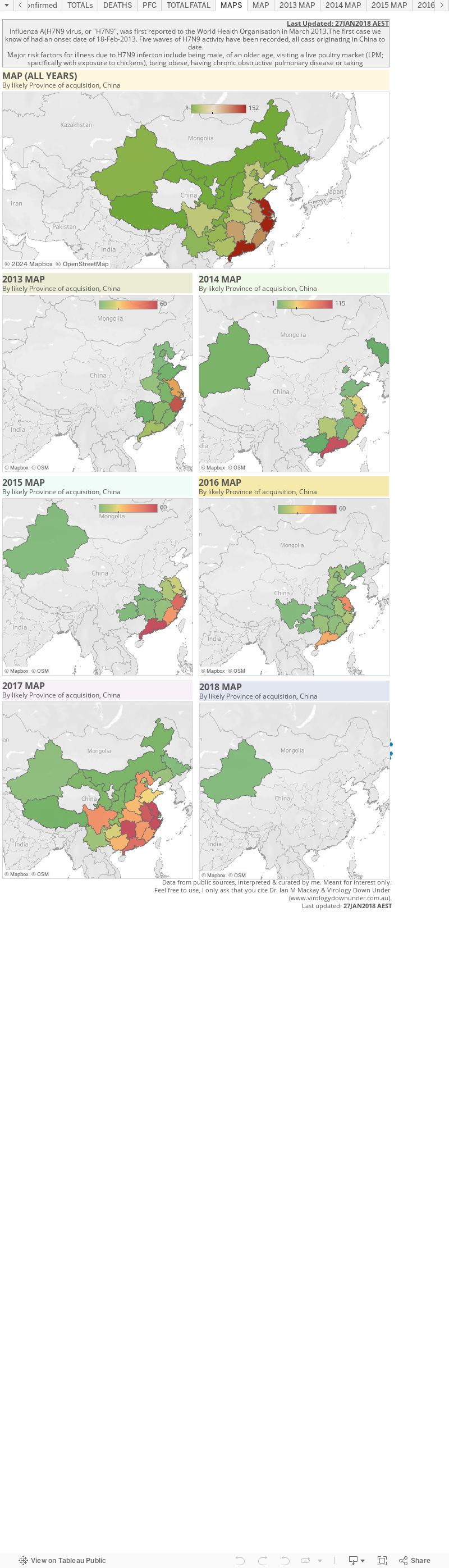
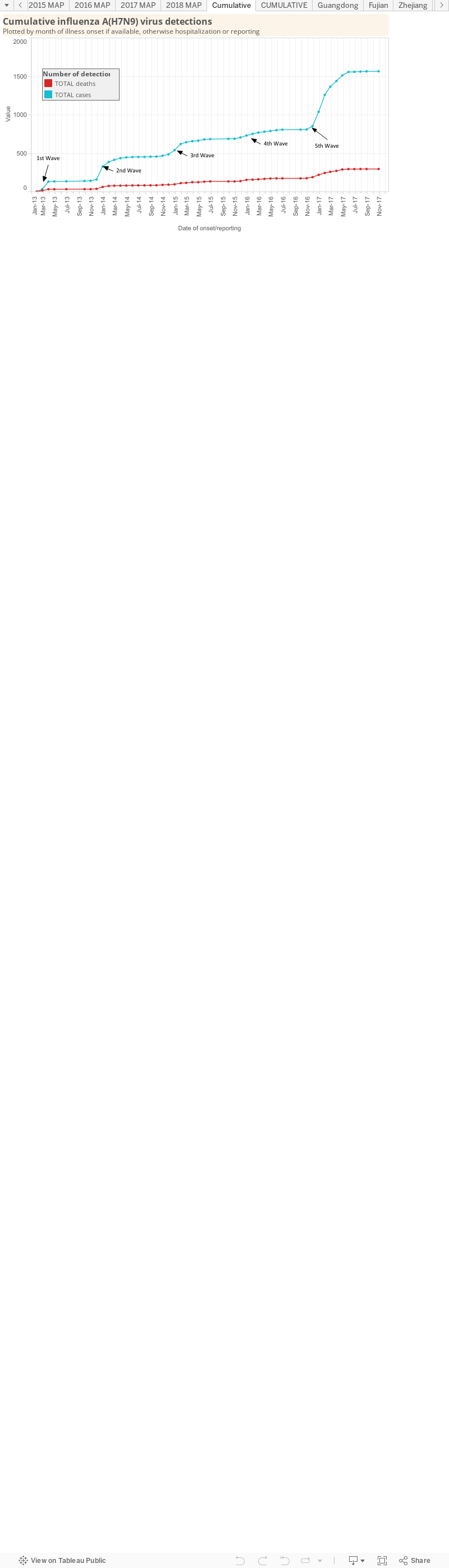
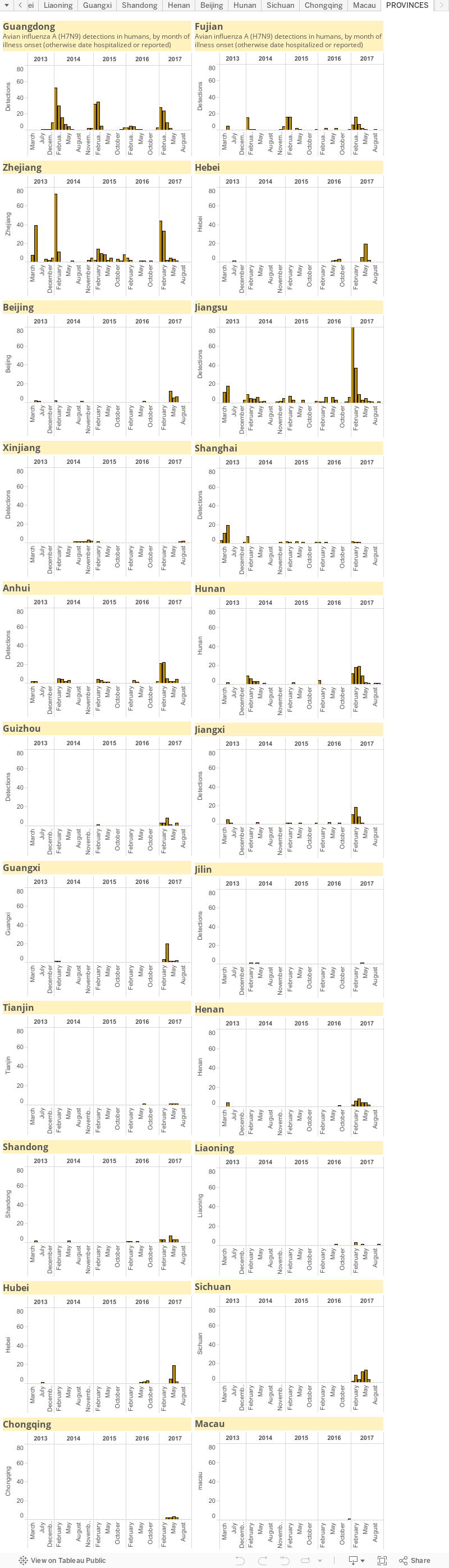

They may take me a little while to get back up-to-date in this new format so stay with me. I will Tweet each update as I do for MERS-CoV and Ebola virus updates.
There is also an accompanying map page which for now is located here.
Reminders:
- The graphs above, as with all on VDU, are made for general interest only. They are also freely available for anyone's use, just cite the page and me please. The data can be downloaded by clicking on the "Download" link at the bottom-right of each dashboard. It may be that I have misinterpreted the language in the reports (sometimes a little tricky to wade through) or miscalculated some totals based on the way data have been presented.
- In any outbreak, epidemic or pandemic caused by a know or emerging pathogen, the numbers presented publicly, and used in these graphs, are expected to represent only a fraction of all the cases that have and are occurring. This is just the nature of the imperfect biological'ness of these events.
- I am only able to plot what is publicly available-you could do this too. No secret associations or back-room deals provide me with these data.
MERS risk reduction and signs of illness to watch for during hajj and umrah...
I love a good infographic and this one ticks a lot of boxes for getting a clear message out about the Middle East respiratory syndrome (MERS) disease and how to avoid catching and spreading the MERS-coronavirus (MERS-CoV).
Thanks World Health Organization.
Of course, I'd be happier if the poster specifically suggested putting more distance between people and potentially infected camels, rather than just avoiding "close contact".
Granted, close contact can include spending time in the close, but not physically connected, "personal space" of a camel. But "close contact" is, in my opinion, one of those infectious disease terms that needs to be made more simple and clear. Like "aerosol" and "airborne", "close contact" gets a little lost when translated to the people who are at actual risk from infection.
Thanks World Health Organization.
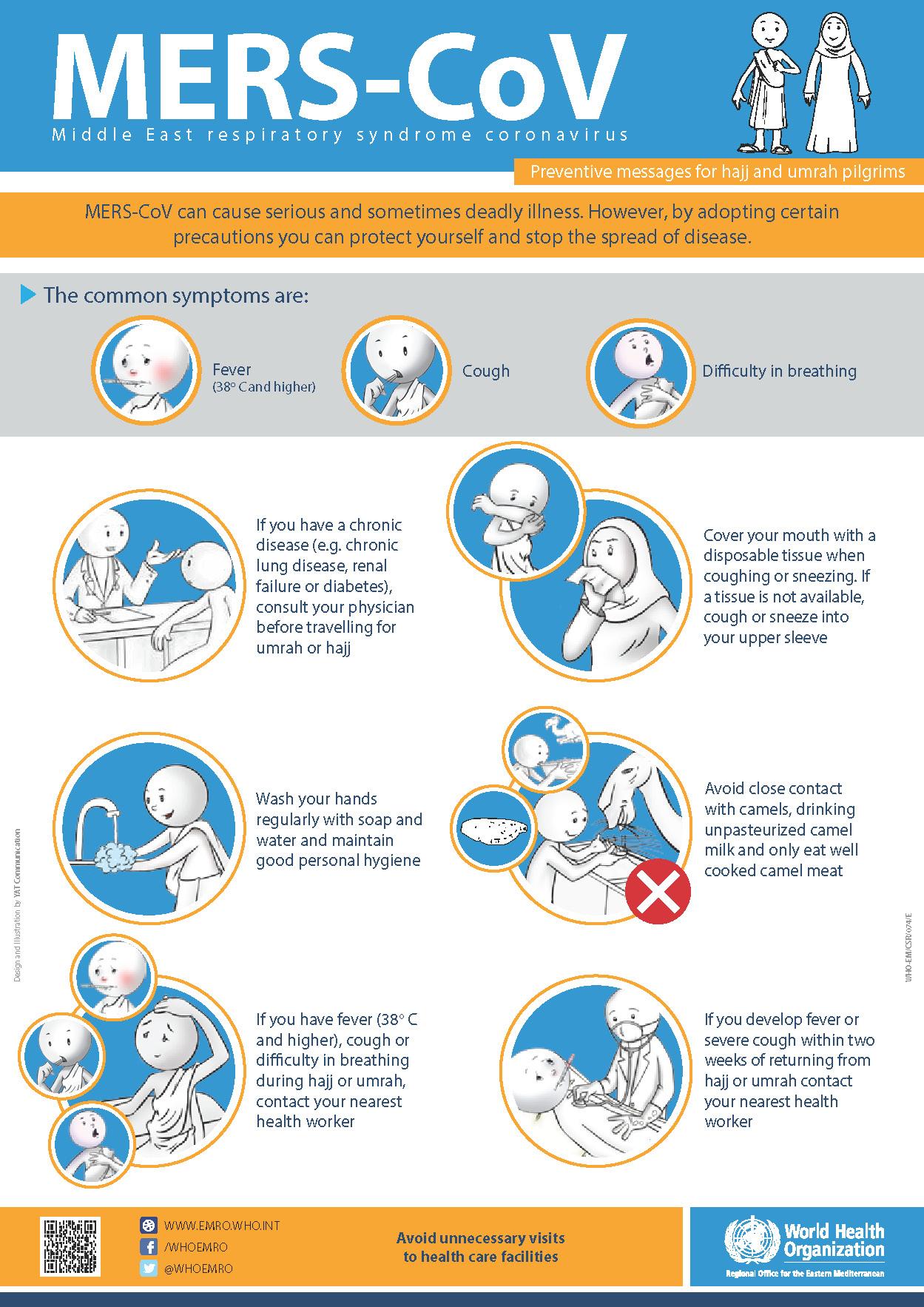 |
| World Health Organization poster describing risk of infection and how to identify when you might have MERS. |
Granted, close contact can include spending time in the close, but not physically connected, "personal space" of a camel. But "close contact" is, in my opinion, one of those infectious disease terms that needs to be made more simple and clear. Like "aerosol" and "airborne", "close contact" gets a little lost when translated to the people who are at actual risk from infection.
Case number changes between Ebola virus disease reports...
This is one of my favourite charts for following the Ebola virus disease outbreak in West Africa because it shows how things are changing from report to report.
It plots the total number of suspected, probable and laboratory-confirmed cases between reports - which is a measure of change over time that is not cumulative.
That's not to say that understanding this chart is easy for everyone...as with everything, what you take away from it may be heavily influenced by your own perspective and your background in reading graphs. I have written something about how to read some of the graphs on my blog here, which may be helpful too.
I've marked up the last three periods between reports to highlight that the time changes differently. You can see this for yourself if you look carefully at the horizontal or "x" axis (the one that has the dates) and look at where each dot lines up with its date. Some are further apart than others.
You can also mouse over the dots on the interactive version of the graph here. That will tell you the dates. THe subtraction is up to you though!
The lines joining the dots here suggest what is happening between the WHO Reports, but the line do not actually use any real collected values...because we don't have them to plot.
Technically, a bar graph would be more accurate, but I find a line graph easier to read at a glance. So do remember - we don't know what is happening between those dots. We're just presuming it.
It plots the total number of suspected, probable and laboratory-confirmed cases between reports - which is a measure of change over time that is not cumulative.
That's not to say that understanding this chart is easy for everyone...as with everything, what you take away from it may be heavily influenced by your own perspective and your background in reading graphs. I have written something about how to read some of the graphs on my blog here, which may be helpful too.
 |
| Uses World Health Organization data up to and including the Situation Report from the 5th-Sept, 2014. Click on chart to enlarge. |
You can also mouse over the dots on the interactive version of the graph here. That will tell you the dates. THe subtraction is up to you though!
The lines joining the dots here suggest what is happening between the WHO Reports, but the line do not actually use any real collected values...because we don't have them to plot.
Technically, a bar graph would be more accurate, but I find a line graph easier to read at a glance. So do remember - we don't know what is happening between those dots. We're just presuming it.
The International Health Regulations (IHR) 2005...
I've heard a lot about the IHR but I have not read the entire document.
This post is just to note which States are considered to be a party to them and what they mean in general terms.
 A blog-friendly reformatted excerpt from the Foreward (highlighting is mine)...
"The purpose and scope of the IHR (2005) are �to prevent, protect against, control and provide a public health response to the international spread of disease in ways that are commensurate with and restricted to public health risks, and which avoid unnecessary interference with international traffic and trade.� The IHR (2005) contain a range of innovations, including:
This was taken from the PDF of the IHR2005 [1]
References...
This post is just to note which States are considered to be a party to them and what they mean in general terms.
"The purpose and scope of the IHR (2005) are �to prevent, protect against, control and provide a public health response to the international spread of disease in ways that are commensurate with and restricted to public health risks, and which avoid unnecessary interference with international traffic and trade.� The IHR (2005) contain a range of innovations, including:
- (a) a scope not limited to any specific disease or manner of transmission, but covering �illness or medical condition, irrespective of origin or source, that presents or could present significant harm to humans�;
- (b) State Party obligations to develop certain minimum core public health capacities;
- (c) obligations on States Parties to notify WHO of events that may constitute a public health emergency of international concern according to defined criteria;
- (d) provisions authorizing WHO to take into consideration unofficial reports of public health events and to obtain verification from States Parties concerning such events;
- (e) procedures for the determination by the Director-General of a �public health emergency of international concern� and issuance of corresponding temporary recommendations, after taking into account the views of an Emergency Committee;
- (f) protection of the human rights of persons and travellers; and
- (g) the establishment of National IHR Focal Points and WHO IHR Contact Points for urgent communications between States Parties and WHO."
This was taken from the PDF of the IHR2005 [1]
References...
- International Health Regulations 2005
Second Edition
http://whqlibdoc.who.int/publications/2008/9789241580410_eng.pdf?ua=1


