Medical News Blog Information

Showing posts with label Guinea. Show all posts

Snapdate: Ebola virus diseaseClick on image to enlarge.

This is one of the data visualizations from my Ebola virus disease (EVD) graphs and tallies page.[1]

A crude extrapolation from current publicly available Ebola virus disease (EVD) confirmed case numbers. To see how I made this please visit here.[2]
The P-value for this linear trend model is <0.0001. 
The standard error = 6.13; R-squared = 0.20.
Click on graph to enlarge.
The first time I posted it I wondered if the end was in sight. That was 6th of May. Over three months later I'm wondering that again - but this time things are a bit different. There has been a steady decline in new cases, also in cases that cannot be tracked back to a known source and in cases found only after they have died of EVD. There have also been the first very promising results from one of the vaccine candidates in Guinea [4] - which has always been a difficult locale for the control of EVD case activity.

So it does look much more likely that the end to EVD in West Africa, or at least an end, is nigh.

By "an end" I mean that we may be close to seeing the cessation of new cases popping up in transmission chains each and every week. We may soon be seeing zero new cases for long periods of time. Those blissful stretches however, may be punctuated by a case arising from parts unknown. They may be tracked to a sexual transmission event, or their origin may never be fully understood. We saw this scenario in Liberia.[3] Virus characterisation indicated that the Ebola virus variant from the young Liberian man was most closely resembled other viruses that had been circulating in Liberia weeks before; the exact source of his infection though, remains unknown.

So we're not at all free and clear of this virus yet - but we are getting very close to shifting into another phase. It's still a long haul with many weeks of anxious waiting and heightened vigilance as well as the need to retain the capacity to cope with a new case or cases. But that said, we do seem to have taken one more step back from the precipice we once stared into as we imagined an Africa fending off a rolling EVD epidemic - and a world at risk as well - however unlikely that should have been. 

Guinea EVD cases rise - but not like they have before...

Edited for clarity 24MAY2015 AEST
The uptick in cases this week from, in particular, Guinea interrupted what was looking promisingly like a continuous downward trend in cases all the way to zero - yes, that was too much to hope for.

However, it's worth keeping some context around this:
  1. Everyone actually working in this space has forewarned us that getting to zero Ebola virus disease (EVD) cases was never going to be an easy journey.
  2. The indicators have consistently shown more reluctance in Guinea to "kick out Ebola" than in Liberia or Sierra Leone. What caused that reluctance, I don't fully understand from my totally uninvolved chair a million  miles away.
    I know right? Surprising.
    Yes-I'd like a specific reason, all wrapped up and presented to me. I'm simplistic and selfish that way. Get that for me will you?? 'Cause I'm totes sure you haven't been trying your collective butts off all this time.
  3. There were fewer new confirmed EVD cases this past week than in the tally for the week before or for other weeks - look back at January 2015, or October 2014 or June 2014, or any of a number of other dates when cases were accruing at a much faster rate than now (graph below).
    That is a silver lining. It's far from ideal, but it's not a return to the worst of it.
All along there has been something different about Guinea and that is now a clear sticking point in the final push to rid its people of Ebola virus|Makona. It never reported, as Sierra Leone did, days with averages of more than 100 cases. 

If we knew what was different about the people, communication, geography, weather, traditions, habits, thinking, ETUs, labs, government...or whatever..then we could perhaps better target the problem(s) and get to zero sooner. 

That will be core business for the next step to occur.

Click on graph to enlarge.

Hans Rosling, a micro-outbreak of Ebola in Liberia and trust issues in Guinea...

As is always the case, Prof Rosling can be seen in front of an audience here, providing a beautifully articulated example of how trust in the Ebola virus disease (EVD) treatment centre/unit plays such a pivotal role in (a) the containment of EVD, even witting a family and its contacts, and (b), the likelihood of survival of EVD patients.

Frame taken from a BBC News video which was being hosted in
an African Geographic Magazine story here. Red dots are survivors,
black dots are deaths
Click on image to enlarge.
In this example, which you can listen to in its entirety here, as time went on, trust grew and this fewer transmission occurred and more f those infected, survived.

This would seem to be a great example of what is lacking in Guinea - trust - a lack of trust that others are be able to stop the spread of virus and to save the lives of those infected. Thus people are not presenting for help at all and still being managed in the community - possibly infecting others - or else they are not presenting early enough, before the disease has done too much damage to the person. Trust and communication is increasingly seen as being as important to the successful reduction of cases in Liberia and Sierra Leone as the building of treatment centres - the two must co-occur.

Trust comes from understanding, and that is heavily influenced by communication. Communication of accurate information, of clear and digestible information. Communication to the right people using the moist effective channels is also essential.

It still feels like communication, or at least accurate and successful communication accessing the key important and influential people, may be the weakest part of the response in Guinea. It seems to have been better implemented in Liberia and Sierra Leone - or maybe just better received. Is it a groundwork thing? Difference in the way science is presented in different countries? I know far too little to guess further.

There continue to be more security incidents and other types of refusal to cooperate in Guinea compared to the other two countries afflicted with the Makona variant of Ebola virus. These incidents are a marker of a community that does not believe or trust those claiming to be here to help. And that's a problem for stopping the constant rivulet of EVD cases in Guinea; a rivulet that never became the river of hundreds of EVD cases per week seen in Liberia or Sierra Leone, but was still a flow that seeded infection across the region and the world. A case anywhere is a threat everywhere, to paraphrase others.


Location of laboratories in Guinea, Liberia, and Sierra Leone
 Location of laboratories in Guinea,
Liberia, and Sierra Leone.
From WHO SitRep 01APR2015.
But there may be other issues to consider and question. 

There are fewer treatment centres and laboratories in Guinea than in Liberia or Sierra Leone - strange given that Guinea is larger and that it still has a geographically widespread distribution of cases. 

While it has lately been noted that new cases in Guinea could be adding to the tally more simply because of success in reaching more remote areas, this seems only to add support to the need for better communication and to provide more of a presence in these remote areas. Hopefully, now that this happening through the efforts of the US CDC and others, we will soon see the pay off as a reduction of EVD cases. But the rainy season is near and travel will be made into a muddy mess by that. Time has never been on the side of those trying to stop this epidemic.

Ebola virus disease: obliterating a variant and stalled case decline...

We've seen the words vigilant and vigilance used widely in recent weeks, ever since we entered a "new phase" of the Ebola virus disease (EVD) battle/fight/war.

The reason for vigilance in all things to do with this campaign has become obvious as the weeks have passed; the reduction in cases has stalled.

I've very crudely drawn in some trends below. Whether you agree with them or not, it is clear that since the fast fall in confirmed cases reported between November-January, it seems to have become very difficult to stamp out the last fires of EVD. 

The phases.
(Very) rough trends in the number of EVD cases over time.
Date from World Health Organization situation reports (SitReps)
and situation summaries (SitSumms).
Click on image to enlarge.
Liberia has come the closest to completing this goal of obliterating the Makona variant of the Zaire ebolavirus (EBOV|Makona) with just 3-9 confirmed cases between World Health Organization (WHO) Situation Report (SitReps) during any of the past 7 weeks. It seems that recent cases can be traced to known transmission chains too and that means no surprise outbreaks. 

However, the people of Guinea and Sierra Leone have not quite got the messages that those in Liberia seem to have embraced (without touching!) so admirably. 

In the last WHO SitRep [1] it was noted that 39-45 unsafe burials (probably not all that occurred) occurred in a week and >40 EVD cases were identified post-mortem. This last observation means exposure of the community to virus, not getting help and treatment for ill people, and unnecessarily requiring contact tracers to play catch-up. Bad for the infected people their friends and families and the response to EVD. It doesn't have to be that way.

This paints a picture of  problems with Ebola outreach and education, communication and cooperation. Those things will keep the latest EVD "phase" chugging along. 

We do need to destroy this variant of Ebola virus by isolating it in the last human cases in each of Guinea, Liberia and Sierra Leone. Once those people recover, or regrettably die, EBOV|Makona will be gone, except for what's in lab freezers around the world and in sequence databases thanks to the efforts of a few expert research teams. Once gone from "the wild", the evolutionary clock resets back to the EBOV variants in the animals of the forest.

EBOV|Makona knows too much; it has seen too much; it has learned too much, to be allowed to "live". It has been passed through humans too many times and while there is a vanishingly small chance it will sprout wings, it is still a virus that spreads relatively easily under the right conditions and circumstances. Explosive loss of 8 litres of fluids a day provides many ways to pass along this blood/gastro virus. EBOV|Makona may also have adapted, and continues to adapt, in other ways that would mean its stay among humans becomes lengthy and its dissemination more widespread.

More bad news from an unsuccessful obliteration of EBOV|Makon-smouldering EVD in Sierra Leone and Guinea may release new case embers that drift across borders and set new fires in other countries. We don't need hundreds of cases a day for that to happen.[3] We know cases also fly with the aid of planes (not wings). And the cycle could renew. I don't think we'll see such big outbreaks of EBOV|Makona again, for reasons I laid out here, but chasing new fires is more work than stamping out the remnants of old ones. Vigilance and action. 

I think vaccines still have an important role to play in the final phase of this epidemic, even if only 3 new healthcare worker cases were noted in the past SitRep week. Vaccine given to more than just healthcare workers could be useful here, if others will accept the needle.

  • Ebola outreach
  • Education
  • Communication
  • Cooperation

Oh, and vigilance.

References..

  1. http://apps.who.int/ebola/en/ebola-situation-report/situation-reports/ebola-situation-report-18-february-2015
  2. http://newsmedicalnet.blogspot.com.au/2014/08/behind-naming-of-ebola-virusesnot-yet.html
  3. http://newsmedicalnet.blogspot.com.au/2015/02/cases-of-ebola-virus-infection-can-be.html

Cases of Ebola virus infection can be exported any old time...

I'm adding my two cents on the issues around remaining vigilant about Ebola virus disease (EVD) cases. 

There are far fewer weekly EVD cases than there used to be but it remains absolutely essential to "kill off" this particular highly-passaged Zaire ebolavirus variant. In other words, push new cases down to zero per day in all three countries, keep it there for 42-days, and thus declare all three nations free of Ebola virus transmission.

Apart from the obvious desire to see these countries rid of this horrible and deadly pestilence, another, less likely thing to consider is that more spillovers to other countries can still happen at any time. And apart from the costs, the reaction from a certain country to its first imported case, just does not bear living through again.

Whether human cases were just kicking off, or after they began accruing at an exponential rate of hundreds per day, the hotspot countries have been the source of export of a case to another country. 

That said, in my opinion we are in a much better global position today than we were six to twelve months ago. We can much more effectively engage and thwart the spread of infection from an EVD case that appears on our doorstep because we now know Ebola virus is out there and can hop on a plane, and many countries and regions within countries have done something to prepare for that rare arrival. Some countries were already in a better position than others, simply because they have (relatively) huge healthcare 
processes in place and are now aware of how to help, and how quickly to respond, should a foreign neighbour acquire a case. 

None of that is to say zero spread in other countries is a given in the near future; humans being humans, accidents and mistakes will always happen. But we are just very unlikely to see EVD spread in a new country to the extent that we saw last year. Hopefully I'm not being too naive on that call.

If we look at the images below, it's plain to see that EVD cases were exported from these countries both early on and late in the outbreaks and later epidemic. Guinea being slightly more of a culprit than the other two countries of intense and widespread transmission (Liberia and Sierra Leone).

Guinea's Ebola virus disease experience. The approximate time at which 
another country receives a person infected by Ebola virus, most likely acquired
from within Liberia, are indicated by an arrow.
Click on graph to enlarge.
Sierra Leone's Ebola virus disease experience. The approximate time at which 
another country receives a person infected by Ebola virus, most likely acquired
from within Liberia, are indicated by an arrow.
Click on graph to enlarge.


Liberia's Ebola virus disease experience. The approximate time at which
another country receives a person infected by Ebola virus, most likely acquired
from within Liberia, are indicated by an arrow.
Click on graph to enlarge.


The filovirus tree has been shooting wildly

While there are not a lot of new branches, there are many, many new leaves on this growing tree. That is overwhelmingly due to the fantastic work of Dr Pardis Sabeti, and Stephen Gire at the Sabeti lab, Harvard University, and their many collaborators. 

It sounds like even more sequences will be coming out in the future. This group is the face of the molecular epidemiology of history's largest Ebola virus disease epidemic in Sierra Leone. If a team of scientists could be said to embody an aspect of an epidemic, it has been these guys and their virus characterization. Hugely impressive stuff.

I only wish we could see more Guinean and Liberian sequences - they are both hugely under-represented in this tree of complete genomes downloaded from GenBank a week or so ago.

Click on tree to enlarge even further.
Coloured boxes surround those sequences generated during the
2014 EVD epidemic. Orange boxes point out the nearest neighbours
and the year from which the sample that was sequenced, originated.
The West African Ebola virus Makona variant has been
traced back to sharing an ancestor in common with a 2007
variant in 2004.

References
  1. Genomic surveillance elucidates Ebola virus origin and transmission during the 2014 outbreak. Gire SK, Goba A, Andersen KG, Sealfon RS, Park DJ, Kanneh L, Jalloh S, Momoh M, Fullah M, Dudas G, Wohl S, Moses LM, Yozwiak NL, Winnicki S, Matranga CB, Malboeuf CM, Qu J, Gladden AD, Schaffner SF, Yang X, Jiang PP, Nekoui M, Colubri A, Coomber MR, Fonnie M, Moigboi A, Gbakie M, Kamara FK, Tucker V, Konuwa E, Saffa S, Sellu J, Jalloh AA, Kovoma A, Koninga J, Mustapha I, Kargbo K, Foday M, Yillah M, Kanneh F, Robert W, Massally JL, Chapman SB, Bochicchio J, Murphy C, Nusbaum C, Young S, Birren BW, Grant DS, Scheiffelin JS, Lander ES, Happi C, Gevao SM, Gnirke A, Rambaut A, Garry RF, Khan SH, Sabeti PC.
    Science. 2014 Sep 12;345(6202):1369-72. doi: 10.1126/science.1259657. Epub 2014 Aug 28.

Bats in a tree...

Meliandou and the burnt tree that
once housed a bat colony (from Fig 3, [1]).
While not snakes on a plane, I'm fairly sure the level of swearing has at times been at least as bad among those suffering from and dealing with the possible fall-out from these bats - if in fact they were the source for the biggest Ebola virus disease (EVD) epidemic on record.

A recent animal counting, trapping and testing study in Guinea included sampling in and around the village of Meliandou.[1] This village is, to the best of our knowledge, the site of the first animal-to-human, or zoonotic, transmission of the Ebola virus variant called Makona.[2]

The study team, made up of researchers affiliated with Germany, Sweden, Core d'Ivoire and Canada, did not find any decline in numbers of usually susceptible larger mammals around the index village; a sign during other outbreaks, of active local ebolavirus "activity". The team also found that primate hunting was not a big thing in this region, which is rather devoid of these and other Ebola virus mammalian host animals (including few of the Duiker, or forest antelope). Fruit bat hunting was common though.

The team captured 169 bats representing at least 13 different species and 6 families. But in the house of the 2-year old boy considered the epidemic's index case, fruits bats were not eaten and no bat hunters resided there. No Ebola virus RNA was detected in any bats and antibody screening results from bat blood were inconclusive. 

These findings led the authors to study Meliandou, resulting in an hypothesis that a nearby hollow tree that once housed a large colony of free-tailed bats [locally described as lolibelo - small and smelly bats - otherwise known to belong to the species of insectivorous bat, Mops condylurus of the family Molossidea; [3], may have been the source of  infection. Why only one child was infected this way when the tree was a site of frequent play by many children is not known. The tree was burned out in March 2014 which caused many bat deaths, some of which were collected for consumption. Sequencing of a PCR-amplified mitochondrial DNA segment found that in 5 of 11 ash and soil samples from around the tree, contained traces of Mops condylurus genetic material. So that species was at least there.

So, this is all quite far from a conclusive link between the 2-year old boy and these bats. But it does read as though every avenue has been tested in this village, perhaps apart from better animal antibody testing (serology), and some serology on the blood of those villagers who remain alive in Meliandou. 

Serology testing is going to be very important for answering many questions around EVD and this outbreak and epidemic. 

Of course this will raise the usual question of whether we cull all bats to prevent this from ever happening again. Don't be ignorant! Bats have very important roles in pollinating and thus in keeping our ecosystem going. Should we kill all bees because they sting us? I'm pretty sure I've been stung by a bee more times than I've had Ebola/Hendra/SARS/Nipah/MERS/Lyssavirus or any other bat-hosted virus infection. Killing off everything to prevent a very rare zoonotic event when better knowledge can resolve the problem is just a typically short-sighted and knee-jerk human reaction (not a fan-can you guess?).

One question that does still remain, and one that is of extreme interest to me, is how often mild disease results from an Ebola virus infection? Good, robust serology methods to the rescue.


References...

  1. Investigating the zoonotic origin of the West African Ebola epidemic. EMBO Molecular Medicine(2014). http://embomolmed.embopress.org/content/embomm/early/2014/12/29/emmm.201404792.full.pdf
  2. Nomenclature- and Database-Compatible Names for the Two Ebola Virus Variants that Emerged in Guinea and the Democratic Republic of the Congo in 2014. Viruses 2014, 6(11), 4760-4799.
    http://www.mdpi.com/1999-4915/6/11/4760
  3. Mops condylurus via the IUCN Red List of threatened species (listed as of least concern)
    http://www.iucnredlist.org/details/full/13838/0


Ebola double vision is clearing...

A quick follow up from my post in October entitled "Ebola double vision".

I've adjusted that graph and it adds another view of how the Ebola virus disease (EVD) epidemic is, in terms of overall case numbers, showing consistent signs of slowing. 

The time it takes for the case total to double (the doubling time) has stretched out from doubling every month or so, to taking about a month and a half to double.

But far from breathing a sigh of relief, the numbers in Guinea, which have never appeared consistently under control, and the still very high numbers in Sierra Leone, highlight that the epidemic is not yet leashed and the need remains for continued vigilance and more of the same hard and risky work being done by those in and around the region. In Liberia, the country that supplied the highest proportion of EVD cases leading up right up until this month, case numbers were down to just 75 in the previous week (reporting week #38). For context, that's still higher than the total of about 15 past outbreaks since 1976. And of course, this entire epidemic started from just 1 case. 100% of infected people need to be isolated and looked after (hydrated given pain relief and antibiotics among other things), 100% of burials need to be safe, and 100% of contacts need to be traced. That represents a huge task ahead of the stalwart healthcare, aid and many other support workers who have been facing Ebola virus every day for months and months.

The time between total case doublings.
For 4 doublings in a row it took a month or so, but the most
recent doubling took 44-days. 

Click on image to enlarge.

The fifth I give you...[UPDATED]

Senegal. 
According to it's Minister of Health, Awa Marie Coll Seck[1,2], a case of Ebola virus disease (EVD) has been imported from Guinea and it is confirmed by testing at the World Health Organization's collaboration Centre, the Pasteur Institute in Dakar.


Interesting that this occurred one week after Senegal closed its borders (again) with Guinea.[3,4] The infected 21-year old Guinean student travelled on 21-August to Dakar. On the 23rd he presented to a hospital but did not admit to being in contact with known EVD cases; Guinea issued an alert that a person with EVD contact has escaped surveillance 27-Aug; Senegal closed its borders around 22-August.[5,6,7,8].
[WHO Disease Outbreak News places his movements ahead of the closure of the border, arriving in Senegal 20-Aug [8]]

These borders are leaky and so the effect of "closure" essentially hinders aid, trade and economy (all very important to the region, especially right now) but very clearly does may not stop the spread of human hosts-as we have seen here


Humans are the variable in outbreaks. 


They behave differently each time. 


They respond differently each time. 


This is why no two outbreaks are identical. 


It's why you're a mug to assume this outbreak will be like the last outbreak.


While it looks like this is now a case study in why closing a border is ineffective, I maintain a position that border closures can't contain infectious disease. And please, do not point me to "temperature measurement" as a way to ensure capture of infected individuals. You could easily be harbouring an infection that does not yet express the symptom of fever. 

Click on image to enlarge. 
Graphic lifted from a great CNN video narrated by
Dr Sanjay Gupta. The video describes an example of
contact tracing and its importance to the fight
to contain EVD.[2] 

The contact tracing starts in Senegal now. A 42-day clock starts for the country and a signs and symptoms watch continues on all this case's contacts for 21-days.

References...
  1. http://in.reuters.com/article/2014/08/29/us-health-ebola-senegal-idINKBN0GT1CD20140829?feedType=RSS&feedName=health&utm_source=dlvr.it&utm_medium=twitter&dlvrit=309303
  2. http://edition.cnn.com/2014/08/29/health/ebola-outbreak-senegal/
  3. http://www.washingtonpost.com/news/world/wp/2014/08/29/the-ebola-virus-has-spread-to-senegal-as-the-deadliest-outbreak-in-history-gets-worse/
  4. http://www.washingtonpost.com/world/africa/alarm-grows-as-ebola-outbreak-spurs-more-flight-cancellations-border-closures/2014/08/25/87e6d020-2c66-11e4-994d-202962a9150c_story.html
  5. http://www.bbc.com/news/world-africa-28893835
  6. http://fox59.com/2014/08/22/senegal-closes-its-borders-with-guinea-over-ebola-fears/
  7. https://www.internationalsos.com/ebola/index.cfm?content_id=434&language_id=ENG


Ebola West Africa numbers in context...[AMENDED]

A quick glance at how the suspect, probable and laboratory confirmed (susp/prob/conf) cases of Ebola virus disease (EVD) stack up in the 3 countries with local spread of Zaire ebolavirus.

Please note that I have separated Guinea-2014, Sierra Leone-2014 and Liberia 2014 only to highlight that each country in the single "West Africa" outbreak (involving a single viral variant as far as we know) has greater case numbers than those found in many of the earlier outbreaks.

I have not yet listed the case imported to Nigeria here.

Click on chart to enlarge.

West African Ebola virus disease (EVD) outbreak flares up in late May and in early June...[UPDATED]

Data are based on WHO DONs. Lines use the numbers on the vertical  axis on the left, bars use the right hand axis. The percentages are the proportion of fatal cases at the time point indicated.
Click on chart to enlarge.
The chart tells a pretty grim story of an outbreak that has flared up, after what looked like some weeks of things settling down. I'd said I would stop charting this outbreak back at 5-May, unless anything major happened. Well it did. In late May in Guinea and then in early June in Sierra Leone.

The causes seem to be the heartbreaking stories of family members sequestering ill loved ones or removing them from isolation wards, and in so doing, getting infected themselves, and so spreading infection.


Click on image to enlarge.
Maps purchased from maptorian and adapted by VDU
The adjacent map has been updated to help communicate an idea of the number of cases in each country.

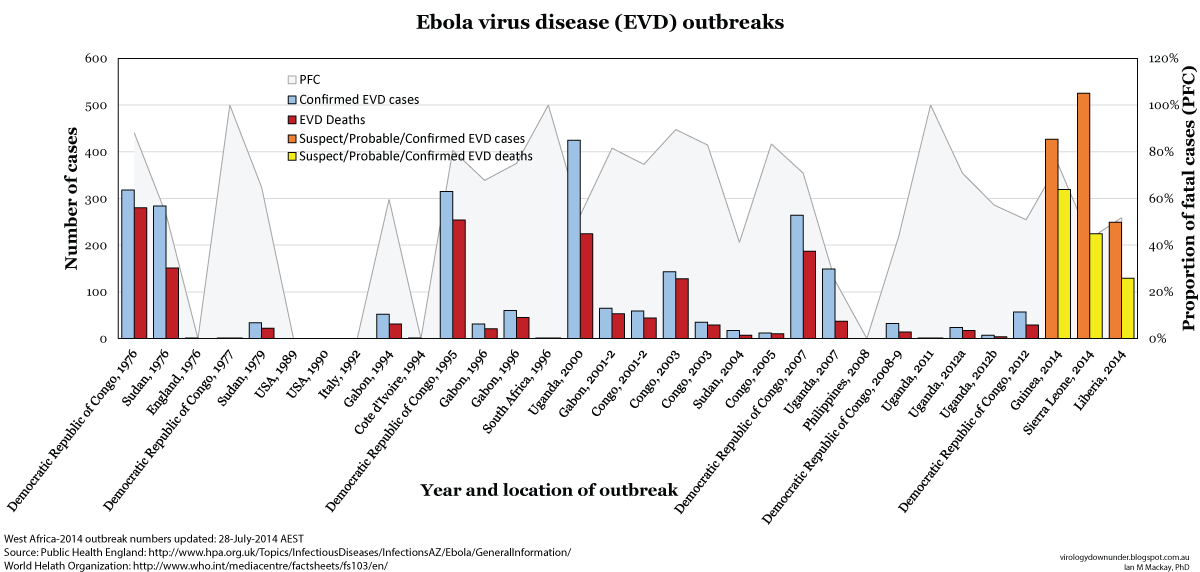
The number of cases and deaths, not all of which are laboratory confirmed as being ebolavirus disease (EVD), are now the highest of any known outbreak of EVD (see the chart below). A grisly fact and one that doesn't change anything. But one I note nonetheless. Also worthy of note is that throughout this outbreak, the proportion of fatal cases (PFC; check the disclaimer in the legend below) has not reached the heights of the Zaire outbreak of 1976, or the Democratic Republic of Congo (DRC) outbreak of 1995, or that in the Republic of Congo (RC) during 2002-3, and others. So that's a small silver lining.
A guide to confirmed EVD cases and those who died from EVD over time.
The data for the non-West Africa-2014 outbreaks, sourced from Public Health England website [1], are defined as "confirmed". Not all of the Wet Africa-2014-related clinical cases or deaths have been laboratory confirmed so these bars are probably a little high (highlighted in the key). Note that looking at proportions alone can be confusing. For example, if 1 of 1 cases is fatal, that's a PFC of 100% but it may not reflect the situation accurately. So please interpret the grey mountains alongside the read and blue bars to get the complete picture. DRC-Democratic Republic of Congo; RC-Republic of Congo
Click on chart to enlarge.

I'll try and keep the charts up-to-date as this outbreak continues to burn. 


References...
  1. http://www.who.int/csr/don/2014_06_18_ebola/en/
  2. http://www.hpa.org.uk/Topics/InfectiousDiseases/InfectionsAZ/Ebola/GeneralInformation/

Ebola virus disease (EVD) West Africa update for 02-May, WHO-AFRO update...

Click on image to enlarge.
Thankfully the latest World Health Organisation update includes figures for Liberia. The last West Africa update did not, so I didn't post a chart.

Summary..

Total suspected/probable/confirmed cases: 244
Total suspected/probable/confirmed deaths: 162 (66.4%)
Total lab confirmations: 133 (54.5% of 227)

These figures are very important for two reasons...


Firstly they show a drop in suspect/probable cases after data scrubbing by the Liberian Ministry of Health and Social Welfare. This reinforces that the outbreak is being well controlled.;The date of isolation of the most recent confirmed cases is 30-April from Conakry and Guekedou (Guinea).


Secondly there has been a concomitant rise in the proportion of fatal cases of EVD due toZaire ebolavirus (see the percentages above the orange line in the chart). This is not because the numbers have jumped, it's because the denominator has shrunk for the relevant calculation:

No. EVD fatalities/No. total susp/prob/conf cases.
We've known this rise in proportion was coming because it was highly likely that case numbers would change as the dust settles and the susp/prob EVD patient numbers get discarded because they are found to be infected by something else; clinically similar disease, but not because of infection with Zaire ebolavirus. I've written about it previously if you'd like some background.

With the use of more antibody testing, the numbers will continue to change, as they always do in outbreaks.

This will be my last update on this outbreak linked to the WHO-AFRO announcements unless anything major happens.

A reminder - the chart above is made for general interest. It may be that I have misinterpreted the language in the report (sometimes a little tricky to wade through these reports) but the trends should still be informative even if a number or data point is out of place.


Sources...

  1. http://www.who.int/csr/don/don_updates/en/
  2. http://reliefweb.int/report/liberia/unicef-liberia-ebola-virus-disease-sitrep-20-2-may-2014
  3. http://newsmedicalnet.blogspot.com.au/2014/04/ebola-virus-disease-and-lab-testing.html

Ebola update: some additional numbers for Guinea from 17-April, WHO-AFRO update

These numbers slightly change the numbers I last posted from 18-April. 

A small uptick in deaths and lab confirmations and a change to the most recent illness onset which is now 17-Apr. The clock is still waiting to start on the 2-incubation periods required, without new cases, before the region will be declared free of Zaire ebolavirus.

18 healthcare workers are lab confirmed with Ebola virus disease, 6 are probables (24 in total) of which 15 have died (11 are lab confirmed).

Source..

  1. http://www.afro.who.int/en/clusters-a-programmes/dpc/epidemic-a-pandemic-alert-and-response/outbreak-news/4104-ebola-virus-disease-west-africa-19-april-2014.html

Update on Ebola virus disease (EVD) case accumulation chart with new WHO African Regional Office data...[UPDATED].

UPDATED with 2 Sierra Leone probable deaths.
Click on image to enlarge
Not much of a change to be seen with the data from WHO following that from UNICEF yesterday.

No Species Zaire ebolavirus cases have been confirmed in Sierra Leone nor any in Mali (6 suspected cases however; 2 other samples tested negative) or elsewhere. 


Click on image to enlarge.
Maps purchased from maptorian and adapted by VDU
EVD cases are still restricted to Guinea and Liberia and all cases remain linked to infections in Guinea. 

As I understood the recent WHO virtual press conference, because the index case was known, the transmission chain of contacts is mostly already under observation. While Ebola virus disease (EVD) has a grisly progression, once experts are in place to help track, test and educate, with the help of local and international governments, the spread of EVD can be contained. 

But it will still take time to be sure the outbreak has been contained; 2 full incubation periods worth of time.[3] As the maximum incubation period is 21-days (2-21 days being the full range), you start to see why the WHO speaks in terms of "months" [2,3] before the outbreak can be considered over. And that clock starts sometime around the end of the last case's disease onset I'd guess.
�We fully expect to be engaged in this outbreak for another two, three, four months�
Dr Kenji Fukuda, WHO[3]

So as the outbreak comes under control, as seems to be the case, we should pay attention to when new cases stop appearing. Then it becomes about waiting until everyone can safely say there are no new cases.


The most recent case had an onset of illness on 08-April-2014.

Sources...
  1. WHO-AFRO Ebola virus disease, West Africa (Situation as of 10 April 2014)http://www.afro.who.int/en/clusters-a-programmes/dpc/epidemic-a-pandemic-alert-and-response/outbreak-news/4093-ebola-virus-disease-west-africa-10-april-2014.html
  2. Ebola expected to terrorise West Africa for �months��WHO - Euronewshttp://www.euronews.com/2014/04/09/ebola-expected-to-terrorise-west-africa-for-months-who/
  3. Officials Say Ebola Outbreak Could Last Months - Timehttp://time.com/54299/officials-say-ebola-outbreak-could-last-months/

Update on Ebola virus disease (EVD) case accumulation chart with new UNICEF data...

Click on chart to enlarge.
Thanks to a UNICEF Australia's update I've added a few cases to the produce a new chart; I expect we'll see some WHO numbers soon, and I'll update if there are any differences.

Check the version number in the bottom left hand corner - it defines whether it is the only chart of the day from VDU, or one of several.

The new version shows the proportion of fatal cases holding fairly steady at ~60% of all cases. This calculation includes those cases that also that look like EVD but have not been laboratory confirmed as EVD, as well as those that have been confirmed.

As I went into yesterday, these are very volatile numbers, so regard this chart for its trends only.

Sources...

  1. UNICEF Australia's PDF of numbers from ~3-hours ago
    http://ow.ly/d/24bM

Recorded Ebola virus disease (EVD) outbreaks throughout time...

A guide of case total confirmed cases and those who died from 
Ebola virus over time.
Sourced from Public Health England website [1]:
Click on chart to enlarge.
A quick chart to highlight the larger and smaller outbreaks and importations of EVD and Ebola viruses, respectively, that have been recorded worldwide since 1976.

I've added in the current tally of 167 suspected/probable/confirmed cases for the 2014 Guinea outbreak but this number is inflated compared to the other entries on the chart because those are reportedly based on confirmed cases; only around a third (59) of Ebola cases in the current outbreak have been confirmed to date.

Thanks to @Pawixx for steering me to the PHE page.

Please note that these numbers differ a little from the World Health Organization's Table [2]. Solving that discrepancy is a problem for another day.

Source...

  1. http://www.hpa.org.uk/Topics/InfectiousDiseases/InfectionsAZ/Ebola/GeneralInformation/
  2. http://www.who.int/mediacentre/factsheets/fs103/en/

Ebola virus disease (EVD) outbreak in West Africa: chart of cases to 04-Apr

Data are based on WHO DONs, French Embassy Conakry
 figures and WHO Tweeted information.
Click on image to enlarge.
The Ebola virus disease (EVD) case chart adjacent is based on the latest Disease Outbreak News (DON) from the World Health Organization (WHO) posted at the Global Alert and Response (GAR) site [1] and at the African Regional Office (WHO-AFRO) [2].

There are roughly 163 suspected, probable and laboratory-confirmed cases including 95 deaths (58.3% proportion of fatal cases) for which only 56 (34.4%) have been confirmed by laboratory tetsing.

I'm also maintaining a curated Storify timeline here which lists some key Tweets and links on this outbreak. 

A few things to note about the chart and the outbreak:

  1. The susp/prob/conf (shorthand I use on Twitter) numbers change - the 1st 2 numbers can go down as well as up as cases that cannot be laboratory confirmed as due to EVD are discarded from the tally. Other diseases with similar presenting signs and symptoms occur in the West African region so this is not at all unexpected. We see the same thing for other viral outbreaks, like influenzavirus, all the time.
  2. The WHO does not posted "grand totals". The DONs present totals for each region (currently Guinea, Sierra Leone and Liberia), which I've tallied up above.
  3. Its worth remembering that this outbreak was happening back in early Feb, so there was a passage of time during which people were exposed and did not know precisely what was causing illness. This creates a lag between the time of the first announcement and when the situation can come under some semblance of control. Control requires that the various teams arrive, are coordinated and set up in the area to test, trace, educate and reduce virus spread. Each time a new region has a case, the same flurry of activity may well ensue, so case numbers will seem suddenly spike - but as we can see, they do not continue to rise exponentially, or even at all in some regions. This is thanks to the expert teams including those from the WHO, jurisdictional Ministries of Health, UNICEF, the Red Cross and M�decins Sans Fronti�res (apologies to all those I've missed - you are all doing a fantastic job under extreme conditions and you are extremely  appreciated)
  4. Posts on this outbreak do not occur daily - I presume, as for avian influenza virus outbreaks etc, posting of numbers is based on when those data are collated, summarized and provided to the WHO.
  5. There are reports of 4 haemorrhagic fever cases from Mali (some of whom had traveled to Guinea; a suspect case is also reported in Ghana coming from Mali although there are questions about where from precisely) that are not, at writing, laboratory confirmed.[5] Samples are being sent to the United States for confirmation. Why not to the Institute Pasteur in Dakar, or Guinea field labs I do not know; presumably because of pre-existing arrangements?
  6. Liberia has 1 suspected EVD case in a hunter who seems to have acquired his infection locally (no contact with know EVD cases or with Guinea). This suggests to me that the vector is actively infected in the region. Perhaps this is a migratory season (seasonal change, following food sources, breeding) for this Ebola virus's animal hosts, previously found to be fruit bats, chimpanzees, gorillas, monkeys, forest antelope and porcupines in particular, eaten as "bushmeat". I admit to knowing nothing about animal movement in the region however.
  7. While EVD is "highly contagious", close contact with an infected animal host or an infected human cases' bodily fluids (blood, organs, mucous, urine, vomit, faeces and semen for up to 7-weeks post-infection) is required to acquire an infection. Generally the virus doesn't spread across distance as well or quickly as for example, influenzavirus does. This is largely because the virus is not spread the same way:
    • Sneezing and coughing is not considered a method of EVD transmission
    • Once the patient is symptomatic, they do not move around as much; from that point, spread of the virus to new people requires those people to come to the ill person. This is why healthcare workers, especially early on in an uncharacterized outbreak, and close family members caring for an ill or deceased relative number highly in new cases of EVD. 
    • Basic levels of infection prevention and control can interrupt transmission. These include good hand hygiene, use of personal protective equipment and prevention of needle stick injuries.
  8. Airborne transmission is not considered a risk factor for acquiring EVD; this is not the movie Outbreak where the fictional "Motaba" virus mutates into an airborne ebolavirus-like pathogen. Also unlike the movies, bleeding from orifices and the skin can occur, but much more rarely than the movies lead us to believe
  9. EVD signs and symptoms start suddenly 2-21-days (8-10 more common[3]) after virus acquisition and usually include fever, headache, joint and muscle aches, weakness, diarrhoea, vomiting, stomach pain, loss of appetite and may also include rash, sore throat, red eyes, hiccups, cough, chest pain, breathing and swallowing difficulties and sometimes internal and external bleeding. Not everyone dies from infection however the higher end of the mortality spectrum for the species Zaire ebolavirus can reach 90% in outbreaks with >1 case identified.[4]
  10. A person with no signs or symptoms of disease is not considered contagious.
  11. While a border closure (Senegal) and some flight restrictions have come into play, these may only serve to disadvantage the outbreak region rather than provide any true risk mitigation. Closing a border may hinder the flow of food, medical supplies and daily goods as well as interrupting the normal commerce of the country, impacting both economically and directly on the lives of the overwhelming majority of people who are not infected. I'm not aware of any evidence that shows closing a border has any reducing effect on an Ebola outbreak. Closures are a knee-jerk reaction caused by the fear of a scary disease.
And that last point is an important one. Ebola evokes some scary images outside of Africa. And so it's important for us not to run around like a decapitated Gallus gallus domesticus. We need to rein in the excessive over-reaction. As Maryn McKenna aptly noted recently over on Superbug, many things are killing more people, more regularly every day both in and outside of Africa. Having said that, I can totally understand the reactions of those living inside of West Africa just now. Among them, those who both have or have never looked this pathogen in its filovirusy-eye and stared down the barrel of its disease before. 

Viruses can be pretty scary things indeed.

References..
  1. WHO Global Alert and Response (GAR) Disease Outbreak News (DONs) Articles
    http://www.who.int/csr/don/en/
  2. WHO African Regional Office (WHO-AFRO)
    http://www.afro.who.int/en/media-centre/pressreleases.html
  3. Signs and symptoms of EVD or Ebola haemorrhagic fever (HF) from US Centers for Disease Control and Prevention
    http://www.cdc.gov/vhf/ebola/symptoms/index.html
  4. WHO EVD fact sheet
    http://www.who.int/mediacentre/factsheets/fs103/en/
  5. WHO AFRO EVD West Africa SitRep for 4-April-2014
    http://www.afro.who.int/en/clusters-a-programmes/dpc/epidemic-a-pandemic-alert-and-response/outbreak-news/4079-ebola-virus-disease-west-africa-5-april-2014.html
  6. A Patient in Minnesota Has Lassa Haemorrhagic Fever. (Don�t Panic.)
    http://www.wired.com/2014/04/minnesota-lassa/

Like Us

Blog Archive