Medical News Blog Information

Showing posts with label Ebola virus. Show all posts

Snapdate: Ebola virus diseaseClick on image to enlarge.

This is one of the data visualizations from my Ebola virus disease (EVD) graphs and tallies page.[1]

A crude extrapolation from current publicly available Ebola virus disease (EVD) confirmed case numbers. To see how I made this please visit here.[2]
The P-value for this linear trend model is <0.0001. 
The standard error = 6.13; R-squared = 0.20.
Click on graph to enlarge.
The first time I posted it I wondered if the end was in sight. That was 6th of May. Over three months later I'm wondering that again - but this time things are a bit different. There has been a steady decline in new cases, also in cases that cannot be tracked back to a known source and in cases found only after they have died of EVD. There have also been the first very promising results from one of the vaccine candidates in Guinea [4] - which has always been a difficult locale for the control of EVD case activity.

So it does look much more likely that the end to EVD in West Africa, or at least an end, is nigh.

By "an end" I mean that we may be close to seeing the cessation of new cases popping up in transmission chains each and every week. We may soon be seeing zero new cases for long periods of time. Those blissful stretches however, may be punctuated by a case arising from parts unknown. They may be tracked to a sexual transmission event, or their origin may never be fully understood. We saw this scenario in Liberia.[3] Virus characterisation indicated that the Ebola virus variant from the young Liberian man was most closely resembled other viruses that had been circulating in Liberia weeks before; the exact source of his infection though, remains unknown.

So we're not at all free and clear of this virus yet - but we are getting very close to shifting into another phase. It's still a long haul with many weeks of anxious waiting and heightened vigilance as well as the need to retain the capacity to cope with a new case or cases. But that said, we do seem to have taken one more step back from the precipice we once stared into as we imagined an Africa fending off a rolling EVD epidemic - and a world at risk as well - however unlikely that should have been. 

Ebola virus: wild and domestic animals, plants and insects...

Initial Ebola virus (EBOV) infection of humans is a rare zoonotic spillover event.  

Hypsignathus monstrosus, Epomops franqueti and Myonycteris torquatebats, all fruit-eating megabats of the familyPteropodidae, are considered to be important reservoir hosts, yet they do not show signs of disease.[1] 

While a great deal remains unknown about the identity and spectrum of natural ebolavirus hosts,[1] zoonoses appear to co-occur with bat pregnancy.[2]


Animals that have died from ebolavirus infections include:[3,4]

  • Duiker (Cephalophus sp.; an antelope) 
  • Gorilla (Gorilla gorilla) 
  •  Chimpanzee (Pan troglodytes)

Living animals found to harbour ebolavirus RNA include:[1,4,23]

  • Cynomolgus macaque monkey (Macaca fascicularis; RESTV) 
  • Franquet�s epauletted fruit bat (Epomops franqueti; EBOV) 
  • Hammer-headed bat (Hypsignathus monstrosus; EBOV) 
  • Little collared fruit bat (Myonycteris torquata; EBOV)
Those animals with only antibodies to EBOV in the absence of infectious virus, suggesting past exposure include:[5,6]

  • Domestic dogs (Canis lupus familiaris
  • Peter�s lesser epauletted fruit bat (Micropterus pusillus; fruit-eating) 
  • Angolan free-tailed bat (Mops condylurus; insect-eating) 
  • Giant roundleaf bat (Hipposideros gigas; insect-eating) 
  • Egyptian fruit bat (Roussetus aegyptiacus; fruit-eating) 
  • Geoffrey�s rousette (Rousettus amplexicaudatus; a bat species; fruit-eating) 
  • Lord Derby�s scaly-tailed squirrel (Anomalurus derbianus)

Porcupines (Hystrix cristata) have been implicated as a source for human EBOV exposure but virus-positive animals have not been documented.[4] 
Between nine and 25% of 337 domestic dogs from various towns and villages in Gabon during an EBOV outbreak in 2001-2002 were identified as possible hosts for EBOV when found to be seropositive.[7,8] It was not known when they became seropositive nor has it been experimentally determined that dogs are able to host an active EBOV infection.[9,10] Dogs were observed in contact with suspected virus-laden fluids and with other animals during the Gabon outbreak but seropositive dog specimens did not contain EBOV antigen or viral RNA. Three specimens from these seropositive dogs did not yield infectious virus in cell culture either and thus there remains no documented evidence for a canine source of human EBOV infection. In 2014, two dogs owned by human cases of EBOV/Mak in Spain (euthanized without testing [11]) and the United States of America (tested negative for EBOV[12,13]) did not exhibit any signs of disease. 
Domestic pigs have been found to be a natural host for the Reston ebolavirus[9,14] and antibodies to EBOV have also been found in guinea pigs, an animal that can also be experimentally infected.[15] Domestic dogs and guinea pigs appear to become infected without symptoms.[6,7] Horses, mice, guinea pigs and goats have been experimentally inoculated with EBOV to produce antisera or test therapeutic preparations.[16,17] 
Pigs experimentally infected with a member of the Zaire ebolavirus become symptomatic.[8] NHP, guinea pigs and mice have been used to examine aspects of disease progression and exhibit various degrees of disease when experimentally infected.[18,19] 
On a few occasions in one study into possible hosts, a low viral load of EBOV could be sporadically recovered after inoculation of a snake (up to 11 days post inoculation), a mouse (up to nine days later) and a spider (21 days later) but the authors of this study concluded that these results could have represented residual inoculum.[21]
Plants, arthropods, cows, cats and sheep have not been found to naturally carry or host ebolavirus infection but only small numbers of some species have been examined.[3,20-22]

References...


    1. Leroy EM, Kumulungui B, Pourrut X, et al. Fruit bats as reservoirs of Ebola virus. Nature 2005;438:575-6. 
    2. Plowright RK, Eby P, Hudson PJ, et al. Ecological dynamics of emerging bat virus spillover. Proc Biol Sci 2015;282:20142124.
    3. Olson SH, Reed P, Cameron KN, et al. Dead or alive: animal sampling during Ebola hemorrhagic fever outbreaks in humans. Emerg Health Threats J 2012;5
    4. Lahm SA, Kombila M, Swanepoel R, Barnes RF. Morbidity and mortality of wild animals in relation to outbreaks of Ebola haemorrhagic fever in Gabon, 1994-2003. Trans R Soc Trop Med Hyg 2007;101:64-78.
    5. Marsh GA, Haining J, Robinson R, et al. Ebola Reston virus infection of pigs: clinical significance and transmission potential. J Infect Dis 2011;204 Suppl 3:S804-9.
    6. Gonzalez JP, Herbreteau V, Morvan J, Leroy EM. Ebola virus circulation in Africa: a balance between clinical expression and epidemiological silence. Bull Soc Pathol Exot 2005;98:210-7.
    7. Allela L, Boury O, Pouillot R, et al. Ebola virus antibody prevalence in dogs and human risk. Emerg Infect Dis 2005;11:385-90.
    8. Weingartl HM, Nfon C, Kobinger G. Review of Ebola virus infections in domestic animals. Dev Biol (Basel) 2013;135:211-8.
    9. Stansfield SK, Scribner CL, Kaminski RM, Cairns T, McCormick JB, Johnson KM. Antibody to Ebola virus in guinea pigs: Tandala, Zaire. J Infect Dis 1982;146:483-6.
    10. Connolly BM, Steele KE, Davis KJ, et al. Pathogenesis of experimental Ebola virus infection in guinea pigs. J Infect Dis 1999;179 Suppl 1:S203-17.
    11. Why Dallas Won't Kill The Dog Of The Texas Nurse With Ebola. Business Insider, 2014. (Accessed 27/4/2015, at http://www.businessinsider.com.au/what-will-happen-to-dallas-nurses-dog-2014-10 )
    12. Starting today, Dallas Animal Services will begin testing Nina Pham�s year-old dog Bentley for Ebola. The Dallas Morning News, 2014. (Accessed 17/4/2015, at http://thescoopblog.dallasnews.com/2014/10/starting-today-dallas-animal-services-will-begin-testing-nina-phams-year-old-dog-bentley-for-ebola.html/.)
    13. EBOLAVIRUS, ANIMAL RESERVOIR (05): USA, DOG, NOT. 2014. (Accessed 01/05/2015, at http://promedmail.org/direct.php?id=20141026.2901733 )
    14. Barrette RW, Metwally SA, Rowland JM, et al. Discovery of swine as a host for the Reston ebolavirus. Science 2009;325:204-6.
    15. Rouquet P, Froment JM, Bermejo M, et al. Wild animal mortality monitoring and human Ebola outbreaks, Gabon and Republic of Congo, 2001-2003. Emerg Infect Dis 2005;11:283-90.
    16. Kudoyarova-Zubavichene NM, Sergeyev NN, Chepurnov AA, Netesov SV. Preparation and use of hyperimmune serum for prophylaxis and therapy of Ebola virus infections. J Infect Dis 1999;179 Suppl 1:S218-23.
    17. Bray M, Davis K, Geisbert T, Schmaljohn C, Huggins J. A mouse model for evaluation of prophylaxis and therapy of Ebola hemorrhagic fever. J Infect Dis 1998;178:651-61.
    18. Ebihara H, Takada A, Kobasa D, et al. Molecular determinants of Ebola virus virulence in mice. PLoS Pathog 2006;2:e73.
    19. Geisbert TW, Young HA, Jahrling PB, Davis KJ, Kagan E, Hensley LE. Mechanisms underlying coagulation abnormalities in ebola hemorrhagic fever: overexpression of tissue factor in primate monocytes/macrophages is a key event. J Infect Dis 2003;188:1618-29.
    20. Turell MJ, Bressler DS, Rossi CA. Short report: lack of virus replication in arthropods after intrathoracic inoculation of Ebola Reston virus. Am J Trop Med Hyg 1996;55:89-90.
    21. Swanepoel R, Leman PA, Burt FJ, et al. Experimental inoculation of plants and animals with Ebola virus. Emerg Infect Dis 1996;2:321-5.
    22. Ebola haemorrhagic fever in Sudan, 1976. Report of a WHO/International Study Team. Bull World Health Organ 1978;56:247-70.
    23. Miranda ME, Ksiazek TG, Retuya TJ, Khan AS, Sanchez A, Fulhorst CF, Rollin PE, Calaor AB, Manalo DL, Roces MC, Dayrit MM, Peters CJ. Epidemiology of Ebola (subtype Reston) virus in the Philippines. J Infect Dis. 1999 Feb;179 Suppl 1:S115-9.

      Ebola mysteriously returns to Liberia...[UPDATED]

      v2-1JULY2015 AEST
      In a gut-wrenching, but not wholly unexpected event, a new case of Ebola virus disease (EVD) has popped up in a town called Nedowein (or Nedowian [8]), about 50km south west of Liberia's capital, Monrovia.

      Liberia had been declared a country free of EVD on 9-May-2015 - 52 days ago, or 1 month, 21-days, or 1248 hours.  

      The 17 year old male (17M) died on Wednesday (about 6 days ago) and has already been buried by all accounts. Samples from his corpse tested positive at least twice.[3]

      It's not an unexpected event because both Guinea and Sierra Leone, adjoining countries, continue to struggle with EVD and have been unable to stop the disease from spreading, even though in relatively small numbers compared to what was occurring in 2014. 

      What makes this new case in Liberia a little mysterious is that 17M died far from the border with either of these countries; approximately 150km from Sierra Leone's south-eastern border and about 200km from the nearest Guinean border. Sure, these are not insurmountable distances to travel while incubating an Ebola virus infection, but it would have been a simpler call that this was an imported case if it had occurred on or nearer to the border of one of the two countries with ongoing disease. However, it seems the young man did not travel outside Liberia.[8]

      Hopefully the contact tracing and investigations that are going on now will find that 17M simply made contact with someone who had traveled from outside of Liberia, perhaps to Nedowein, which is described as the home town of 17M.[2,7] If this is not an imported case then one is left to wonder about various other scenarios including:

      1. sexual or other less common transmission of Ebola virus from an as yet undiscovered convalescent EVD case
      2. contact with an unknown case who had traveled across the border from a country with EVD
      3. a new zoonotic acquisition of a different Ebola virus variant
      4. there may still be clusters of EVD within Liberia that have been smouldering on without the knowledge of any authorities

        Time and further hard work will no doubt tell.

        UPDATE: A second  case, associated with 17M ("Abraham") has been diagnosed.[9] Some discussion is evolving around the consumption of dog meat by 17M,[11] however, the same questions around how a dog would become infected (no record of the detection of active replication in a dog have been recorded to date, although antibodies have suggested the possibility in earlier outbreaks) will apply.

        Further reading...

        1. http://www.frontpageafricaonline.com/index.php/news/5660-ebola-back-in-liberia-1-month-20-days-after-free-declaration
        2. http://www.bbc.com/news/world-africa-33323664
        3. http://www.ibtimes.com/ebola-liberia-corpse-tests-positive-deadly-virus-weeks-after-liberia-declared-ebola-1989248
        4. http://bigstory.ap.org/article/581e523aeb1144f68aa1a1629b0e9252/liberian-official-says-corpse-tests-positive-ebola
        5. http://news.yahoo.com/liberia-announces-return-ebola-one-death-094057018.html
        6. http://www.nytimes.com/2015/06/30/world/africa/liberia-new-ebola-death-is-reported.html
        7. http://newsworldmap.com/ebola-returns-to-liberia-but-health-minister-tells-public-no-need-to-panic-washington-post/ 
        8. http://news.sciencemag.org/africa/2015/06/liberias-puzzle-how-did-new-ebola-patient-become-infected 
        9. http://www.nytimes.com/2015/07/01/world/africa/liberia-ebola-epidemic.html?partner=rss&emc=rss&smid=tw-nytimesscience&_r=0  
        10. http://frontpageafricaonline.com/index.php/health-sci/5667-ebola-mystery-dog-meat-story-eclipses-border-lapse-theory
        Version history..
        1. New links added; town name variation added from Science report; hypothesis of contact with another imported case - #2; note on lack of travel outside of Liberia; announcmene tof a 2nd case

          Guinea EVD cases rise - but not like they have before...

          Edited for clarity 24MAY2015 AEST
          The uptick in cases this week from, in particular, Guinea interrupted what was looking promisingly like a continuous downward trend in cases all the way to zero - yes, that was too much to hope for.

          However, it's worth keeping some context around this:
          1. Everyone actually working in this space has forewarned us that getting to zero Ebola virus disease (EVD) cases was never going to be an easy journey.
          2. The indicators have consistently shown more reluctance in Guinea to "kick out Ebola" than in Liberia or Sierra Leone. What caused that reluctance, I don't fully understand from my totally uninvolved chair a million  miles away.
            I know right? Surprising.
            Yes-I'd like a specific reason, all wrapped up and presented to me. I'm simplistic and selfish that way. Get that for me will you?? 'Cause I'm totes sure you haven't been trying your collective butts off all this time.
          3. There were fewer new confirmed EVD cases this past week than in the tally for the week before or for other weeks - look back at January 2015, or October 2014 or June 2014, or any of a number of other dates when cases were accruing at a much faster rate than now (graph below).
            That is a silver lining. It's far from ideal, but it's not a return to the worst of it.
          All along there has been something different about Guinea and that is now a clear sticking point in the final push to rid its people of Ebola virus|Makona. It never reported, as Sierra Leone did, days with averages of more than 100 cases. 

          If we knew what was different about the people, communication, geography, weather, traditions, habits, thinking, ETUs, labs, government...or whatever..then we could perhaps better target the problem(s) and get to zero sooner. 

          That will be core business for the next step to occur.

          Click on graph to enlarge.

          A good week for viruses...not so great for humans...

          Edited for clarity 25MAY2015
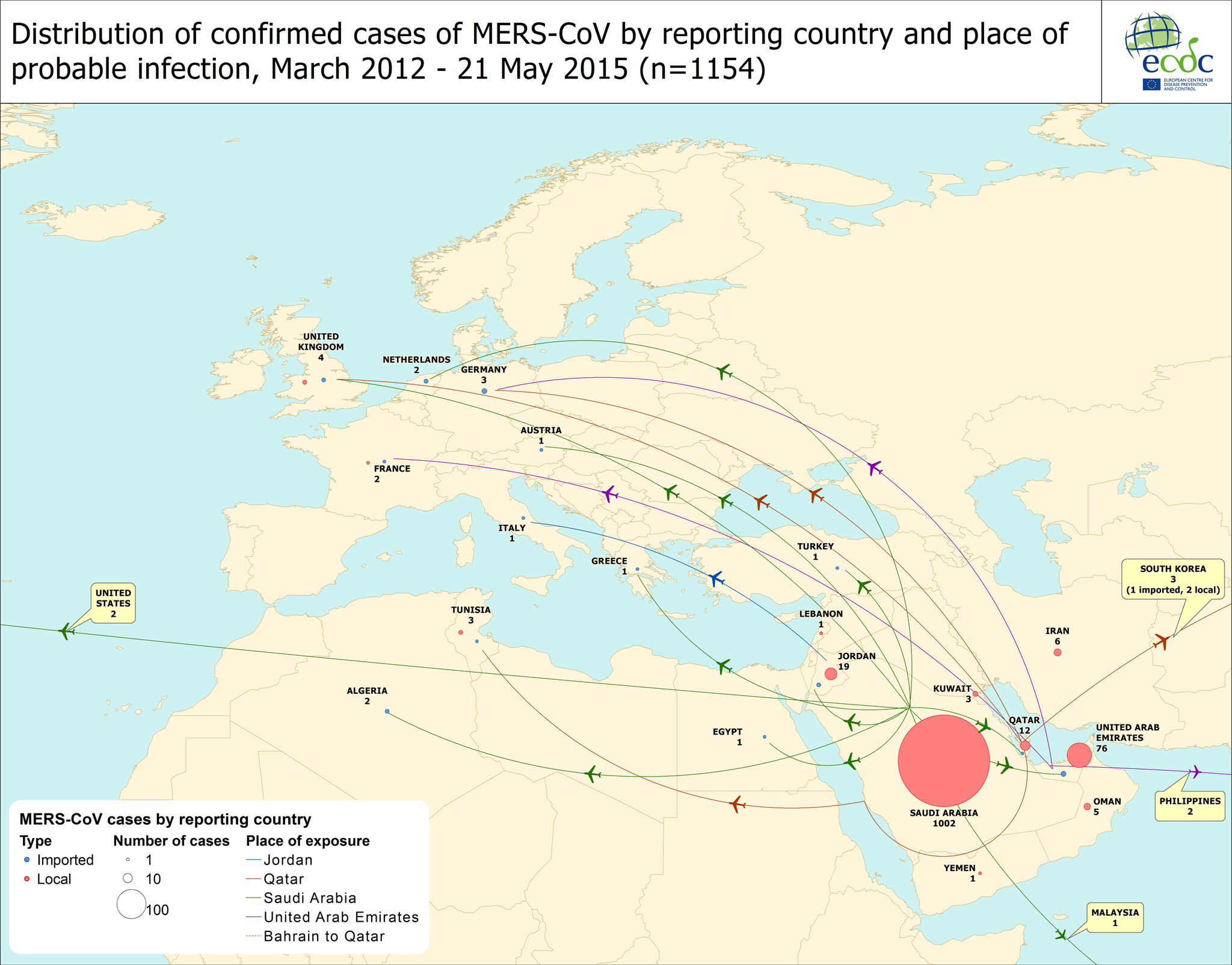
          Middle East respiratory syndrome coronavirus (MERS-CoV) managed to get out for some sightseeing - travelling to South Korea this week - and Ebola virus|Makona was given a helping hand to spread to new people in Guinea and Sierra Leone with a small splurge of new confirmed cases.

          MERS has now trickled into 24 countries world wide as shown in the European Centre for Disease Prevention and Control's (ECDC) epic 'travel-by-plane' map.

          Media preview
          The original of this is created by the ECDC and is presented here.
          Click on image to enlarge.
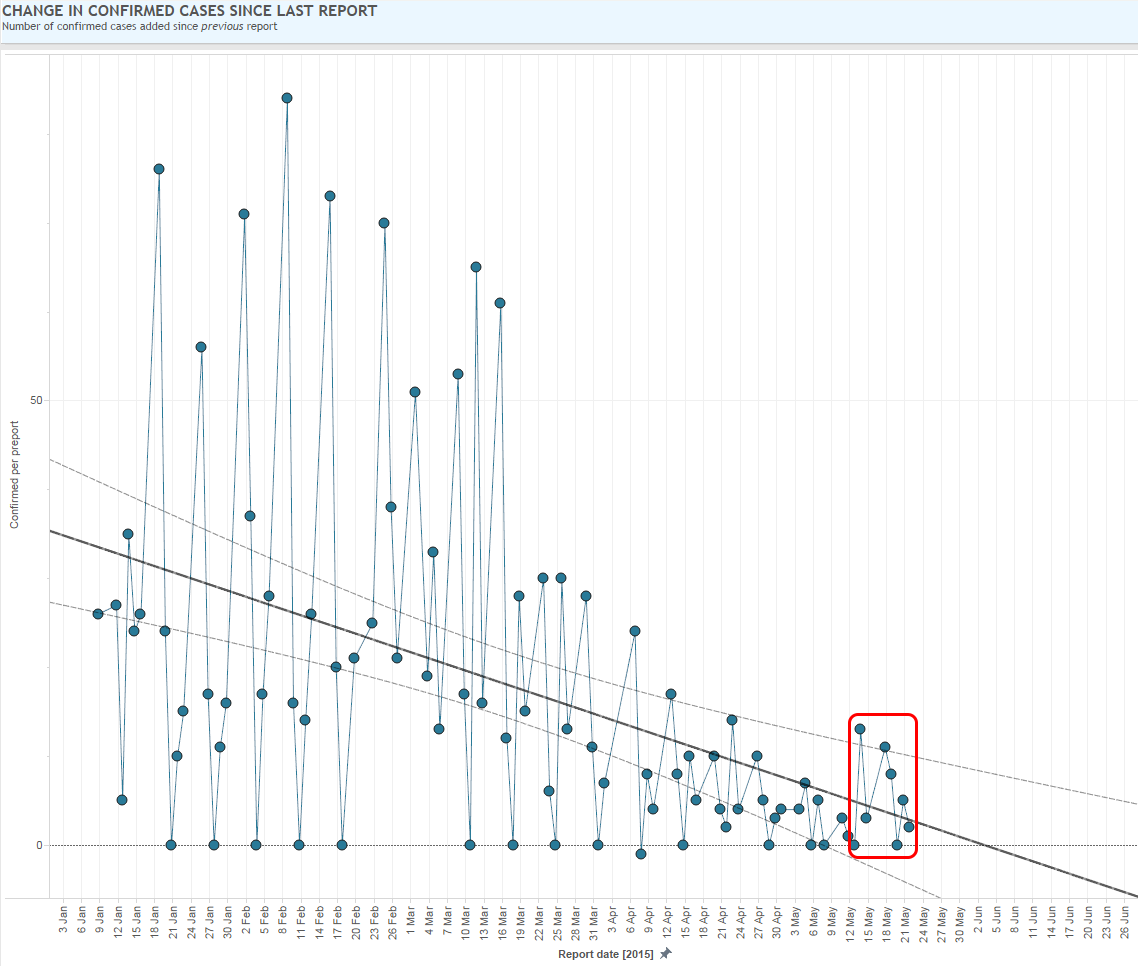
          Meanwhile, a crude extrapolation from current Ebola virus disease (EVD) case numbers saw the predicted date when we might reach zero cases, move further into June. 

          This could pull back again or it could move further away if the EVD clusters and sporadic cases continue to spread. We can't model that because it's entirely down to unpredictable human variables. We can list what those are, we can better prepare for them, we can educate about them and how to prevent them and we can acknowledge that they are real, but we cannot know when and in what mix they will come into play.

          Extrapolation of the public data for confirmed Ebola virus disease cases from
          WHO. The most recent week is boxed in red and bucked the trend of declining
           cases. To see how I made this please visit here.
          Click on image to enlarge. 
          The newest EVD cases remain mostly clustered around the Forecariah prefecture of western Guinea, on the north west border with Sierra Leone but also 5 new cases appeared in the north west of Guinea in Boke prefecture, which borders Guinea-Bissau. 

          Geographical distribution of new and total confirmed cases
          From the World Health Organization's Ebola virus disease Situation Report, 20MAY2015.
          Click on image to enlarge.
          Since the last EVD SitRep, two days of reporting have seen fewer cases than in the same two days of the week before. 

          So there's that. 

          Quickly reporting what is actually happening is invaluable for all sorts of reasons. Modelling and prediction allow us to get ahead of the virus. But having the data, and having them available publicly remains a challenge for every country and for every outbreak. 

          Public health data are about the public's health. If it has been considered worth collecting and collating, why not communicate it too?

          Liberia gave Ebola the boot...and a virus may soon be removed from the wild

          The people of Liberia have earned our respect, some time for national celebrations and frankly any other rewards that may flow from denying the Makona variant of Ebola virus any hosts among their community. 

          The world considered this viral species to be one of the list-toppers when it came to ranking the causes of the most scary acute infectious diseases. Ebola virus has been the basis for all sorts of 'end-of 'the-world' mutating virus horror movies, books, and TV shows. It's not at all surprising that the public view of an Ebola virus infection had long been one of blood, fear and terror.

          Figure 1. The decline of the Makona variant of
          Ebola virus in Guinea, Sierra Leone and Liberia
          (now free of EVD transmission).
          Click on image to enlarge.
          Behavioural change was a major factor in reducing virus transmission in Liberia. Alongside that was a broad range of aid given from within and beyond Africa's nations. By working together, a widespread outbreak that was not initially thought likely to happen at all, was routed. 

          For now. 

          Liberia is not immune to new cases of Ebola virus disease (EVD) crossing its borders or popping up due to a new animal-to-human jump (a zoonosis). That could happen any day - it might be happening now. But those who are still on watch will be searching out new cases while the remaining sites of transmission - Guinea and Liberia - do their best to deny Ebola virus a chance to replicate and spread. The people of Liberia will keep watch help because they have learned very tough lessons about viruses, epidemiology and communication. At least 10,604 suspect, probable and confirmed EVD cases, 4,769 deaths and way too many stories of sadness and families destroyed are a very strict teacher. 

          Figure 2. The number of confirmed EVD
          cases (yellow) grinds to a standstill. Only
          9 cases in the week to 10th May 2015.
          Click on image to enlarge.
          The crude prediction in Figure 1 suggests that zero cases across all three countries could happen at the end of May, but many stars must align for that to be a real event. 

          Human factors - the causal and sustaining variables of any outbreak of infectious disease in humans and sometimes animals - remain very much in play. But once that tri-country zero case value is attained, we have 42 days of watching and waiting - from the time the final case tests negative. 

          New cases may arise from sources as-yet-unknown. But even if they do keep popping up, it seems very unlikely that widespread transmission will amplify to earlier levels (see the steep slopes in Figure 2) unless a major lapse in attention occurs. Hence,the need for continued vigilance - and Liberia remains on alert for a further 90 days. That more recent figure comes about because we know that infectious Ebola virus can persist in some body sites for many weeks after signs of disease have passed. Whether that virus reservoir is present in every person and whether it actually does cause new Ebola virus infections remain unproven. When you consider what can happen when one person gets infected by an Ebola virus in a tiny remote village in a country that is ill prepared to cope with it and has traditions that lend themselves to its spread...even minor risks rightly come under more intense scrutiny.

          What next for this particular virus though? The only place where the Makona variant of this member of the Zaire ebolavirus species will soon exist, is in the freezer of (hopefully) very biosecure laboratories in the US, UK, Africa, Russia, China and probably other laboratories in countries that hosted, evacuated or repatriated cases of EVD. 

          There is no sign at all - and this is because of the continued efforts and focus of many currently working throughout west Africa - of the fabled "endemic Ebola" becoming a reality. Unless you mean enzootic 'Ebola'- in which case , it already is, I suspect. It seems very, very likely that the forests of west Africa continue to shelter animal hosts with less mutated versions of this and other ebolaviruses (and filoviruses and who-knows-what else). The host species and route(s) of transmission to humans are yet to be confirmed but for now, we are not too far off eradicating one unwanted viral scourge from the wild. Impressive what we can do when we pull together.

          Outbreak resources: more expert detail presented simply, to more people, at a trusted site, quickly, and for free...

          Many, many of us have learned a lot about Ebola virus and Ebola virus disease (EVD) over the past 61 weeks - some more than others. 

          Some have paid very dearly for their new knowledge and some few have leveraged the event to try and make a buck or draw more attention to themselves or their trade.

          Many have been scared - few outside Guinea, Sierra Leone and Liberia have had a real need to be - but fear of this tiny killer is understandable. I stand by my comments on that from back in August when the United States woke up to what had been happening in west Africa for five months, and promptly started freaking out...without evidence of any widespread threat or danger.


          Not everyone has a library on everything
          For all of the unwanted, unnecessary and often inflammatory commentary, hypotheses, guesses and conspiracy theories, there was some good information to be found about EVD. Sometimes it was only able to be found by academics or others with access to journals that sit behind fee-for-view virtual walls (paywalls). Sometimes the science was too dense for the public to follow - even when they could access it. But most of the time it just took far more digging to unearth the basics than it should have. It would have been good if more of those who could access and interpret that information, had proactively done so.

          EVD in west Africa helped generate a lot of publicly accessible descriptive information about some of the technical language of infectious disease outbreaks. But there could be more. New information for public consumption should be...

          • Clear, simple information that can be easily read and shared using today's short, punchy and graphic-laden social media communication tools
          • Information that is quick and easily found or can be found using (way more) friendly search engines. A page of 2,000+ poorly descriptive results returned from a keyword search...is not helpful
          • Broad descriptions about broad topics - not just narrow descriptions for one aspect of one outbreak caused by one virus. We need to explain the wider patterns that are shared among many outbreaks and by many viruses. Ebola virus is not the first bloodborne virus, not the first sexually transmitted virus, not the first virus to spread in vomit and faces or by droplets, or to survive on surfaces, or to mutate, or to have an RNA genome, or to be detected by RT-PCR, or to have its genome sequenced, or to be the trigger for contact tracing, or to have just appeared in west Africa in 2014...etc. Start tying these patterns together to give the public a better sense of what we live with every day, instead of responding to the now and the scary.
          • A single online, well formatted (for multiple devices) site that hosts all this information provided, checked, updated and agreed upon by experts in the fields, written by communicators and hosted by the new and improved World Health Organization (WHO). The world needs a one-stop outbreak info shop that it can rely on. And that shop should be staffed by assistants who are available to answer questions or direct customers to the aisles best suited to their needs. We expect access to information and answers to questions from our phone company, so why not from our World's health experts?
          • Using better citation to acknowledge the reference material in public health information - what is so wrong with letting everyone know what the guidelines are guided by? Anecdotal is not enough.
          • Date stamped to make it clear when it was written and when it was updated. Am I looking at contemporary thinking - or something from 2 days ago before that major discovery/event changed everything we knew about virus X? 
          Many public health entities already create pages upon pages of information on each outbreak but some of that is written for people who like to read...a lot...and is in a style that is sometimes too dense and dry with words and phrases that are not well defined. A glossary might also be of use. 

          There will always be a portion of the public who seek their news and detail from the loudest and most garish 'news' source. There are also many who would like to be the smartest person at water cooler - but not if that comes at the expense of trying to locate and then wade through reams of technical guff. 


          More expert detail, simply presented, to more people, from a trusted site, quickly and for free.

          The next 'Ebola' might have a much harder time getting traction in a territory if its population is ready for it, or can get up to speed quickly.

          Snapdate: Confirmed Ebola virus disease cases - the end in sight?

          I think we're a little bit beyond "jinxing" something by pointing it out, so here is graph of the confirmed Ebola virus disease cases based on the World Health Organization report date (Situation summary or Situation Report), including a basic model to predict when cases may hit zero, if nothing changes.

          The P-value for this linear trend model is 0.00067. The standard error = 19.29;R-square = 0.14.
          Click on graph to enlarge

          I use Tableau Desktop Public Edition v9.0.0 for my graphs these days - and have taken advantage of its inbuilt linear trend model for this chart. This "model" accounts for precisely nothing apart from the trend based on the numbers that are available and have been plotted in this particular way, on this day, near a full moon. 

          Reported numbers or outbreaks could flare up tomorrow or dry up overnight. 

          I can say that over the past 2 weeks, data from each new summary or report have moved the predicted "end" data closer - from mid-June to now early June.

          I am not an expert at modelling or statistics so please just take this at face value. The line suggests that if all things stay the same, we will reach zero considered cases per report around the 3rd of June 2015.

          Please let it be so. 

          Realistically, we may be heading for another "step down" - followed by a smaller trickle of ongoing cases for some period, ahead of a final push to zero. But there are experts who will know more about this than I.

          Once we get to zero, the 42 day count begins.

          Ebolaradication around the corner..?

          The downward trend for new, confirmed, Ebola virus disease (EVD) cases continues as we can see in the graph below.

          This graph plots the number (each blue data point or dot) of newly confirmed cases in each World Health Organization situation report of summary. The joining lines don't mean anything (the WHO doesn't provide any numbers to place between dots)- they just make it cleared how think go up and down. You can see a little about Monday'itis and its role in the bumpy road to zero cases here.

          Below is part of one of the charts from my Ebola virus disease numbers page -  you can get to it from any page on this blog by clicking on that tab up there^.

          The line indicating the linear trend of fewer cases over time has a p-value of  0.023 and was
          calculated within Tableau Public Edition v9.0
          Click on image to enlarge.

          I've zoomed in the graph to highlight distinct data points (thanks to Ramon i.e. @HlthAnalysis for helping me learn to make the separately coloured dots I missed so much from my Excel graphs). Without the zooming we can see from the full dataset that it's getting a bit hard to see each data point as time goes by, and case numbers shrink (yay!).


          An Ebola virion enters a cell, replicates and leaves....

          The code to embed this animation has kindly been provided to me by the team at Scientific Animations IncI'd made a few suggestions about an earlier version (no payment was received), which they added in. 

          I think this gives a clear idea, both to the layperson - and to different types of professional microbiologist and virologist - of the processes of this virus as it commandeers a cell to make more of itself.

          You can also see the movie one a page at their website site http://ebola-virus-disease.scientificanimations.com/ebola-mechanism-of-action/


          Yes, there were signs that Ebola was in west Africa, perhaps as far back as 1973...

          If a bat carries Ebola virus in the forest, people find signs of infection in humans, publish it and read about it, but no-one remembers, does it make a sound?

          Apparently, it now does. The New York times [3] has found that there were studies reporting signs of Ebola virus antibodies in humans in Liberia in samples collected back in 1982.

          I'll see your 1982 and raise you 1973! [1] That's when some other samples were collected that were found to contain antibodies to Ebola virus. This doesn't come up in the abstract for this article, but is buried in the Methods and Materials section.
          "..antibodies specific for Marburg virus and Ebola virus antigens tested by immunoblotting (21% and 14%,respectively)"
          We noted this paper in 2014 - in a piece for the Conversation [2] - and listed some other articles which found similar signs of prior human exposure to Ebola virus or something related. The NYT piece has also captured some of these papers by the looks of it.

          In many (most?) cases, these scientific papers can only be reached after paying a fee, or being affiliated with an Institutions that has a good library. Many researchers, clinicians and public health professionals can be described as such.

          For me, it seems clear that there were many people aware of the possibility the Ebola virus was pretty much "always" (in the context of our history with Ebola virus disease[EVD]) in the forests within the regions underneath the flyways of some likely filovirus-host bat species.

          But seemingly no action was taken on these reports. Was that because...

          • the serology assays were perhaps too non-specific or otherwise unreliable (were they cross-reacting with as-yet unknown filoviruses perhaps (h/t Stephen Goldstein)
          • no-one thought much of EVD's capacity to cause a big outbreak? 
          • we didn't care about smaller outbreaks because they had always been controlled previously?
          • we just didn't care because it was "over there" (in Africa)?
          • we just forgot about it as soon as it was published?
          It really doesn't matter what the reason(s) was, because global political willingness to invest the mental and physical capital in a program that could think about, monitor and foresee the risks associated with anything found, and one with a very long view of protecting the public from possible infectious threats...just does not exist. 

          This is not a problem specific to EVD of course. Trying to stay ahead of infectious threats will take much more devotion than the world has shown it can muster to date. Even when we can see their potential for harm, there are only so many resources we will mobilize for an infectious threat that is not knocking on our specific door.


          References...

          1. Neppert J, G�hring S, Schneider W, Wernet P.
            No evidence of LAV infection in the Republic of Liberia, West Africa, in the year 1973.
            http://www.ncbi.nlm.nih.gov/pubmed/3015288
          2. How Ebola started, spread and spiralled out of control
            https://theconversation.com/how-ebola-started-spread-and-spiralled-out-of-control-32137
          3. Yes, We Were Warned About Ebola
            http://www.nytimes.com/2015/04/08/opinion/yes-we-were-warned-about-ebola.html

          Ebola - the lesser transmission risks are still risks...

          The United Nations (UN) Foundation blog has used some pretty strong language in their latest post of the 5 Things to Know on Ebola This Week.

          Number 2 on their list stated (by highlighting)...
          First detected case of Ebola transmitted through sexual intercourse
          Earlier research suggested that three months of abstinence or condom use among male survivors would suffice to prevent the transmission of Ebola through intercourse. But an Ebola patient in Liberia who died last week had just one known risk factor: her boyfriend was an Ebola survivor, treated last September. This is the first case detected of the Ebola virus being transmitted through sexual intercourse, which has necessitated updated recommendations. Read the full story here: http://unfoundationblog.org/ebola/5-things-to-know-on-ebola-this-week-10/#sthash.2HkUbbYT.dpuf
          While there is reported to be ongoing testing (and presumably virus genotyping), I've yet to hear publicly the outcome of such testing. 

          Perhaps the results are known behind closed doors and perhaps that testing has firmly pointed to a sexual transmission route. The UN post above certainly seems very sure and it also seems that this event has triggered an update to recommendations. There is solid literature about the presence of infectious Ebola virus in seminal fluids so the possibility shouldn't be far beyond belief.[4]

          Another possible, albeit also unproven, transmission route is urine. This fluid seems to me to be a far more likely source of trouble. One cannot abstain from urination. So why worry about urine as a risk for transmission of Ebola virus? An EVD case study last year showed very nicely that infectious Ebola virus could be cultured from urine for about 12 days longer than it could be from blood.[1] Viral RNA has also been found in urine for four weeks.[1,2] 

          Perhaps urine should be a more noteworthy concern for its potential to remain infectious after blood test become negative. This concern might be greater wherever toilet and hand-washing facilities and sewers, are minimal or poorly maintained.

          Urine and seminal fluids are not considered to be major transmission routes for Ebola virus. But let's not forget that it was probably an unlikely transmission event, and route - a single jump from an animal to a human - that triggered >25,000 EVD cases in this epidemic. Even a rare risk must be given serious consideration when such a large public health impact can realistically result.

          References...

          1. Kreuels B, Wichmann D, Emmerich P et al. A Case of Severe Ebola Virus Infection Complicated by Gram-Negative Septicemia. N Engl J Med. 2014 Oct 22. 371:2394-2401
          2. Lyon GM, Mehta AK, Varkey JB et al. Clinical Care of Two Patients with Ebola Virus Disease in the United States.  N Engl J Med. 2014 Nov 12. 371:2401-2409
          3. Ebola Virus Disease (EVD). Key questions and answers concerning water, sanitation and hygiene. World Health Organization. http://apps.who.int/iris/bitstream/10665/137181/1/WHO_EVD_WSH_14_eng.pdf?ua=1
          4. Mackay IM, Arden KE. Ebola virus in the semen of convalescent men. Lancet Infect Dis. 2015 Feb;15(2):149-50.

          Like Us

          Blog Archive