Medical News Blog Information

Showing posts with label LBMs. Show all posts

Guangdong sees sense among the feathers...

Guangdong province in southern China is suspending its poultry markets. All of them. From 15-Feb to 28-Feb.[1] While the closures are only for 2-weeks, this will be very important for stopping human cases of avian influenza, particularity of the H7N9 subtype, during the bustling spring period in China. 

Live poultry market closures also remove a traditional dish of fresh cooked chicken. One can be certain that no-one will die because of the substitution of frozen or factory prepared chicken for a fresh chicken, even if chefs don't succumb to the tantrums of last year and refuse to prepare dishes made from anything but fresh market-selected poultry. One can be equally certain that if the markets remain operating during the peak season for influenza virus circulation as they have been, that human infections, and deaths, due to H7N9 infections, will also continue 


Guangdong province has been a major
source of human H7N9 cases in 2015.
Some restrictions were put in place back in December 2014 [2], but that did not stop human cases of infection or deaths.

Why does this closure in Guangdong matter? 

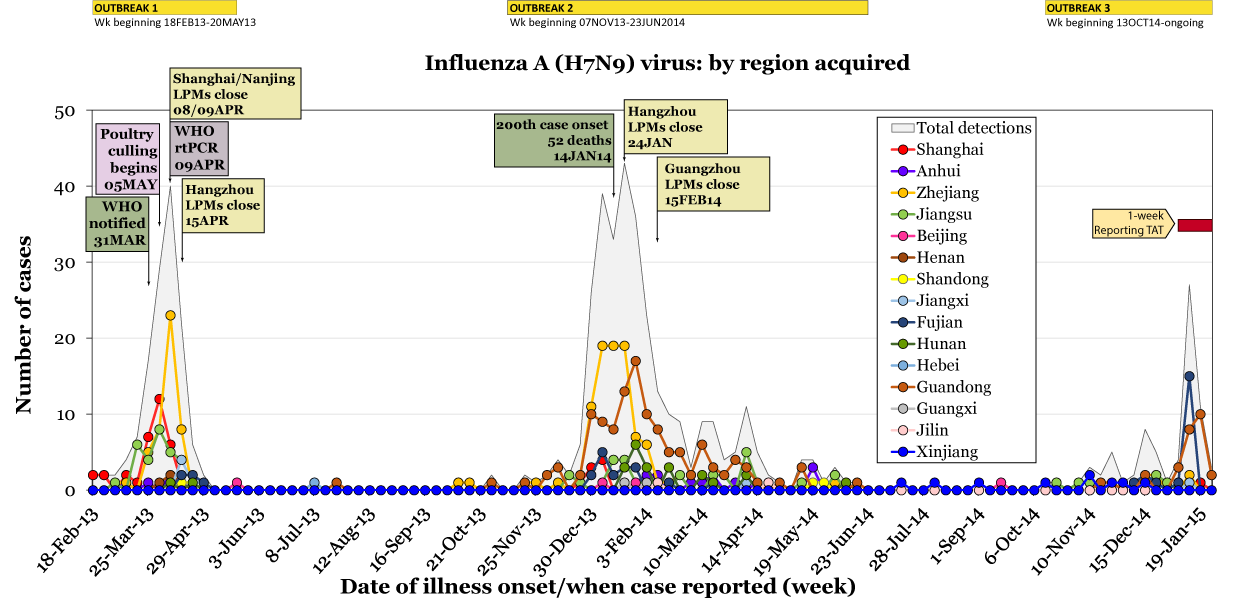
Guangdong province has been a major source of human H7N9 cases this year, as it was in 2014. If we look at the activity under the outbreak curves, we can see the brown line of Guangdong cases has been prominent in both years, only brought under control last year after the closure of the poultry markets...although their temporary closure may have been the reason for the long tail on Outbreak #2's epidemic curve compared to Outbreak #1. Will that tailing happen again in 2015 because Guangdong's markets are only being closed for a short period? Time will tell. 

Occurring at a similar time is the change in seasons. Seasonal change towards summer, makes the survival of influenza viruses in the environment more difficult. It's hard to tease out any one main cause of the precipitous case decline; the market closures or the seasons changing or both. Because most H7N9 human cases have exposure to poultry listed among their details when they are passed along and posted by the World Health Organization, live poultry markets clearly are one major factor for human acquisition of infection. There is literature that agrees.[3,4,5]


The activity under the epidemic curves for each of the three outbreaks. Guangdong province-acquired human cases are indicated by the brown line and features in 2014 and 2015.
Having these markets close is a great achievement for stopping these unnecessary and preventable infections and deaths die to H7N9. Its a big step, a sacrifice and its social change in action. But shutting them permanently would be better.

References...

  1. http://news.xinhuanet.com/english/china/2014-02/15/c_126138118.htm
  2. http://www.thepoultrysite.com/poultrynews/33938/guangdong-restricts-poultry-markets-over-bird-flu-fears
  3. http://www.ncbi.nlm.nih.gov/pubmed/25340354
  4. http://wwwnc.cdc.gov/eid/article/20/12/14-0765_article
  5. http://jvi.asm.org/content/88/6/3423.long

Societal change and H7N9..

The importance of societal change for controlling infectious disease outbreaks really cannot be over-stated. 

For Ebola virus disease, it came down to stopping the tradition of direct contact with the body of those who have died and dircet contact in general. For MERS it
seems that occasional camel contact triggers insertion of the MERS-CoV virus into hospitals where lax infection prevention and control practices add to the case load. 

For influenza A(H7N9) virus cases, it is the habit of obtaining live poultry from retail markets where rare virus-laden chooks are culled and handed over because of a desire to see, choose and purchase the tastiest fresh chicken. 

There is a common thread among these stories about direct contact or inefficiently droplet-transmitting virus infections: we can stop their spread. 

But we also amplify and prolong their spread. 

However, when it comes to human-adapted, efficient droplet-spread or airborne-transmitted viruses - well, then we're in trouble. Of course we could all just lock ourselves in a room for a few weeks but that won't ever happen.

So its very important to head off these "emerging" viruses while we still have a modicum of control over them. Once they get away from that control, and theoretically that could happen in the blink of an eye-right now even-no amount of fancy infra red cameras, poorly donned surgical masks or fancy hospitals laden with machines that blink and go ping, will stop them from spreading globally.

Cheery.

In the meantime - here's hoping China speeds up the closure of those live poultry markets. Habits can be changed but death is forever.

Click on image to enlarge.

Avian influenza A(H7N9) virus found in more than half of wet markets in Guangdong...

It comes as no surprise to me, but is still a very welcome piece of data, that Guangzhou's ongoing live bird markets and concurrent continued cases of H7N9 in people, are also happening in a an environment of 60% of market stalls tested positive for the virus in April.

A report in the South China Morning Post noted 
"Upon conclusion of the trial on September 30, the city government proposes gradually extending the ban, covering chickens, ducks, geese and pigeons, to other parts of the metropolis. The ban is expected to be implemented citywide by 2024."

"Currently, it affects 298 live poultry stalls at 82 wet markets in Yuexiu district, and in parts of Tianhe, Liwan and Panyu districts, where vendors will sell centrally slaughtered chickens that will be provided by three designated suppliers."
This is welcome news and a positive step towards stopping not just H7N9, but a raft of other influenza viruses that jump to us from, and mix to create new virus within, birds.

Source...
  1. http://www.scmp.com/news/china/article/1505389/guangzhou-begins-trial-ban-live-poultry

Zhejiang province leads the way in H7N9 cases and their decline 3-weeks after market closures...

Click on image to enlarge.
It's the Province in China that has seen more H7N9 cases confirmed in human than any other Province (39% of all cases have originated here). 

It reached 50 cases faster in 2014 than 2013. 

It closed its markets back in 24-Jan. And for a little while it kept finding new cases. 

But the past 2-days have see no new cases announced from Zhejiang province. Eerily reminiscent of 2013 sudden disappearance of cases announcements.

If we look at the data by date of onset of illness (pretty much all of the second wave data are this thanks to WHO's reporting and data fill-in) in the chart above, we can see this decline clearly depicted. 

After three weeks of cases nearing 20/week, they've dropped to less than half and then a quarter of that rate. 

Cases are still coming out of Guangdong Province though, but I don't have market closure dates to hand for Guangdong. 

Actually - now I do. Guangzhou's markets have just been shut (Friday, 15-Feb but only until 28-Feb) according to a timely update at Crawford Kilian's H5N1 blog as I write this. Well, that's pretty late in the game and will certainly not be a long term solution. 

I'm surprised that the vocal poultry industry has not yet realised that this sort of money-haemorrhaging close-disinfect-open-restock cycle of events will continue to recur so long as this way of presenting chickens continues. 

Instead of crying fowl (oh yes I did) it would be worth investing that energy and money into educating the population about the freshness and safety of factory-prepared refrigerated/frozen poultry. To my mind anyway. 

Create and promote new oversight and checks and balances to assure the population that the chickens won't be prepared in some dodgy way; about the cold chain; about the benefits in the longer run. 

Of course those assurances would rightly need to include some proof that concerns were unwarranted that poultry were being presented that had:


  • died from disease or poisoning due to pesticide, melamine or grain fumigants
  • been treated with harsh chemicals such as bleach or other disinfectants (credit: anonymous). 
A long road a ahead if this path is ever chosen but it would life-saving benefits both at home and worldwide. Hopefully the industry will find a way to evolve and still make a profit when it is able (or is forced) to see past its grief and current anger at everyone else. 

But back on topic, if Zhejiang is anything to go by - expect to see the Guangzhou (who knows about the rest of Guangdong province?) cases decline steeply within 3-weeks.

Zhejiang remains as my sentinel Province for watching the potential impact of live bird market closures. Last year, daily case numbers dropped by 97-99% within about 3-days of market closure in different Provinces.

Will the drop we've seen recently in Zhejiang be maintained in 2014 as it was in 2013, or will cases take off again? If so and in the absence of data to support any other reason for human cases declining, I think Zhejiang should be used by China's Ministry of Health as an example with which to "educate" the poultry industry on what happens to an emerging lethal infectious disease when you take the live poultry markets out of the equation.

Stay tuned.

H7N9 case announcements dropping: is Wave 2 under control? [UPDATED]

Its a very tough question to answer. There has been public pressure by China's poultry-farming groups on China to take measures to stem the industry's financial losses. These have been driven by the public concern that H7N9 can seriously afflict people and in about a fifth of recorded instances, kill them. 

And rightly so. The concern for those of us outside China is that reporting may be artificially halted, reduced or stemmed to calm the public - while doing nothing to stop the march of H7N9. This concern extends into thoughts about why we have so very few 2014 H7N9 sequences to date. Background for this paranoia about non-biological reporting limitations takes the form of :


  • MOA noting no evidence of H7N9 in poultry farms (1). Perhaps time to propose an alternative source then?
  • Poultry industry writing to demand that descriptors like "H7N9 bird flu" or "people infected with H7N9 avian flu" be changed to "H7N9 influenza" (2)(4). No argument from me there - bird flu is not part of the WHO nomenclature anyway. It's a media thing. Seriously though, will the name change the infections? Of course not. Same virus, same bird/poultry association with human disease. Call it Frank if you like but the process of infection, morbidity and mortality in 1:5 cases will go on.
  • Poultry industry groups asking Guangxi and Guangdong provincial governments to stop reporting each H7N9 case (3). Not acceptable and not addressing the problem at the source.

Click on image to enlarge.
Cases per day for all of Wave 2 (arbitrarily selected as
Oct-7-2014) and specifically for 2014. 

Orange and blue dots mark the rolling average
(each dot [data point] is the average of all data points
before it). The grey dots are the cases with illness

 onset on that day. The green bar reflects he current
laboratory turnaround time; the time between date
of illness onset and the date of reporting which we
hear about 2-3 days after the case is reported by
the jurisdictional Ministry. The pink bar indicates
that 2-3 day WHO delay period. Please allow for the 

fact that I am doing this from Australia which is 
ahead in time from the Northern hemisphere so my 
data are from "yesterday" and the x-axis extends into
a day you haven't had yet. The date the Hangzhou bird
markets in Zhejiang closed, my sentinel Province for a
market impact, is indicated. 
So, when we see a chart like this one, we may have those doubts at the forefront of our minds; more so than other reasons for what appears to be a constant decline in case reporting in recent days.

One such reason would be that the market closure (22-days ago for Zhejiang) and the laboratory reporting delay (currently 8.7-days for Wave 2) have finally caught up to the present day - and we are seeing a real impact of reduced exposure of humans to birds (poultry or market-based wild/song birds). 

As @influenza_bio (please follow him if you have an interest in flu - a real repository on influenza) noted on Twitter, it may also reflect a change in bird migration patterns. To me that that seems to be 2 coincidences in a row given a similar relationship between cases dropping and markets closing last year. The different could be that weather changes helped speed up the case decline in 2013. Maybe.

None of you reading this (since I believe the blog cannot be accessed in China) know the actual reason for this decline. 

In the absence of any other data or a change in climate, I'm proposing that the case decline to a direct effect from the market closure. If that hypothesis is correct, we will see continued decline in cases in Zhejiang and wherever else markets were closed. 

That decline in total H7N9 human case announcement began 3-days after Hangzhou markets closed. Given that most cases were accruing from Zhejiang province, I still think that's a good place to watch.

Sources.
  1. Xinhua story.
    http://news.xinhuanet.com/english/china/2014-01/27/c_133078220.htm
  2. Xinhua story (needs translation)
    http://news.xinhuanet.com/2014-02/04/c_119212598.htm
  3. South China Morning POst
    http://www.scmp.com/print/news/china-insider/article/1421319/chinas-poultry-industry-wants-hush-bird-flu-news-damage-control
  4. China Animal Husbandry Association
    http://www.caaa.cn/show/newsarticle.php?ID=329866

Zhejiang live bird market closures and enhanced monitoring of farms, wild bird habitats and parks...

Crawford Kilian is always on top of the market closure announcements, and Xinhua in general. His recent blog post is particularly welcome; halting of live bird trading in Hangzhou's markets (on Friday 24th). Markets in 6 districts will be closed and disinfected and some/more monitoring of birds (hopefully not just for H7N9) will be launched on supplying farms and in wetlands and parks. I hope that's all RT-PCR-based.

Hangzhou is the largest (2.5-million people), and capital city of Zhejiang province, a region that has served as H7N9's playground over the past few weeks. 

This action comes on top of 2 other districts (1 in Hangzhou and one in Jinhua) already having closed their markets.

Shanghai closes up 31-Jan to 30-Apr, for the Spring Festival. 

The Xinhua story quotes Li Lanjuan of the Chinese Academy of Engineering and director of State Key Laboratory for Diagnosis and Treatment of Infectious Diseases as predicting that...

"China will see more human H7N9 cases in the future as the virus tends to become more active during winter and spring"

...or at least, human cases appear more often then.

References...

Market sampling: H7N9, sensitive testing, market closures and small numbers

A World Health Organization Western Pacific Region update on influenza A (H7N9) virus has a few interesting bits of information that pulls together a recent flurry of reports. This is the situation as of 22-Jan...
  • 18/200 (9.0%) "pathological samples" from markets (listed below) in Zhejiang province, presumably using PCR-based methods, were H7N9 positive  
    • Sanliting Agriculture Products Market (6 oral/cloacal swabs, 2 environmental faecal swabs)
    • Central Agriculture Products Market (2 oral/cloacal swabs, 1 environmental faecal swab) 
    • Fenghuangshan Agriculture Products Market (1 oral/cloacal swab)
    • Guoqing Poultry Wholesale Market (3 oral/cloacal swabs, 3 environmental faecal swabs).
  • 2/2,521 (0.08%) pathological samples were H7N9 positive in Guangdong province
  • Pathology specimens from the provinces of Jiangxi, Liaoning, Jilin, Heilongjiang, Jiangsu, Fujian, Shandong, Hubei, Hunan, Guangxi, Yunnan, Qinghai, Xinjiang Provinces and Chongqing and Shanghai Cities were H7N9-negative
  • 7-Jan, H7N9 RNA was also reported  in 3/17 samples collected from the kitchen of a restaurant in Haizhu District, Guangzhou City, from the chopping board and sewage water. 
  •  Meanwhile H7N9 RNA was identified in 8 out of 34 environmental monitoring samples collected from the Guangdong's Longbei Market, Jinping District, Shantou City.
  • Ningbo city (Zhejiang Province) has stopped commercial live birds entering the city
  • Shanghai city will suspend live bird trade all over the city from 31-Jan to 30-Apr. Live poultry from other provinces will not be allowed into the city except for transport to a centralized slaughterhouse.
It's great to see some data from other provinces and municipalities that have not reported any human H7N9 cases to date.  I do wonder about the relatively small numbers of market samples though. Some of these samples pale in comparison to what was tested in 2013; which reacted earlier than this, the second time around. While 2,00 samples is not an easy day in the lab, we saw >800,000 bird samples tested by "virological" (?culture) and serological methods in 2013 (see other thoughts on the use of PCR in birds here).

So what have we learned here? 
  1. Further confirmation that live bird markets house H7N9-positive birds. With most human cases this year having come into contact with poultry, the transmission chain is in place. Market closures seem the most effective way to stop transmission abruptly and they have a precedent for this in 2013. This is happening. Will it be enough? What  about the market-supplying farms?
  2. RT-PCR testing is more likely to uncover influenza in birds than culture methods and is better than antibody testing (although how much better is hard to judge from the information provided). Added bonus: RT-PCR is more likely to tell you what's circulating now rather than a little while ago...although no-one really responds to the lab results that quickly anyway.

H7N9 hasn't left, it's just been building capacity... [UPDATED WITH NEW WHO DON]

Click on image to enlarge.
I updated this chart a week ago, when the avian influenza A(H7N9) virus tally was at 158.

This morning I check FluTrackers list and its sitting at 189 cases; 31 reported so far this week. Just to be clear though, not all of those cases acquired their infection in this week. Some cases go back to mid-December 2013. 


This week has so far seen 10 cases with disease onset listed as occurring in it (5, 17 and 6 in going back by week in time). For comparison, at the height of the 2013 H7N9 outbreak, in Weeks 6-9 (March and April) there were 17, 29, 40 and 19 cases in each of those weeks respectively. We don't seem that far off from those numbers right now - except that this outbreak/wave we're seeing cases starting from more regions than last time. Without some serious intervention, I think 2013's peak of 40 case acquisitions in a week will seem small in 2014.

We can also see from the chart that Fujian province is emerging from the background noise of a handful of cases and could be starting that steep'ish climb that suggests bird-to-human transmission events are on the rise. That adds to ye other "newcomer", Guangdong province. In 2013 Shanghai, Zhejiang and Jiangsu were the hotzones, and they have all reported cases in recent weeks. H7N9 hasn't left, it just built more capacity to transmit...because that is a virus's life.

Which brings me to a whinge. 

You could be forgiven for thinking that from all we've learned about H7N9 and all that we already knew about influenza viruses and markets and transmission and detection and diagnosis and treatment) from...
  • The 318+ research papers
  • The many words written in a vastly greater number of news articles, blogs and comments
  • The many (I expect) millions of dollars invested in learning, battling and cleaning up after H7N9 over the past 48 weeks
  • The strong link between a precipitous drop in new cases and the closure of live poultry markets in 2013 
..that a similar response to the liver bird markets would have been triggered this time around. In 2013 the first key market closures were underway by Week 8 (1st week of April'ish) after the first known H7N9 case became ill (Feb-18). This time around we're already at 15-weeks after H7N9 cases started to accrue again (taking the start as the week beginning 7-Oct).

I forgive you for thinking this way because I think that way too. This much newly and recently accrued knowledge should have informed the decision to close markets by now. Or change the markets. I get that fresh poultry is an ingrained and cultural issue. But I also get that public health is at serious risk just now, not just in south east China but globally. Is it worth your life or the life of a family member just to get a clucking chicken from a market rather than a farmed pre-prepared one? The solution to reduce that risk to people and the world lies in the live bird trade and associated habits. Closing down a market here and there for "sanitation" (or aerosolising everything by hosing it out as @Laurie_Garrett suggested in a fantastic Twitter exchange earlier today), doesn't appear, to the casual observer, to be slowing infections. Can a "market" really be suitably sanitized? Not just the one-off cleanup, but the more conceptual idea of a market as a large gathering of animals frequented by hundreds of thousands of people each day, meeting there, handling, haggling, buying, breathing, drinking, eating... 

Can you ever get ahead of that risk while markets exist in their current form?

Laurie Garrett also mentioned a practice involving the sniffing of a chicken's butt to see if it is healthy. Beyond the laughter that image triggers, flu is a gastro virus in birds. Better cleaning of a market's environs won't stop that practice, nor other risky practices, from being  a source for influenza virus acquisition.

Perhaps sanitizing markets is working. Perhaps we'd be seeing a lot more cases if such cleansing had not been happening. But aren't the markets just being restocked with HXNY-laden birds the next day or week?

The H7N9 cycle wasn't broken when the markets were shut in 2013; it was just temporarily halted. 

We know that these birds have multiple influenza viruses in them including H9N2, H5N1 and H7N9. 

The conditions for the emergence of viruses we already know, and those we have yet to meet, continue to be created and maintained. 

The spectre of "the next pandemic" will not get the banishment it deserves while the live bird market system continues as it has. It's just our luck that may run out as it did for those infected by H7N9.

H5N1 case in Canada had been diagnosed with pneumonia...testing at the source would have been helpful

And now, from a fantastically detailed post onto ProMED by Fonseca and colleagues, we see that the H5N1 case was diagnosed with pneumonia.

On 28-Dec, the patient presented to a local emergency department.

"A chest X-ray and CT scan revealed a right apical infiltrate. A diagnosis of pneumonia was made; the patient was prescribed levofloxacin and discharged home."
One sad point made in the ProMED post which supports the need for constant viral vigilance the world over, coupled with the dissemination of those surveillance data, so that patient management anywhere in the world can be armed with the best possible decision-making information...
"The index of suspicion was low as travel was to an area in China where there have been no recent reports of the circulation of this virus, and coupled with no obvious exposure to poultry, the diagnostic work-up and consideration for A(H5N1) infection was very low"
As a recent J Virology article by Yu and colleagues highlights, when a sensitive testing method like the polymerase chain reaction (PCR; in this case RT-PCR because influenza viruses all have an RNA genome, not a DNA one) is applied to the search for a virus, it yields the kind of data that can:

  1. Explain from where a virus emerges
  2. Inform the search for disease aetiology - where are human cases getting infected from and if a zoonotic infection (from animals to humans), which animal(s) is the culprit?
  3. Alert the world to any risks of infection when travelling to a certain area(s)
  4. Allow the local health departments to mitigate the risk of their population acquiring infection by instigating controls (like live bird market closures). This has implications for the world since respiratory viruses have the potential (thankfully not realized for H7N9 or H5N1 to date) to spread more rapidly and efficiently that blood-borne or mosquito-borne or sexually transmitted viruses.
  5. Permit understanding of how widespread (over what geographic area is it detected) a novel or emerging virus may be and how entrenched (is the same site repeatedly positive) it is
Not doing such testing, or using less sensitive methods will not yield this information. 

In Yu's study, testing of 12 poultry markets, mostly urban, and local farms linked to 10 human infections in Hangzhou, Zhejiang province around 4th to 20th April 2013 yielded signs of H9N2, H7N9 and/or H5N1 viruses in all markets. Poultry were often positive for H7N9 and H9N2 (this finding from individual RT-PCRs was confirmed using next generation sequencing), whereas human specimens were not. These levels hadn't been turned up when 899,000 bird were tested in 2013 using (perhaps) less sensitive methods.

I think with influenza, it may be safer to presume its everywhere until that presumption can be discounted. Clearly the conditions for influenza viruses to swap gene segments and sort themselves into new subtypes and variants are commonplace and frequent; these aren't just chance occurrences of different birds passing in the night via overlapping flyways. These feathered vectors are co-infected by 2 or more viruses at a time. Luck and the constraints of viral fitness are presumably the only things keeping H7N1, H5N9, H7N2 cases from dialing up in humans? What seems to be lacking is more molecular testing at the farms supplying the markets. Not just in Zhejiang, but all over the region.

As the authors noted, 100,000s of people visit these live bird markets each day and very few influenza cases seem to be due to them. Long may that last. But it's a tinderbox for which matches are already being struck; if the viruses should bud of that one-in-a-million variant that is enabled to readily spread from person-to-person, whooshka

More testing guys, keep testing.

H7N9 in Guangdong; Market #2

As the tally of H7N9 cases passes 150 (n=151 since Feb-19-2014, 321-days), crofsbogs has picked up on an environmental sample from a second live bird market (Nanchao market) that has been confirmed as positive for H7N9 by Center of Disease Control and Prevention (CDCP).

This time we learn that nucleic acids were detected so RT-PCR methods are in use, at least in Zhuhai city, a prefecture-level (between less populated than a Province but more than a County) city on the coast of Guangdong province bordering with Macau. 

Was RT-PCR in use during those huge poultry screening events last year? Tracking back to a post on some of the vast numbers of animals tested (hundred's of thousands) earlier in 2013 it looks like the testing back then was virological (trying to grow virus I presume) and serological (detecting antibody to recent infection by the virus) rather than molecular (PCR-based). I stand to be corrected on that.

Just thinking out loud, but it seems to me that 800,000+ birds had been tested using RT-PCR then we would have had a much better idea of the extent to which H7N9 was distributed across China.

As an aside, the 3 most recent human cases also read like a who's-who of 2013's H7N9 hotspots; Jiangsu province, Shanghai municipality and Zhejiang province. 

I'm making some more lines available on my Excel sheet.

A summary of Influenza A(H7N9) virus findings in birds and humans [UPDATED, AMENDED FIGURE]

An article from Bloomberg news highlights some interesting studies, how they present opposing conclusions and why we can expect to see more H7N9 activity, perhaps peaking at Chinese New Year.

Click on image to enlarge.
H7N9-positive birds and humans (see MOA report) in 
April 2013. 17x more humans were virus-positive 
than humans were PCR/symptom positive. Based on 
Li et al's April 24th New England Journal of Medicine 
article from a similar time period which uses observation 
for signs of disease among 1,251 followed contacts of 81 cases and
sentinel surveillance PCR data from 5,551 humans to
identify H7N9 cases).
The authors (Khan and Loo) remind us that earlier in the year, China's Ministry of Agriculture reported 46 positive poultry samples among 68,060 tested positive using viral culture, for H7N9 (0.07% or about 1:1,500). 

In a more detailed report from MOA from 30th May 2013, 88 of 899,758 [0.009%] duck, pigeon, chicken (722,380 or 80% of all the samples tested), wild bird, pig, geese, "other" animal or environmental samples were virus [197,389 of the samples tested this way] &/or antibody [702,369 of the samples] positive (chicken, duck and pigeons were the positives; 3 were positive for both). The report presented by Zhang Zhongqiu does not make clear how many swabs and bloods were tested per animal so I'll just talk about sample numbers. The report notes that there were no clinical cases reported from 44 million farming households and no positives from 51,876 samples of 746,212 samples (?chickens) sent to Hong Kong; monitored by the General Administration of Quality Supervision, Inspection and Quarantine, China) nor among the 120/samples being tested per day in Hong Kong. In 1,874 samples collected from Henan and Jiangxi provinces, none were positive. Transmission among chickens was possible but was not efficient among ducks.

  • Lam and colleagues (previously reviewed) identified 8 avian H7N9 strains from 1,308 (0.6%) chickens (95% of samples), ducks, pigeon and geese samples collected from live bird markets (LBMs) in Rizhao, Shandong province (about 9 times more than the 1st MOA study above, if they can be compared directly). 
  • Yang and colleagues (previously reviewed) found H7N9 antibodies in 25 (6%) of 396 humans poultry workers (none prior to 2013) but only 9 of 1,129 (0.8%) members of the general community showed some weak sign of past exposure (or cross-reaction with another influenza). No viral RNA was found in these poultry workers.
  • Wang and colleagues, writing in the Journal of Infectious diseases,  recently traced the source of some cases in the Hangzhou region of Zhejiang, to LBMs. 95 samples from chickens (n=47 samples), ducks (n=9), quails (n=2), pigeons (n=3) and poultry handlers and 4 from water were inoculated into eggs and were tested by real-time RT-PCR, within the first 2-weeks of April 2013. H7N9 RNA was found in 41/85 (48%) of samples. 40% of the chicken samples, 89% of the duck samples and a third of the pigeon samples. No human or environmental samples were positive. The authors concluded that migratory birds would continue the spread of H7N9 viruses and that their findings highlight LBMs as the major source of infection an as such control measures are needed.
  • Shi and colleagues reached a similar conclusion in April in the Chinese Science Bulletin. "Strong measures" were needed to control the spread of H7N9 in order to prevent more infections. This followed the testing of 970 samples of drinking water, soil, cloacal and tracheal swabs from LBM poultry in Shanghai and Anhui province using egg inoculation. All 20 (10 from chickens) of the H7N9 isolates came from LBMs in Shanghai, confirming high genetic homology across the H7N9 genome from human H7N9 cases.

Today's Bloomberg article quotes researchers' concerns that the cooler weather will drive the re-appearance of H7N9, since influenza usually reaches epidemic levels during cooler months. In other words they believe this particular strain of H7N9 (the one infecting humans) was never removed from the ecosystem.

Re-opening of the LBMs has been ongoing since June in Shanghai municipality and Zhejiang and Jiangsu provinces, albeit in a more regulated fashion. The cleansing of the markets after culling more than 560,000 poultry from LBMs as of May 2013 combined to precede the precipitous decline in what had been an alarming rate of new cases in those regions. Is testing of these markets an ongoing process?

With the markets refilling from farms located in rural regions with exposure to mobile wild bird populations that may (albeit infrequently) carry H7N9 (and many other influenza viruses including its components), the risk of fresh outbreaks among humans is also growing. 

It's a numbers game. 

Even 1 human case, like the one we saw infected this week could signal an even wider level of circulation of H7N9. Let's hope testing will make sure our number's not up this time around.

Editor's Note - the figure was altered 01.02.14 to correct an error in the proportions and to adjust down the number of contacts since not all had been followed.

H7N9 more transmissible than H5N1.

A comment in BMJ by Jane Parry stresses the use of closing live bird markets (LBMs)to halt human H7N9 cases and adds that this virus is more transmissible to/between humans than is H5N1 (45 human cases confirmed in China since 2001 vs H7N9's 132 but in only 5 weeks). 

I wonder how related this is to H7N9 being a low pathogenic avian influenza (LPAI) in birds compared to H5N1's highly pathogenic course in birds. H7N9 can, in theory, stealthily sweep through flocks without setting off veterinary alarm bells (human cases acting as the "sleeping" canary in the mine) whereas H5N1 triggers alarm and can be better controlled by early culling. 

So far 47,8000 samples from 1,000 farms and poultry markets have been been tested and only 39 have been H7N9 positive.

Prof Peiris posits poultry progressing problem.

Esteemed virologist Professor Malik Peiris believes the drop in H7N9 cases linked to the shutdown in wet markets, underscores the impact of the large, fast-moving and diverse poultry trade in the south east of China. 

Wet markets have closed in all affected areas and cases have subsequently dropped. Prof Peiris noted that a study of human blood samples is underway. 

This will shed light on the proportion of cases, if any, that did not have severe enough disease to put them on the hospital radar or to lift them above the "noise" of normal upper respiratory tract infections, other respiratory diseases or pollution-exacerbated lung problems. 

The new study will provide a key piece of the H7N9 puzzle.

New insight into testing and epidemiology of infection.

In an excellent new article in the Lancet, Chen and colleagues explain testing (sensitive real-time RT-PCR for M, H7 and H9 targets; culture on MDCK (canine) cells to grow virus) describing result from throat and sputum samples from 4 patients.

They associate human cases directly to epidemiologically linked chickens (also tested quail, pigeons and ducks) samples from "wet" market (traditional live animals with on-site butchery - water used to clean up).

Market closure the key?

Is the closure of Shanghai's wet animal markets to thank for the precipitous drop in H7N9 cases from Shanghai from around mid-April? 

Back in 13.04.13 I mentioned we still had a few days to see if there was any impact based on the diagnostic testing lag of 10-12 days. Dr Kelso of the WHO influenza-A team thinks the drop and the market closures could be linked.

New H7N9 cases bring tally to 43

Another 5 H7N9 confirmations including a new death (n=11). Total of 43 cases - looks like 5/day is the new rate...an increase over time.
Given the approx 12-d gap between onset and test confirmation, it will still be a few days before we see an impact, if any, of Shanghai market closures and even more time for an impact from poultry culls.

Like Us

Blog Archive