In an unusual twist to the ever-entertaining Middle East respiratory syndrome coronavirus (MERS-CoV) narrative, a new study has been published(1,2) that calls upon us to consider seriously, or at least acknowledge, the possibility that bioterrorism explains the emergence of this virus as a rare but often deadly human pathogen. Dr Raina MacIntyre (@RainaMacIntyre) of the University of New South Wales suggests that "deliberate release" may explain the allegedly paradoxical pattern of ongoing MERS-CoV infections in Saudi Arabia. She concluded this after comparing MERS-CoV numbers to the 2003 epidemic of severe acute respiratory syndrome coronavirus (SARS-CoV).(3) Apparently, the elephant in the room that we may all be overlooking is the possibility that the virus is being or has been released deliberately in repeated acts of bioterrorism.
�Bioterrorism� is inherently an evocative and emotive word; it has the ability to elicit the sort of worry and fear among the wider community generated by the likes of �Ebola� and �deadly airborne virus�. It also feeds conspiracy theories.
In our collective opinion, bioterrorism, with respect to MERS-CoV and otherwise, should not be invoked without at least some preliminary data that point specifically to a deliberate human cause.
We would like to make it clear that we don't object to considering bioterrorism as a potential cause of the emergence of MERS-CoV. It is always worth considering whether an outbreak of any human, animal or plant disease is due to deliberate human activity. Thankfully, there are people whose jobs are to do just that.
However, we have some concerns about the rationale put forth in Dr. MacIntyre's paper regarding why bioterrorism may explain sporadic MERS-CoV infections better than nature and would like to highlight some notable factual errors and omissions that might have influenced her conclusions. No data are available that could decisively rule out the possibility of bioterrorism as the cause of the ongoing MERS-CoV outbreak, as one cannot prove a negative. Nonetheless, we believe that Dr. MacIntyre's arguments are flawed and that the available evidence cannot be used to support her theory. Substantial scientific and methodological problems exist in Dr MacIntyre�s paper that undermine her deliberate release theory. Here, we discuss some of these issues, and we offer perspective on why bioterrorism is unlikely to be a cause of human or animal MERS-CoV infections.
MERS is different to SARS. Yep. We already knew that.
A substantial amount of Dr MacIntyre�s report is based on comparing MERS to SARS.(4) MERS-CoV and SARS-CoV are genetically, taxonomically and phylogenetically divergent, and MERS and SARS are immunobiologically, clinically and pathologically distinct. Furthermore, their transmissibility in humans, their environmental contexts, their animal hosts and the interactions between their animal hosts and humans are different. Thus, the comparison between the two viruses must, a priori, result in finding MERS and SARS outbreaks to be characteristically different. That SARS and MERS are different has also been stated previously.(5,6) Compared to SARS, MERS generally progresses more rapidly and occurs more frequently in individuals with pre-existing medical conditions, including diabetes, chronic lung disease, renal failure and in people who are immunocompromised. Moreover, MERS-CoV exhibits a broader tissue tropism and induces faster cellular damage than SARS-CoV; it also employs a completely different receptor and prompts a comparatively delayed cellular immune response. These two viruses belong to separate lineages within the genus Betacoronavirus; they are chalk and cheese.
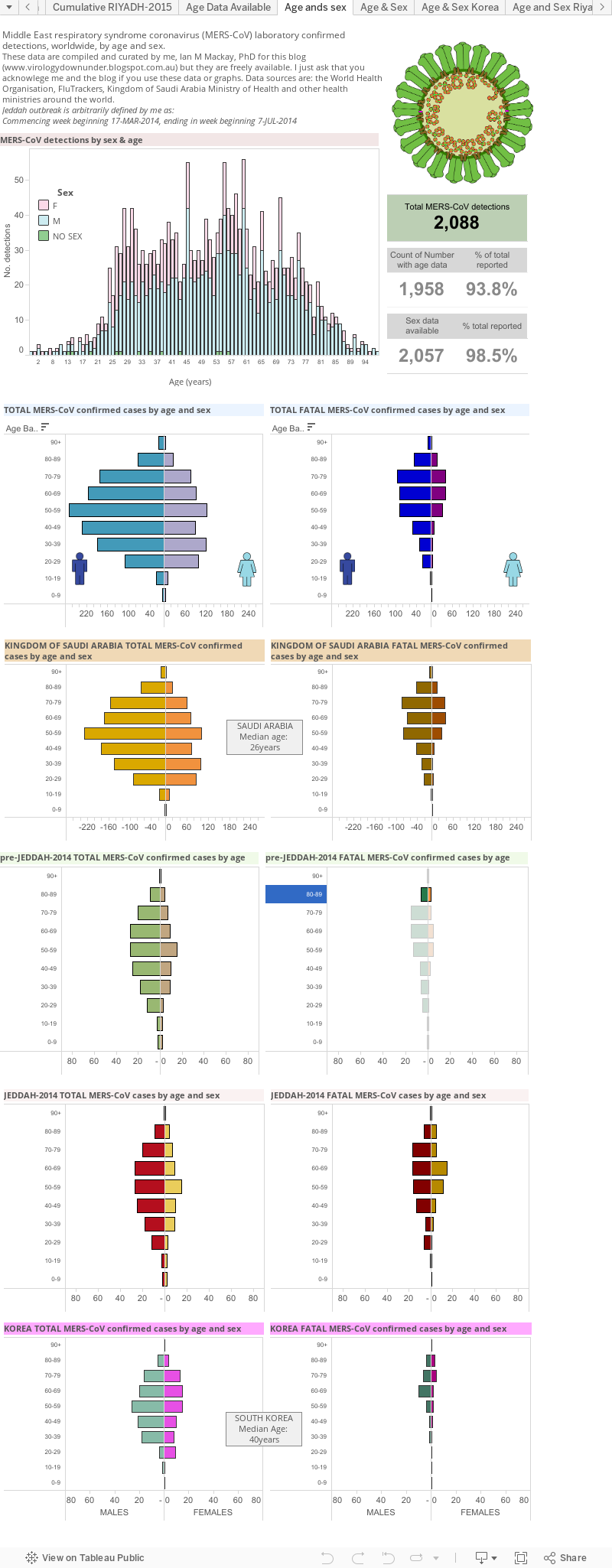
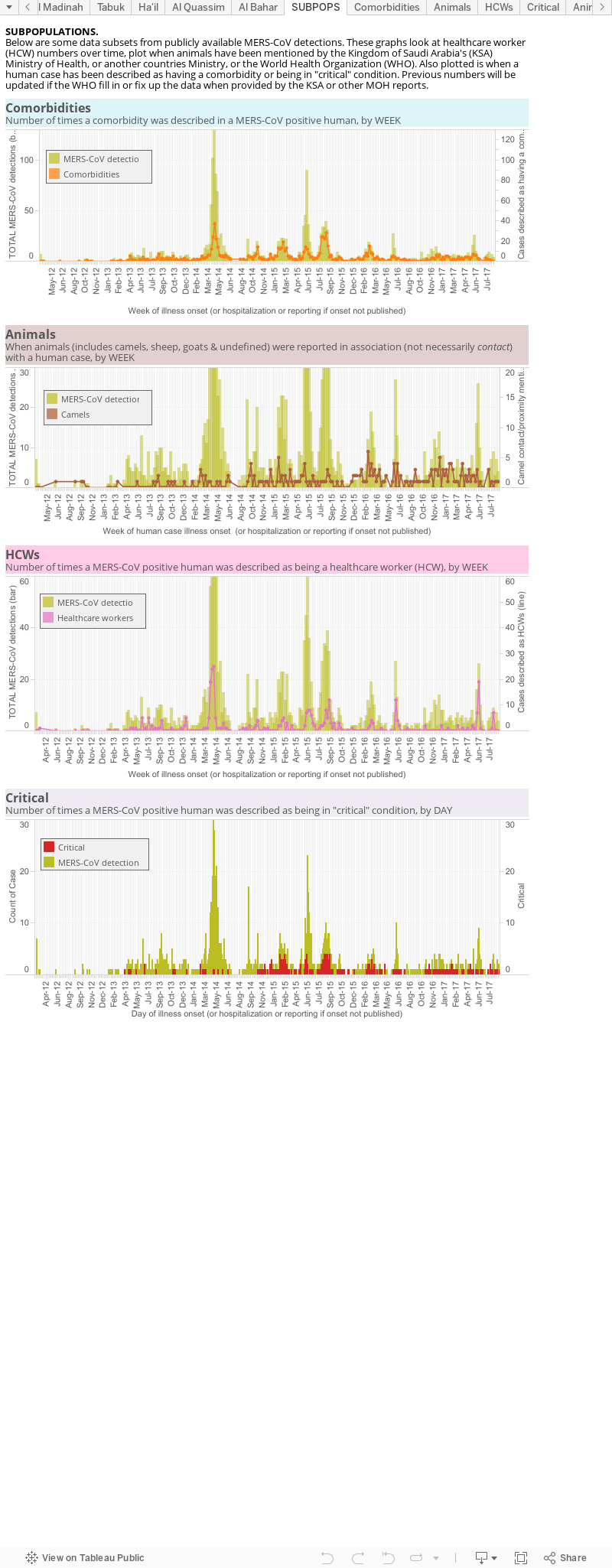
Moreover, from an epidemiological viewpoint, it is extremely important to note that human cases of infection with these two viruses have never geographically overlapped. This is no small fact. The population of Saudi Arabia seems to have an unusually high proportion of older males (Fig 1) with pre-existing medical conditions; from the data that are currently available, this particular group also appears to be most vulnerable to fatal outcomes. Outside this population, MERS-CoV infections seem to be far less frequently associated with severe disease and death.
 |
| Figure 1. Older males represent a greater proportion of MERS cases and even more of the deaths attributed to infection with MERS-CoV. |
Perhaps most salient to this discussion is that MERS-CoV does not transmit in humans as well as SARS-CoV did. In fact, MERS-CoV transmits quite poorly between humans unless a perfect storm of pre-existing medical conditions and poor infection prevention and control in a healthcare setting, and perhaps the right environmental factors, occur.
Dr. MacIntyre compared epidemic curves for SARS and MERS to show that, aside from this year�s March/April hospital outbreaks, the appearance of new MERS cases doesn't follow the same pattern that new SARS cases did. Namely, new MERS cases have continued to appear at a trickle, up until a few weeks ago, whereas SARS disappeared entirely once human-to-human transmission was stopped. One explanation for this is that the Arabian Peninsula has a lot more domesticated camels, which are believed to be the primary host reservoir for MERS-C0V, than China has captive civet cats, which serve as an intermediate host transmitting SARS-CoV from bats to humans. For this and other reasons, there may be a far greater number of opportunities for repeated zoonotic transmission of MERS-CoV than there was for SARS-CoV. In support of this idea, it has been found that those who work with camels are at greater risk of acquiring MERS-CoV than are those who do not.(7)
In short, MERS-CoV is barely contagious among humans but highly zoonotic, and SARS is highly contagious among humans but barely zoonotic.
All of these considerations are reasons to dissuade one from expecting much overlap between the epidemiology of SARS and that of MERS.
Dr. MacIntyre's arguments that some features of the MERS outbreak may be specific to the repeated, deliberate release of MERS-CoV are not supported by evidence.
Dr. MacIntyre states that the ongoing MERS outbreak appears to involve "sporadic ongoing infections from a non-human source." We agree, with the caveat that such infections represent a minority of cases; most cases have resulted from short human-to-human transmission chains in healthcare settings.8 Dr. MacIntyre further states that, "Possible sources of ongoing sporadic infection in humans include animals (camels appear the most likely source), or deliberate release." However, she argues that the epidemiological data may be more easily explained by deliberate release than by infections acquired from animal (camel) sources.
The main features of MERS-CoV infections that are suggested in Table 1 of Dr. MacIntyre's paper to distinguish between deliberate and natural infections are the following:
In support of deliberate release, but not natural infections:
- "Evidence of multiple introductions in a single outbreak."
- Possibly, "Several cases with no link to human OR zoonotic source."
- Possibly, "Multiple genetic strains in a single hospital outbreak at Al Ahsa Hospital."
In support of natural infections, but not deliberate release:
- "MERS-CoV identified in camels."
Below, we respond to each of the features of the ongoing MERS-CoV outbreak that Dr. MacIntyre has suggested provide evidence in favor of deliberate release.
- MERS is repeatedly introduced into the human population, most likely because humans are repeatedly exposed to animal sources of the virus.
While we have yet to see seroprevalence data (though we have on good authority that community seroprevalence is low and a detailed report on the matter will be released soon), no evidence of high population prevalence exists. So far, cases have been sporadic without prolonged chains of human-to-human transmission. Healthcare settings, especially hospitals, have served as both amplifier and nexus for human-to-human spread; approximately 75% of the surge of cases in Saudi Arabia during March-May 2014 are thought to have resulted from human-to-human transmission, primarily in these settings.(9) In fact, many cases initially thought to have been primary, zoonotic cases have subsequently been linked to exposures to confirmed human cases.(8) Also, more than 25% of all cases have been healthcare workers, highlighting the extent of nosocomial (hospital-related) transmission.(8) Moreover, despite Dr MacIntyre�s assertions, a substantial proportion of cases have been mild. Between a quarter (of detections worldwide) and a third (of 113 previously unreported cases announced by the KSA Ministry of Health in early June 2014) were asymptomatic, i.e., they had no notable signs or symptoms of illness.
However, until a pause this July, new MERS cases have been detected almost continuously at low levels over the past year or more. Aside from outbreaks in healthcare settings, these cases are thought to be by and large primary, zoonotic cases, i.e., caught from an animal source, most likely related to camels. Thus, we agree with Dr. MacIntyre that many MERS cases are likely due to multiple introductions into humans; however, we disagree with the idea that this points more to bioterrorism than to an animal source. Instead, we believe that multiple introductions into humans more likely reflect ongoing exposures to infected animals or contaminated animal products; a lot of camels live in and are also imported into the Arabian Peninsula. It is important to note that multiple introductions into humans have also been observed with other zoonotic pathogens as well, including highly pathogenic avian influenza A (H5N1) virus(10) and avian influenza A (H7N9) virus.(11) Existing health conditions have an impact on disease outcomes in such other zoonotic diseases, too. Repeated introductions of a virus into a human population are not unique to bioterrorism; nature does a very good job of creating confounding epidemiological conundrums that are often made worse by inadequate human responses. - We don't know of a source of exposure for a proportion of MERS cases, but that's probably just because we don't have perfect information.
Small numbers of sporadic cases have been reported for which no contact with other confirmed cases or animals is known. Dr. MacIntyre suggests that the simplest explanation for these cases may be bioterrorism. In our opinion, however, these cases may be explained most simply by the pervasiveness of incomplete case histories, and occasionally by contact with undiagnosed cases, rather than by the deliberate release, past or ongoing, of pathogens into the environment. Moreover, patients or their relatives may not be aware of all relevant interactions with animals or animal products, and we also may not be asking the right questions about those interactions. We will simply never know about all relevant contacts for every infected person; we never really do for any viral outbreak. MERS is a fairly new disease, and even the experts are unclear about how MERS-CoV is transmitted from camels to humans or even from humans to humans, for that matter. Let's figure out the basics before we say that bioterrorism is a more likely cause than nature. - Genetic variability among different human MERS-CoV variants is small and probably results from natural variability in MERS-CoV; viruses are naturally diverse.
The fact that multiple MERS-CoV strains were detected in a single outbreak at Al-Ahsa Hospital suggests only that the outbreak resulted from human-to-human transmission of virus introduced via multiple zoonotic events that exhibited some expected genetic variability. Such multiple introductions have been documented and explained already.(12) While it�s possible (though unlikely) that several viral variants were deliberately released, nature is quite capable of doing this without human help.
Genetic variation among MERS-CoV isolates has indeed been detected in Saudi Arabia. However, the changes have affected <2% of the entire genome, a degree of variation that is not uncommon within other endemic human coronaviruses. Virus variation can also occur among MERS-CoV strains passaged through cells in culture, indicating that virus-driven adaptive changes are not unusual in this virus under a variety of host and growth conditions. Furthermore, the genotypes found in both camels and humans throughout the Arabian Peninsula have generally been no more or less divergent than what we�ve seen in Saudi Arabia thus far. The exception is a strain found in a camel in Egypt that had been imported from Sudan or Ethiopia;(13) this strain is notably more divergent and may hint at an as yet untapped source of variation to be found in geographically dispersed cousins of the Saudi viruses. Genetic variability occurs naturally among viruses, including zoonotic viruses,(14) and is not a hallmark of bioterrorism.
There are better ways to explain the unusual features of the observed epidemiology of MERS-CoV.
Dr. MacIntyre states, "The continued increase in cases in KSA in 2014, without satellite epidemics in other countries, and without consistent animal contact in all cases is inexplicable." These observations are not inexplicable for a virus that transmits poorly. We argue that satellite epidemics have not been observed simply because secondary, human-to-human spread of MERS-CoV is rare and is, moreover, most likely attributable to a small percentage of cases. We have seen evidence for such inefficient transmission in almost every exported MERS case to date. People sitting next to a confirmed case during tours and on planes have not become ill; nor have they tested positive for MERS-CoV. Apart from weaknesses in the virus and environmental factors (e.g. temperature, humidity, outside camel birthing season), good infection prevention and control may also play a role in limiting spread.
Dr MacIntyre suggests, further, that, �If the large recent increase in cases in KSA is due largely to person-to-person transmission, other similar increases (satellite epidemics) would be expected in other countries.� However, even though satellite epidemics have not occurred, it is a fact that most cases in the spring in the KSA were due to human-to-human transmission. The healthcare-related outbreak in Jeddah was tied to location-specific failures of infection prevention and control, as the World Health Organization (WHO) has pointed out.(8,15)
As for cases "without consistent animal contact," we hope that Dr. MacIntyre is not expecting proof of animal contact for every case, but rather for suspected primary cases only. As discussed above, most cases have reportedly resulted from human-to-human transmission, and the rest are probably accounted for by incomplete medical case histories and overlooked contacts with an undiagnosed case or infected camel source. Alas, for some primary cases, we simply do not have enough information yet.
The epidemiological data used by Dr MacIntyre, courtesy of the Saudi Arabian Ministry of Health and the WHO, are imperfect. Those of us maintaining MERS-CoV detection line listings are painfully aware of the limitations associated with these data and their communication. Reporting formats have changed repeatedly, resulting in inconsistent case histories. Testing delays, reporting gaps, incomplete case information and translation errors are but a handful of issues that must be considered and controlled for when using these data to improve our understanding of MERS epidemiology.
Yes, there have been seemingly incongruous pauses in case announcements during periods of mass gatherings � times when we might expect detections of a respiratory virus to be on the rise. Yes, it appears, from the data alone, that only a handful of cases have reported animal contact, despite the fact that about 25% of human cases have been zoonotic, according to the WHO.(9) Yes, countries with cases outside Saudi Arabia more often report contact with camels. However, these �paradoxes and inconsistencies� are far more likely due to incomplete and inconsistent data collection and reporting than to a �deliberate release� of MERS-CoV as a putative category C bioterrorism agent.
How likely is it that MERS-CoV is a cultured pathogen deliberately released by bioterrorists?
The likelihood that MERS-CoV was deliberately released in Saudi Arabia is vanishingly small, and Dr MacIntyre�s article fails to provide any sound scientific basis to convince us otherwise. Each of the features of the ongoing MERS-CoV outbreak that she has put forth as an indicator of deliberate release can also occur naturally. In addition to the issues discussed above, Dr MacIntyre offered no explanation to describe a mechanism by which MERS-CoV could have been weaponized; however, given what we do know about MERS-CoV, purposeful weaponization seems highly improbable. Thus, while it is worth considering whether any disease outbreak has a deliberate human cause, Dr. MacIntyre's paper provides no evidence that supports bioterrorism as a cause of MERS. Instead, an abundance of evidence suggests that MERS results from natural causes.
MERS-CoV is known to infect dromedary camels across the Arabian Peninsula and Africa; we likely know of only a fraction of its geographic range in the latter. Moreover, the virus has been in these animals for at least 20 years. As we continue to learn, it�s looking more and more like an ancestor of MERS-CoV first emerged in bats, potentially in Africa.(16,17) If the virus did spill over from bats to camels at some point, it remains unknown when or how, as does the scope of how many other animals carry some version of MERS-CoV-like viruses.
So, does any of this mean that a deliberately engineered form of the bat virus was purposefully released into camels more than two decades ago? Could it have been a (very poorly functioning) bioweapon intended for use against camels? Who would have created such a weapon? Or, was such a virus potentially introduced into humans first and we�ve been the source of camel infections ever since? Due to the large genome sizes of coronaviruses (the largest among all RNA viruses), reverse genetics systems, used for �made-to-order virus� construction, are quite cumbersome and demanding; only a handful of labs are known to be proficient with these systems. These significant technical requirements provide further evidence against the possibility that MERS-CoV has been used as a bioweapon.
Dr. MacIntyre states that, �when a new infectious disease emerges, bioterrorism, unless it is caused by an eradicated disease such as smallpox, may not be easily recognized for what it is unless we consider the possibility.� This, however, is not supported by the last decade of research and development, undertaken across the world, towards the goal of preventing, detecting, and mitigating the effects of bioterror. Since 2001, considerable resources have been invested in preparing for bioterrorism. This has led to the deliberate and explicit �securitization� of public health and medicine, with a focus on conceiving the potential for human-caused disease outbreaks.(18) The focus on man-made viruses and the potential for bioterror is a multibillion dollar enterprise;(19) if the status of MERS-CoV as an intentional release agent were plausible, it would provide rare vindication for such efforts. That it has not is not for want of attention on the behalf of policymakers around the globe.
It is also worthwhile to reflect on the reasons one might release a pathogen and how the ultimate goals of any purported bioterrorist might inform their release strategy. The two iconic instances of bioterror�separate from biological warfare�in the twentieth century were the use of Salmonella enterica by the Bagwan Shree Rajneesh cult in Oregon in 1984 and the 2001 anthrax attacks.20 In both, a bacterium was used with very specific goals: the attempted manipulation of a local election and the targeting of US public service institutions.
A poorly transmitting coronavirus, however, could not be targeted as well as the pathogens used in the above cases. It isn�t an ideal agent for more common attempts to use pathogens as weapons, either, such as the failed attempts to weaponize anthrax and the botulinum toxin by the Aum Shinrikyo doomsday cult.(20) Rather, MERS-CoV occupies a biological limbo in which its effects are too intermittent for it to be a targeted agent, but nowhere near prolific enough to be a means of generating widespread bioterror. If MERS-CoV were to be�counterfactually�a bioterror agent, then its creators would have surely failed at their task.
We don�t see too many new diseases; there are only so many ways a pathogen can make us sick. In this sense, MERS is not really clinically distinct, and certainly nothing about MERS can be pointed out as pathognomonic; however, there still remains much to learn about the epidemiology, clinical course and virology of the disease. This is quite commonly the case, even two years after the discovery of a new viral species. By all means, investigators should consider all potential causes of outbreaks of new human pathogens, even bioterrorism. However, in the case of MERS, while detailed laboratory, epidemiological and clinical studies are absent or found wanting, the publicly available data that exist are consistent with a natural origin for the outbreak. The simplest explanations are likely still the best; in this case, when we hear hoof beats, we shout camel, not bioterrorist.