 |
| Click on map to enlarge. |
Showing posts with label Ebola virus disease. Show all posts
Showing posts with label Ebola virus disease. Show all posts
A good week for viruses...not so great for humans...

Edited for clarity 25MAY2015
Middle East respiratory syndrome coronavirus (MERS-CoV) managed to get out for some sightseeing - travelling to South Korea this week - and Ebola virus|Makona was given a helping hand to spread to new people in Guinea and Sierra Leone with a small splurge of new confirmed cases.MERS has now trickled into 24 countries world wide as shown in the European Centre for Disease Prevention and Control's (ECDC) epic 'travel-by-plane' map.
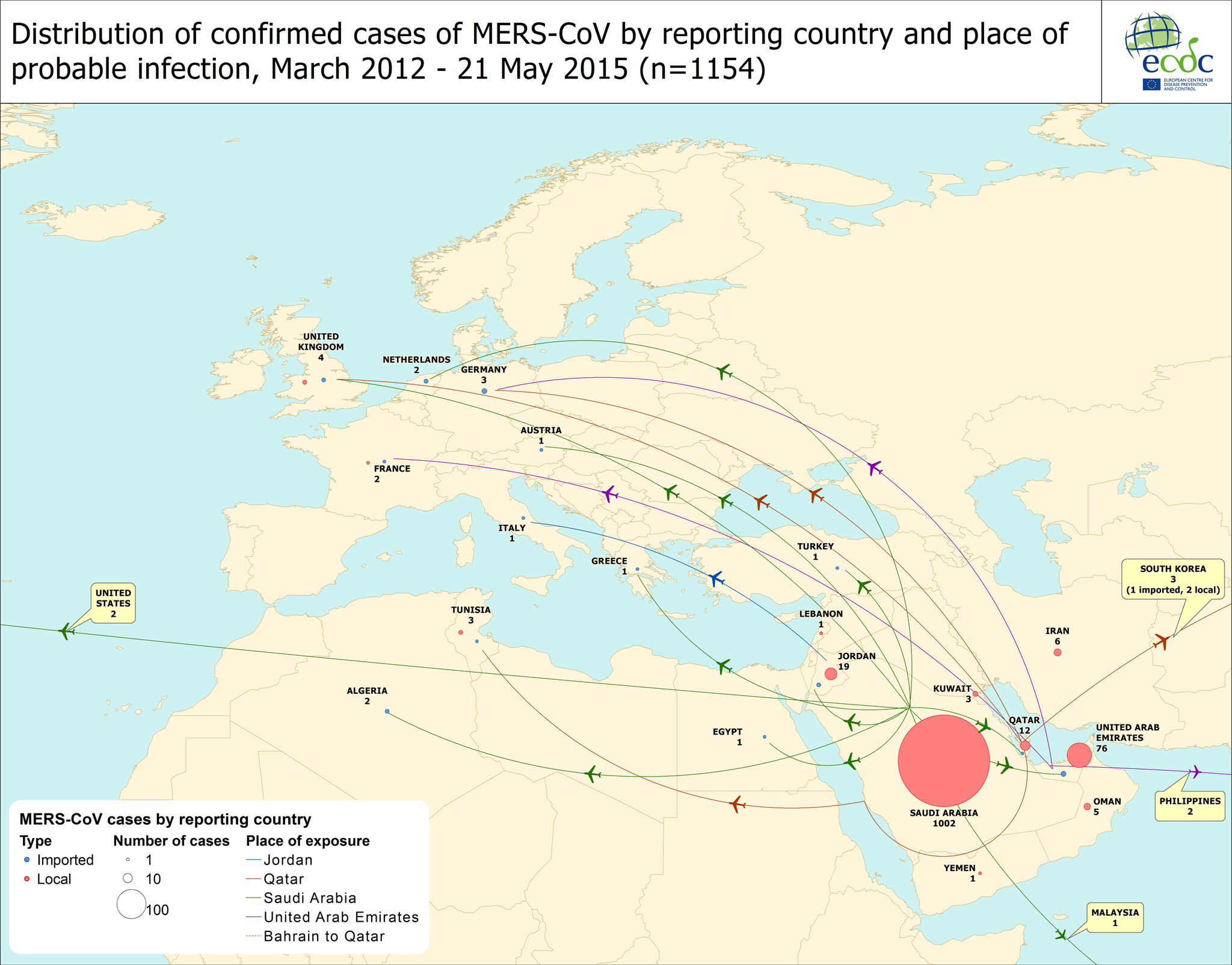 |
| The original of this is created by the ECDC and is presented here. Click on image to enlarge. |
Meanwhile, a crude extrapolation from current Ebola virus disease (EVD) case numbers saw the predicted date when we might reach zero cases, move further into June.
This could pull back again or it could move further away if the EVD clusters and sporadic cases continue to spread. We can't model that because it's entirely down to unpredictable human variables. We can list what those are, we can better prepare for them, we can educate about them and how to prevent them and we can acknowledge that they are real, but we cannot know when and in what mix they will come into play.
This could pull back again or it could move further away if the EVD clusters and sporadic cases continue to spread. We can't model that because it's entirely down to unpredictable human variables. We can list what those are, we can better prepare for them, we can educate about them and how to prevent them and we can acknowledge that they are real, but we cannot know when and in what mix they will come into play.
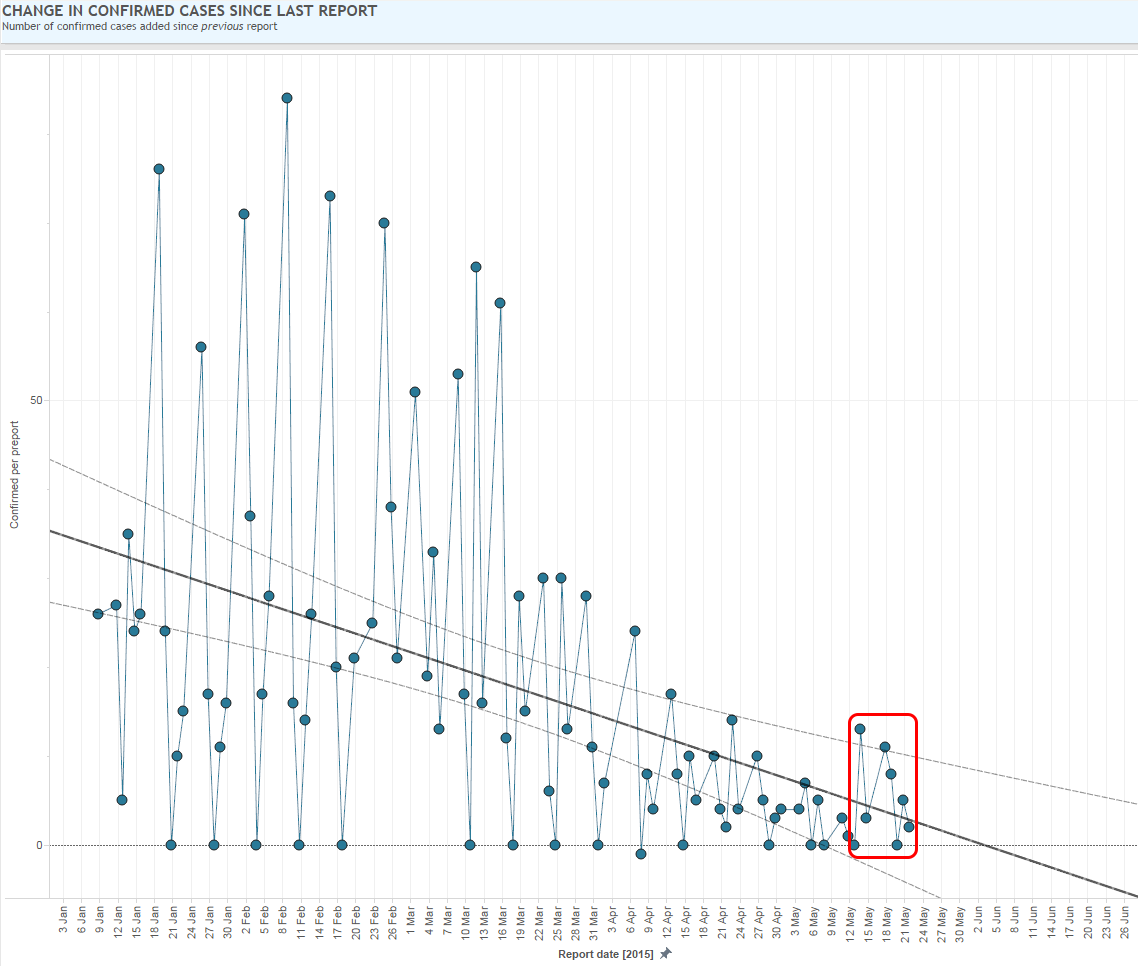 |
| Extrapolation of the public data for confirmed Ebola virus disease cases from WHO. The most recent week is boxed in red and bucked the trend of declining cases. To see how I made this please visit here. Click on image to enlarge. |
The newest EVD cases remain mostly clustered around the Forecariah prefecture of western Guinea, on the north west border with Sierra Leone but also 5 new cases appeared in the north west of Guinea in Boke prefecture, which borders Guinea-Bissau.
 |
| From the World Health Organization's Ebola virus disease Situation Report, 20MAY2015. Click on image to enlarge. |
Since the last EVD SitRep, two days of reporting have seen fewer cases than in the same two days of the week before.
So there's that.
Quickly reporting what is actually happening is invaluable for all sorts of reasons. Modelling and prediction allow us to get ahead of the virus. But having the data, and having them available publicly remains a challenge for every country and for every outbreak.
So there's that.
Quickly reporting what is actually happening is invaluable for all sorts of reasons. Modelling and prediction allow us to get ahead of the virus. But having the data, and having them available publicly remains a challenge for every country and for every outbreak.
Public health data are about the public's health. If it has been considered worth collecting and collating, why not communicate it too?
Snapdate: Confirmed Ebola virus disease cases - the end in sight?
I think we're a little bit beyond "jinxing" something by pointing it out, so here is graph of the confirmed Ebola virus disease cases based on the World Health Organization report date (Situation summary or Situation Report), including a basic model to predict when cases may hit zero, if nothing changes.
 |
| The P-value for this linear trend model is 0.00067. The standard error = 19.29;R-square = 0.14. Click on graph to enlarge |
Reported numbers or outbreaks could flare up tomorrow or dry up overnight.
I can say that over the past 2 weeks, data from each new summary or report have moved the predicted "end" data closer - from mid-June to now early June.
I am not an expert at modelling or statistics so please just take this at face value. The line suggests that if all things stay the same, we will reach zero considered cases per report around the 3rd of June 2015.
Please let it be so.
Realistically, we may be heading for another "step down" - followed by a smaller trickle of ongoing cases for some period, ahead of a final push to zero. But there are experts who will know more about this than I.
Once we get to zero, the 42 day count begins.
Yes, there were signs that Ebola was in west Africa, perhaps as far back as 1973...

Apparently, it now does. The New York times [3] has found that there were studies reporting signs of Ebola virus antibodies in humans in Liberia in samples collected back in 1982.
I'll see your 1982 and raise you 1973! [1] That's when some other samples were collected that were found to contain antibodies to Ebola virus. This doesn't come up in the abstract for this article, but is buried in the Methods and Materials section.
"..antibodies specific for Marburg virus and Ebola virus antigens tested by immunoblotting (21% and 14%,respectively)"We noted this paper in 2014 - in a piece for the Conversation [2] - and listed some other articles which found similar signs of prior human exposure to Ebola virus or something related. The NYT piece has also captured some of these papers by the looks of it.
In many (most?) cases, these scientific papers can only be reached after paying a fee, or being affiliated with an Institutions that has a good library. Many researchers, clinicians and public health professionals can be described as such.
For me, it seems clear that there were many people aware of the possibility the Ebola virus was pretty much "always" (in the context of our history with Ebola virus disease[EVD]) in the forests within the regions underneath the flyways of some likely filovirus-host bat species.
But seemingly no action was taken on these reports. Was that because...
- the serology assays were perhaps too non-specific or otherwise unreliable (were they cross-reacting with as-yet unknown filoviruses perhaps (h/t Stephen Goldstein)
- no-one thought much of EVD's capacity to cause a big outbreak?
- we didn't care about smaller outbreaks because they had always been controlled previously?
- we just didn't care because it was "over there" (in Africa)?
- we just forgot about it as soon as it was published?
This is not a problem specific to EVD of course. Trying to stay ahead of infectious threats will take much more devotion than the world has shown it can muster to date. Even when we can see their potential for harm, there are only so many resources we will mobilize for an infectious threat that is not knocking on our specific door.
References...
- Neppert J, G�hring S, Schneider W, Wernet P.
No evidence of LAV infection in the Republic of Liberia, West Africa, in the year 1973.
http://www.ncbi.nlm.nih.gov/pubmed/3015288 - How Ebola started, spread and spiralled out of control
https://theconversation.com/how-ebola-started-spread-and-spiralled-out-of-control-32137 - Yes, We Were Warned About Ebola
http://www.nytimes.com/2015/04/08/opinion/yes-we-were-warned-about-ebola.html
Hans Rosling, a micro-outbreak of Ebola in Liberia and trust issues in Guinea...
As is always the case, Prof Rosling can be seen in front of an audience here, providing a beautifully articulated example of how trust in the Ebola virus disease (EVD) treatment centre/unit plays such a pivotal role in (a) the containment of EVD, even witting a family and its contacts, and (b), the likelihood of survival of EVD patients.
In this example, which you can listen to in its entirety here, as time went on, trust grew and this fewer transmission occurred and more f those infected, survived.
This would seem to be a great example of what is lacking in Guinea - trust - a lack of trust that others are be able to stop the spread of virus and to save the lives of those infected. Thus people are not presenting for help at all and still being managed in the community - possibly infecting others - or else they are not presenting early enough, before the disease has done too much damage to the person. Trust and communication is increasingly seen as being as important to the successful reduction of cases in Liberia and Sierra Leone as the building of treatment centres - the two must co-occur.
Trust comes from understanding, and that is heavily influenced by communication. Communication of accurate information, of clear and digestible information. Communication to the right people using the moist effective channels is also essential.
It still feels like communication, or at least accurate and successful communication accessing the key important and influential people, may be the weakest part of the response in Guinea. It seems to have been better implemented in Liberia and Sierra Leone - or maybe just better received. Is it a groundwork thing? Difference in the way science is presented in different countries? I know far too little to guess further.
There continue to be more security incidents and other types of refusal to cooperate in Guinea compared to the other two countries afflicted with the Makona variant of Ebola virus. These incidents are a marker of a community that does not believe or trust those claiming to be here to help. And that's a problem for stopping the constant rivulet of EVD cases in Guinea; a rivulet that never became the river of hundreds of EVD cases per week seen in Liberia or Sierra Leone, but was still a flow that seeded infection across the region and the world. A case anywhere is a threat everywhere, to paraphrase others.
But there may be other issues to consider and question.
There are fewer treatment centres and laboratories in Guinea than in Liberia or Sierra Leone - strange given that Guinea is larger and that it still has a geographically widespread distribution of cases.
While it has lately been noted that new cases in Guinea could be adding to the tally more simply because of success in reaching more remote areas, this seems only to add support to the need for better communication and to provide more of a presence in these remote areas. Hopefully, now that this happening through the efforts of the US CDC and others, we will soon see the pay off as a reduction of EVD cases. But the rainy season is near and travel will be made into a muddy mess by that. Time has never been on the side of those trying to stop this epidemic.
 |
| Frame taken from a BBC News video which was being hosted in an African Geographic Magazine story here. Red dots are survivors, black dots are deaths Click on image to enlarge. |
This would seem to be a great example of what is lacking in Guinea - trust - a lack of trust that others are be able to stop the spread of virus and to save the lives of those infected. Thus people are not presenting for help at all and still being managed in the community - possibly infecting others - or else they are not presenting early enough, before the disease has done too much damage to the person. Trust and communication is increasingly seen as being as important to the successful reduction of cases in Liberia and Sierra Leone as the building of treatment centres - the two must co-occur.
Trust comes from understanding, and that is heavily influenced by communication. Communication of accurate information, of clear and digestible information. Communication to the right people using the moist effective channels is also essential.
It still feels like communication, or at least accurate and successful communication accessing the key important and influential people, may be the weakest part of the response in Guinea. It seems to have been better implemented in Liberia and Sierra Leone - or maybe just better received. Is it a groundwork thing? Difference in the way science is presented in different countries? I know far too little to guess further.
There continue to be more security incidents and other types of refusal to cooperate in Guinea compared to the other two countries afflicted with the Makona variant of Ebola virus. These incidents are a marker of a community that does not believe or trust those claiming to be here to help. And that's a problem for stopping the constant rivulet of EVD cases in Guinea; a rivulet that never became the river of hundreds of EVD cases per week seen in Liberia or Sierra Leone, but was still a flow that seeded infection across the region and the world. A case anywhere is a threat everywhere, to paraphrase others.
 |
| Location of laboratories in Guinea, Liberia, and Sierra Leone. From WHO SitRep 01APR2015. |
There are fewer treatment centres and laboratories in Guinea than in Liberia or Sierra Leone - strange given that Guinea is larger and that it still has a geographically widespread distribution of cases.
While it has lately been noted that new cases in Guinea could be adding to the tally more simply because of success in reaching more remote areas, this seems only to add support to the need for better communication and to provide more of a presence in these remote areas. Hopefully, now that this happening through the efforts of the US CDC and others, we will soon see the pay off as a reduction of EVD cases. But the rainy season is near and travel will be made into a muddy mess by that. Time has never been on the side of those trying to stop this epidemic.
The weakening pulse of the Ebola monster...
As of this post, some of the most comprehensive publicly available data on an emerging virus is coming out of the Kingdom of Saudi Arabia in relation to the Middle East respiratory syndrome coronavirus (MERS-CoV). Yeah-that's what I said. Even with all the issues I complain about, its more detailed than for other current outbreaks.
In 2015, China became a major disappointment in its poor publication of data for the avian influenza A(H7N9) virus's 3rd outbreak - choosing to release bulk updates and little to no detail on who, where or when.
The continuing avian influenza A(H5N1) virus outbreak in Egypt is also a mystery to all but a very few. Something that is a concern I think, for a much larger number.
Data from the Ebola virus hotzone countries in western Africa has also had many ups and downs. This is not at all surprising given the conditions, the extent of mobile communications, the history of the region, the political and social issues, the poor health infrastructure and the speed with which Ebola virus disease (EVD) spread through Guinea, Liberia and Sierra Leone in 2014. Many different patterns have emerged over the past year among these numbers.
One pattern is the "heartbeat" of EVD cases - the difference in number between update and summary tallies - seen when plotting the data reported by the World Health Organization.
The peaks (Wednesdays and Mondays) and troughs in this chart both hide and reveal all sorts of tales. Principal among these is that the pulse is slowing. The life of the EVD epidemic monster is steadily draining away as the courageous aid workers in western Africa, those from within and from outside each afflicted nation, track the monster to its every hideout and starve it of its avenues for escape and further spread.
It is perhaps the slowest and most painstaking of the phases of this epidemic, but the process still moves forward towards the goal of zero cases and the complete eradication of these particular variants of Zaire ebolavirus, from the planet.
In 2015, China became a major disappointment in its poor publication of data for the avian influenza A(H7N9) virus's 3rd outbreak - choosing to release bulk updates and little to no detail on who, where or when.
The continuing avian influenza A(H5N1) virus outbreak in Egypt is also a mystery to all but a very few. Something that is a concern I think, for a much larger number.
Data from the Ebola virus hotzone countries in western Africa has also had many ups and downs. This is not at all surprising given the conditions, the extent of mobile communications, the history of the region, the political and social issues, the poor health infrastructure and the speed with which Ebola virus disease (EVD) spread through Guinea, Liberia and Sierra Leone in 2014. Many different patterns have emerged over the past year among these numbers.
One pattern is the "heartbeat" of EVD cases - the difference in number between update and summary tallies - seen when plotting the data reported by the World Health Organization.
 |
| Click on image to enlarge. |
It is perhaps the slowest and most painstaking of the phases of this epidemic, but the process still moves forward towards the goal of zero cases and the complete eradication of these particular variants of Zaire ebolavirus, from the planet.
Useful Ebola virus disease graphics...
Good graphics can be really helpful to convey information quickly - and no-one has time to read words anymore right?

The one above came from CNN [1] and presents the number of cases that have been treated in the United States prior to the 11 or so contacts/associates of the last unidentified case being evacuated.

The second one, above, came form the European Centre for Disease Control and Prevention (ECDC).[2] These guys make excellent plane travel/infectious disease maps. This one shows that the UK has kept pace with the US in medical evacuations or repatriations of EVD cases, or suspected cases, from the hotzone in west Africa.
References..
Liberia enters the next phase of Ebola virus disease (EVD) eradication with a new case...
version 2
What a heartbreaking disappointment this is for the people of Liberia, with a reported new case of EVD in a 44-year old woman who showed signs of disease 15th March and tested positive for Ebola virus on Friday 20th in Monrovia, Liberia.[2,7,8] after more then 3-weeks (28 days or more[6]) with zero new cases and no ongoing, known, transmission of Ebola virus in any county in the country.[5] The previous final case in Liberia tested negative around the 3rd of March (about 17-days ago), when the 42-day clock was started.[5]
Now it has been stopped.
Starting it again will await this new case returning a negative test as well as all their contacts (who will be monitored for 21-days) being declared infection- (actually disease-, but I say infection intentionally) free.
And thus we enter the next phase � that of a different type of frustration and heartbreak as countries within the tri-nation hotzone come tantalisingly close to being declared free of known cases of Ebola virus disease (EVD; see how those seemingly pedantic words [1] have added meaning now?) or virus transmission, or in fact succeed only to have a random case pop up from somewhere unexpected or travel across a border causing disappointment for the people of the country, the aid workers and the family and friends of the new case.
A random case will also trigger all new contact tracing efforts to try and find the source and lock down further spread as quickly as possible.
There is noise on twitter (see Tweet below) and in the media quoting authorities [6] noting that the case may have been from a sexual contact with a previously infected male. Infectious virus has been found in semen in the past in which it can linger for more than a month [3,4], but this has not been a factor in the timing of release of convalescent males in the recent epidemic. If this is the route of acquisition, then the ensuing costs, scope of the response, risk to a country that had nearly cleared the virus and to the stamina of an Ebola-ravaged country may serve to justify additional testing the future.
#Liberia Min of Info says 'initial suspicions' are that country's 1st #Ebola victim in 28 days could have had sex w/ ebola survivorThe route of acquisition in this latest case remains totally unconfirmed at writing.[7] I'll update this post as I find more details.
� Katerina Vittozzi (@kvittozzi) March 20, 2015
My thoughts are with you Liberians � stay strong � it�s a setback to be sure, but you were very close this time and will get there.
References...
- http://unfoundationblog.org/mali-42-days-free-of-ebola-transmission/
- http://www.bbc.com/news/world-africa-31991748?ocid=socialflow_twitter
- http://www.ncbi.nlm.nih.gov/pubmed/25467652
- http://newsmedicalnet.blogspot.com.au/2014/08/ebola-virus-in-semen-is-real-deal.html
- http://apps.who.int/ebola/current-situation/ebola-situation-report-18-march-2015
- http://www.aljazeera.com/news/2015/03/ebola-case-ends-liberia-countdown-virus-free-150321003004879.html
- http://time.com/3753233/ebola-liberia-new-patient/
- http://www.nytimes.com/2015/03/21/world/africa/liberia-reports-first-ebola-case-in-weeks.html
Catching Ebola: mistakes, messages and madness [amended]
Written by Dr. Ian M. Mackay and Dr. Katherine E. Arden
Despite obvious community and media fear, speculation and exclamation that Ebola virus would enter and spread widely within countries outside the hotzone, such an event did not come to pass in 2014. The early public health messaging on Ebola virus and disease were, for the most part, spot on.
In 2014 and 2015, thousands of cases of Ebola virus disease (EVD) ravaged Guinea, Sierra Leone and Liberia in 2014 (the "hotzone"). A smaller outbreak was defeated in Nigeria [8] and another distinct Ebola virus variant drove an outbreak of EVD in the Democratic Republic of the Congo[7] - they too controlled spread of the virus. Ebola virus travelled from the hotzone to other countries including Senegal, Nigeria, the United States of America (USA), Mali and most recently, the United Kingdom. It did this by hitching a ride in a usually unknowingly infected human host.
Over 40 people have been intentionally evacuated or repatriated for observation or more aggressive supportive care - and perhaps the use of experimental therapies - to France, the USA, Spain, Sweden, Norway, Denmark, Germany, Netherlands, Italy, Switzerland and the United Kingdom.[1,18]
Recently, the last country outside of Africa to have unintentionally acquired a case of EVD, the United Kingdom, passed a milestone; 42 days since the last ill patient tested negative for Ebola virus. They were declared free of known virus transmission.[17]
Containing the spread of each imported case has relied upon stringent infection prevention and control measures and the identification and monitoring of each and every contact of an Ebola virus infected person. And these have been used with great success. No country, apart from the three in which transmission has been widespread and intense, has seen the appearance of multiple and continuing rounds of new EVD cases. A rough calculation of the numbers of contacts falling ill from each EVD index case who travelled outside the hotzone is shown in the table. It only includes those with data available publicly.
On average, fewer than 1 in 100 contacts (0.8%) came down with EVD. Not the easiest virus to catch? If you compare that to measles, 9 in 10 non-immune people close to an infectious measles case will acquire disease (90%).[19]
Table 1. Index cases and the proportion of contacts they infected
 |
a-man travelled overland from Guinea while infected; b-man with EVD repatriated from Liberia; c-man who flew while symptomatic to Lagos, Nigeria with a stopover in Lome, Togo; d-man flew from Liberia while infected; e-male healthcare worker returned from Guinea; f-a 2 year old girl travelling overland while infected; g-male travelled by car to a clinic in Bamako, Mali from Guinea (assumed Ebola case); h-female healthcare worker returning from deployment in Sierra Leone; i-this figure may indicate all contacts for both Mali cases |
Some of the heat may have been taken out of the emotional response to Ebola outside Africa because it is now clear that a catastrophic pandemic is not going to happen. Kinda like we were told. I know; it;s so uncool to be reminded that you were told something by a grown up - and it was right!
Well...THEY TOLD YOU SO!!!
Nations with better (some!) healthcare infrastructure, preparedness, healthcare to patient ratios and those who got advice and help quickly, curtailed the spread of EVD. Kicked it out. Stomped on it. Terminated it. This was true even when contacts had been classified as at high risk of getting sick.[15]
Public health messaging made some big calls early on. Some examples include tweets by Head of Public Relations for the WHO, Gregory H�rtl, and later by the Centers for Disease Control and Prevention�s Director, Dr Tom Freiden.[11] They made it clear that Ebola virus was not easy to catch and that measures to stop an outbreak were known.[16] At the time, this didn't jibe with other voices and the unprecedented number of EVD cases and deaths, especially from August onwards, that were tallying up at an exponential rate in west Africa. But those messages, while technically correct, probably didn't convey enough of some of the biggest factors in a disease outbreak - fear, ignorance (meant only in the sense of no specific knowledge of Ebola virus and EVD), tradition and history - the human factors rather than the viral ones. Some comments about transmission suggested essentially no chance of even a single new case happening on the home soil of richer countries - they were overly enthusiastic. They were unjustifiable and when some hospital workers in non-African countries became infected, they were ultimately seen for the mistake in message crafting that they were.
Much of the science of the Ebola epidemic is yet to be written, but what we know today is that it is unlikely that Ebola transmission is any different from what was observed decades ago. Direct, physical contact with a very ill person�s fluids is the overwhelmingly biggest risk factor to target in reducing disease spread. And even then there's no guarantee that disease will result from all instances of contact. We still have much to learn.
What has changed since the bad old days? We�ve learned how to better manage and support EVD cases. EVD is a disease that caught us a little unawares in its combination of "skills" - it spreads by care and through direct contact, accrues a lot of virus in the blood but also vast quantities in explosively propelled fluids produced from "both ends"; virus that remains infectious for even longer in urine and semen than in blood. Quite the mix of issues to deal with.
EVD is no longer a death sentence, and this needs to become part of the new messaging paradigm. It's a message that may still be highly relevant to those in Guinea and Sierra Leone who seemingly would still rather risk death than seek care at a treatment unit. Post-mortem detection of EVD cases is ongoing, although may be on the decrease but also nearly a third of cases in Guinea and Sierra Leone are arising from unknown human sources.[21] Contextual communication is needed from within each country and region. That aspect cannot be allowed to wane.
With early care, and active care, rather than the palliative model that seemed to occur when the ratio of EVD cases to healthcare workers was too high, patients mostly survive. The EVD treatment center at the Hastings Police Training School near Freetown, Sierra Leone stands as a model for successful life saving and is the best described example of this from the west Africa epidemic to date.[20]
Ebola virus infection is not easy to catch, it can be survived much more often than was generally accepted and its spread can indeed be stopped. Stopping an Ebola outbreak quickly seems to be helped mostly by prior education, ongoing communication, forewarning and preparation but also needs ongoing surveillance, functional healthcare infrastructure, a range of experienced workers and all of that must all be under-written by money.
But even with all that help in place, mistakes will be made and lessons will be learned, by everyone, all the time. Embrace that. We're all human.
References
Ebola virus infection is not easy to catch, it can be survived much more often than was generally accepted and its spread can indeed be stopped. Stopping an Ebola outbreak quickly seems to be helped mostly by prior education, ongoing communication, forewarning and preparation but also needs ongoing surveillance, functional healthcare infrastructure, a range of experienced workers and all of that must all be under-written by money.
But even with all that help in place, mistakes will be made and lessons will be learned, by everyone, all the time. Embrace that. We're all human.
References
- http://www.nytimes.com/interactive/2014/07/31/world/africa/ebola-virus-outbreak-qa.html
- http://apps.who.int/iris/bitstream/10665/137510/1/roadmapsitrep_5Nov14_eng.pdf
- http://www.who.int/mediacentre/news/ebola/20-november-2014-mali/en/
- http://www.who.int/mediacentre/news/ebola/17-october-2014/en/
- http://www.nyc.gov/html/doh/html/pr/press-statements.shtml
- http://www.cdc.gov/vhf/ebola/outbreaks/2014-west-africa/united-states-imported-case.html
- http://www.nejm.org/doi/full/10.1056/NEJMoa1411099
- http://www.eurosurveillance.org/ViewArticle.aspx?ArticleId=20920
- http://apps.who.int/ebola/en/status-outbreak/situation-reports/ebola-situation-report-14-january-2015
- http://www.symplur.com/blog/the-life-cycle-of-ebola-on-twitter/
- http://www.foxnews.com/opinion/2014/08/09/truth-about-ebola-us-risks-and-how-to-stop-it/
- http://www.nytimes.com/interactive/2014/10/20/us/cascade-of-contacts-from-ebola-case.html
- https://www.gov.uk/government/news/ebola-contact-tracing-underway
- http://www.thelancet.com/pdfs/journals/lancet/PIIS0140-6736(14)62016-X.pdf
- http://www.who.int/mediacentre/news/ebola/3-september-2014/en/
- http://www.bloomberg.com/news/videos/b/4a798222-3666-446d-81ff-f21412a3f068?cmpid=yhoo
- http://www.euro.who.int/en/health-topics/emergencies/pages/news/news/2015/03/united-kingdom-is-declared-free-of-ebola-virus-disease/_recache
- http://ecdc.europa.eu/en/healthtopics/ebola_marburg_fevers/Pages/medical-evacuations.aspx
- http://www.cdc.gov/measles/about/transmission.html
- http://www.nejm.org/doi/full/10.1056/NEJMc1413685
- http://apps.who.int/iris/bitstream/10665/156273/1/roadmapsitrep_18Mar2015_eng.pdf?ua=1&ua=1
Last country outside the hotzone to pass 42-day period-awaits official announcement...
The United Kingdom (UK) reached the 42-day mark, during which no new known cases resulted from the index case, on the 6th March 2015.
The UK's accidentally imported Ebola virus disease (EVD) case, a female healthcare worker returning from deployment in Sierra Leone [1], last tested negative for Ebola virus on 23rd of January. She was discharged from hospital on 24th of January.[2]
All that remains now is for an official announcement...from someone (else) official, singing this achievement from the rooftops.
A Public Health England report (below), posted on the UK government website has already acknowledged the 42 day mark.
A bit understated even for the mother country!
References...
The UK's accidentally imported Ebola virus disease (EVD) case, a female healthcare worker returning from deployment in Sierra Leone [1], last tested negative for Ebola virus on 23rd of January. She was discharged from hospital on 24th of January.[2]
 |
| Timeline of the UK EVD case. Green=onset; pink=hospitalization; blue=date of final NEG test on which the 42-day clock started; grey box=country considered, if not yet declared, free of known ongoing Ebola virus transmission. Click on image to enlarge |
All that remains now is for an official announcement...from someone (else) official, singing this achievement from the rooftops.
A Public Health England report (below), posted on the UK government website has already acknowledged the 42 day mark.
A bit understated even for the mother country!
 |
| From here Click on image to enlarge. |
- World Health Organization Disease Outbreak News (DON)
http://www.who.int/csr/don/30-december-2014-ebola/en/ - Ebola Situation Report - 4 March 2015
http://apps.who.int/ebola/current-situation/ebola-situation-report-4-march-2015
Two tales of the same review...
Could these articles about a recent review on Ebola virus transmission be any more different?
Which do you "believe"?
Limited airborne transmission of Ebola is �very likely,� new analysis says Post
From the Washington Post
http://www.washingtonpost.com/news/to-your-health/wp/2015/02/19/limited-airborne-transmission-of-ebola-is-likely-new-study-says/
No, A New Scientific Report Does Not Say That Ebola Is Now Airborne
From Vice News
https://news.vice.com/article/no-a-new-scientific-report-does-not-say-that-ebola-is-now-airborne
The article being referred to is from a team of "Ebola experts" and is entitled:
Transmission of Ebola Viruses: What We Know and What We Do Not Know.
http://mbio.asm.org/content/6/2/e00137-15
At this juncture might I just add that I do not consider myself a real Ebola virus disease (EVD) expert. I'm just an interested scientist who blogs about Ebola virus and the most recent outbreaks and epidemic. To be an expert, at least in my opinion, one would have to have one or more of the following under one's belt:
Which do you "believe"?
Limited airborne transmission of Ebola is �very likely,� new analysis says Post
From the Washington Post
http://www.washingtonpost.com/news/to-your-health/wp/2015/02/19/limited-airborne-transmission-of-ebola-is-likely-new-study-says/
No, A New Scientific Report Does Not Say That Ebola Is Now Airborne
From Vice News
https://news.vice.com/article/no-a-new-scientific-report-does-not-say-that-ebola-is-now-airborne
The article being referred to is from a team of "Ebola experts" and is entitled:
Transmission of Ebola Viruses: What We Know and What We Do Not Know.
http://mbio.asm.org/content/6/2/e00137-15
At this juncture might I just add that I do not consider myself a real Ebola virus disease (EVD) expert. I'm just an interested scientist who blogs about Ebola virus and the most recent outbreaks and epidemic. To be an expert, at least in my opinion, one would have to have one or more of the following under one's belt:
- to have conducted experiments on the Ebola virus and written those up in the scientific literature
- to have generated data from other derivative works with parts of the virus, such as in vaccine works, and written those up
- to have treated or cared for patients with Ebola virus disease (EVD)
- to have worked in a public health capacity managing an outbreak of EVD
The rest of us are interested parties but will likely always miss some aspect of understanding the virus and its disease having not been in close contact with it, its hosts or the response to it.
Cases of Ebola virus infection can be exported any old time...
I'm adding my two cents on the issues around remaining vigilant about Ebola virus disease (EVD) cases.
There are far fewer weekly EVD cases than there used to be but it remains absolutely essential to "kill off" this particular highly-passaged Zaire ebolavirus variant. In other words, push new cases down to zero per day in all three countries, keep it there for 42-days, and thus declare all three nations free of Ebola virus transmission.
Apart from the obvious desire to see these countries rid of this horrible and deadly pestilence, another, less likely thing to consider is that more spillovers to other countries can still happen at any time. And apart from the costs, the reaction from a certain country to its first imported case, just does not bear living through again.
Whether human cases were just kicking off, or after they began accruing at an exponential rate of hundreds per day, the hotspot countries have been the source of export of a case to another country.
That said, in my opinion we are in a much better global position today than we were six to twelve months ago. We can much more effectively engage and thwart the spread of infection from an EVD case that appears on our doorstep because we now know Ebola virus is out there and can hop on a plane, and many countries and regions within countries have done something to prepare for that rare arrival. Some countries were already in a better position than others, simply because they have (relatively) huge healthcare
processes in place and are now aware of how to help, and how quickly to respond, should a foreign neighbour acquire a case.
None of that is to say zero spread in other countries is a given in the near future; humans being humans, accidents and mistakes will always happen. But we are just very unlikely to see EVD spread in a new country to the extent that we saw last year. Hopefully I'm not being too naive on that call.
If we look at the images below, it's plain to see that EVD cases were exported from these countries both early on and late in the outbreaks and later epidemic. Guinea being slightly more of a culprit than the other two countries of intense and widespread transmission (Liberia and Sierra Leone).
There are far fewer weekly EVD cases than there used to be but it remains absolutely essential to "kill off" this particular highly-passaged Zaire ebolavirus variant. In other words, push new cases down to zero per day in all three countries, keep it there for 42-days, and thus declare all three nations free of Ebola virus transmission.
Apart from the obvious desire to see these countries rid of this horrible and deadly pestilence, another, less likely thing to consider is that more spillovers to other countries can still happen at any time. And apart from the costs, the reaction from a certain country to its first imported case, just does not bear living through again.
Whether human cases were just kicking off, or after they began accruing at an exponential rate of hundreds per day, the hotspot countries have been the source of export of a case to another country.
That said, in my opinion we are in a much better global position today than we were six to twelve months ago. We can much more effectively engage and thwart the spread of infection from an EVD case that appears on our doorstep because we now know Ebola virus is out there and can hop on a plane, and many countries and regions within countries have done something to prepare for that rare arrival. Some countries were already in a better position than others, simply because they have (relatively) huge healthcare
processes in place and are now aware of how to help, and how quickly to respond, should a foreign neighbour acquire a case.
None of that is to say zero spread in other countries is a given in the near future; humans being humans, accidents and mistakes will always happen. But we are just very unlikely to see EVD spread in a new country to the extent that we saw last year. Hopefully I'm not being too naive on that call.
If we look at the images below, it's plain to see that EVD cases were exported from these countries both early on and late in the outbreaks and later epidemic. Guinea being slightly more of a culprit than the other two countries of intense and widespread transmission (Liberia and Sierra Leone).
 |
| Guinea's Ebola virus disease experience. The approximate time at which another country receives a person infected by Ebola virus, most likely acquired from within Liberia, are indicated by an arrow. Click on graph to enlarge. |
 |
| Sierra Leone's Ebola virus disease experience. The approximate time at which another country receives a person infected by Ebola virus, most likely acquired from within Liberia, are indicated by an arrow. Click on graph to enlarge. |
 |
| Liberia's Ebola virus disease experience. The approximate time at which another country receives a person infected by Ebola virus, most likely acquired from within Liberia, are indicated by an arrow. Click on graph to enlarge. |
The filovirus tree has been shooting wildly
While there are not a lot of new branches, there are many, many new leaves on this growing tree. That is overwhelmingly due to the fantastic work of Dr Pardis Sabeti, and Stephen Gire at the Sabeti lab, Harvard University, and their many collaborators.
It sounds like even more sequences will be coming out in the future. This group is the face of the molecular epidemiology of history's largest Ebola virus disease epidemic in Sierra Leone. If a team of scientists could be said to embody an aspect of an epidemic, it has been these guys and their virus characterization. Hugely impressive stuff.
I only wish we could see more Guinean and Liberian sequences - they are both hugely under-represented in this tree of complete genomes downloaded from GenBank a week or so ago.
It sounds like even more sequences will be coming out in the future. This group is the face of the molecular epidemiology of history's largest Ebola virus disease epidemic in Sierra Leone. If a team of scientists could be said to embody an aspect of an epidemic, it has been these guys and their virus characterization. Hugely impressive stuff.
I only wish we could see more Guinean and Liberian sequences - they are both hugely under-represented in this tree of complete genomes downloaded from GenBank a week or so ago.
 |
| Click on tree to enlarge even further. Coloured boxes surround those sequences generated during the 2014 EVD epidemic. Orange boxes point out the nearest neighbours and the year from which the sample that was sequenced, originated. The West African Ebola virus Makona variant has been traced back to sharing an ancestor in common with a 2007 variant in 2004. References
|
Some changes to my Ebola virus disease (EVD) graphs...
To perhaps provide clearer info and to accommodate the changes in the epidemic, namely the reduction in cases and the focus on ridding Guinea, Liberia and Sierra Leone from any and all cases of EVD, I've made some tweaks to my Tableau data visualizations (or dashboards). Briefly...
The dots take their leave.
Gone are the dots in my cumulative chart, to be replaced by a third "area under the curve" style graph.
This brings out the importance of the confirmed cases-more on why that matters later. This week Cedric Moro @Moro_Cedric) asked why we seem to have a relatively large number of suspect and probable cases released in each report World Health Organization situation report (WHO SitRep) or summary (SitSumm). I imagine this is due to the turnaround time once the sample arrives, occasions when results may need to be repeated to confirm strange results, time between seeing a patient and sampling them for Ebola virus testing...but there are probably more obvious reasons. Chime in.
Plot the right data for now.
The dots take their leave.
 |
| Was this. |
Gone are the dots in my cumulative chart, to be replaced by a third "area under the curve" style graph.
This brings out the importance of the confirmed cases-more on why that matters later. This week Cedric Moro @Moro_Cedric) asked why we seem to have a relatively large number of suspect and probable cases released in each report World Health Organization situation report (WHO SitRep) or summary (SitSumm). I imagine this is due to the turnaround time once the sample arrives, occasions when results may need to be repeated to confirm strange results, time between seeing a patient and sampling them for Ebola virus testing...but there are probably more obvious reasons. Chime in.
 |
| Is now this. |
Plot the right data for now.
I'm not an epidemiologist - yes, I know you epidemiologists out there already know that. But I like to play with numbers and pretty colours. So this week I got some information that I didn't have before - the reason why use of cumulative curves was frowned upon by the excellent numbers communicator, Prof Hans Rosling (@HansRosling).
I had read previously that Prof Rosling was no fan of cumulative curves in graphically explaining progress in ridding west Africa of EVD. But I like them - I've even explained, in my epidemiologically unprofessional opinion - how a flat plateau on a cumulative curve clearly shows the stalling of an outbreak or epidemic. Turns out I either didn't read all of that quote, or the text I read didn't contain the key fact.
It's not really that cumulative curves are at fault, it's what they are plotting that can mislead. The important thing to plot, especially now that cases are fewer and laboratory capacity is in place, are the confirmed cases, not the total cases which include suspected+probable+confirmed cases.
Confirmed cases are Ebola virus, unconfirmed cases may never be.
In the last WHO SitRep (14-Jan-15) it was noted..
All 54 EVD-affected districts (those that have ever reported a probable or confirmed case) have access to laboratory support within 24 hours of sample collection."Access" doesn't mean a result will appear 24 hours after sampling though. But even with this shorter access period, suspected and probable cases are in fact still making up a decent proportion of the total cases reported in even the most recent reports. For example...
- In Guinea the numbers between 14-Jan-2015 and 15-Jan-2015 saw suspected cases rise by 3, probables stayed the same and confirmed cases lifted by 8; 27% of the total cases reported between this pair of reports were not confirmed to be Ebola virus infections, at the time of reporting.
- In Liberia over this period, suspected cases rose by 29, probables by 2 and confirmed case numbers did not change-so none of the 31 cases were laboratory confirmed as an Ebola virus infection.
- In Sierra Leone over this period, suspected cases rose by 10, probables remained the same and confirmed cases lifted by 16; 38% of the total cases were not confirmed to be Ebola virus infections.
If we compare those figures to 2 SitReps from well before the WHO had declared the 24 hour laboratory support, dated 24-Sept-2014 and 26-Sept-2014, we find that Guinea only had 8% of its tally unable to be confirmed, Sierra Leone was at 12% not confirmed while 87% of EVD-like cases added to Liberia's tally between reports were not confirmed as due to and Ebola virus infection.
This may not be a fair comparison of course and it's not one that accounts for every report - just the 2 pairs of reports I arbitrarily chose as being from 'now' and 'back then'. Nonetheless, I expected there to be a bigger and more obvious difference in the proportion of cases that were now being quickly confirmed-I thought that percentage would have gone up as the unconfirmed cases were less frequent. Instead, it seems that the proportion is not that much better. Perhaps this is an indication of the other diseases which mimic EVD early on, that normally emerge at this time of year or have emerged because of the state of healthcare in the countries blasted by the EVD epidemic. As I said above, it may also just be the time it takes to observe, collect a good history and make a clinical decision before a sample is collected. It may also be that laboratory turnaround times (including testing, verifying and reporting) take a bit longer than we naively expect from reading that quote from the WHO above.
More visualizations of confirmed case numbers.
So for the reasons above, I've added the changes I've mentioned and I've also duplicated some of the "total case" graphs by creating versions that only include confirmed cases.
In the example below I'm showing that it looked like Liberia was experiencing an uptick in cases for 2 consecutive reporting weeks (blue bar graph, right column). I tweeted about this during the week. In fact, those rises were due to unconfirmed cases. The confirmed case plots (green titles in the right-hand column of graphs) show the consistent decline in new EVD cases we had been hearing about.
Live and learn.
 |
| Graphs plotting total EVD cases (including suspected, probable and laboratory confirmed; brown title bars, left-hand column) versus graphs plotting only the laboratory confirmed cases (green title bars, right-hand column). Data are from WHO SitReps and SitSumms Click on image to enlarge. |
It's Christmas time...
Below is my attempt to try an make the BandAid30 lyrics a little more relevant and specific to the West African Ebola virus disease epidemic.
I'm not musician, or poet - as you may tell - but I like these lyrics more...and they scan for me!
I've tried to build this while listening to my bought version of the latest BandAid song from iTunes or you can watch the video for the tune - just yell these lyrics over the top!!
I've tried to build this while listening to my bought version of the latest BandAid song from iTunes or you can watch the video for the tune - just yell these lyrics over the top!!
It's Christmas time
Sometimes it hard not to be afraid
At Christmas time
We let in light and we banish shade
And in our world of plenty
We can spread a smile of joy
Throw your arms around the world
At Christmas time
But say a prayer
Pray for less lucky ones
At Christmas time it�s hard
But while you're having fun
Remember a world outside your window
That it's a world less safe than here
Where a farewell kiss can kill you
And that death is much more near
And muddy roads all over
Cause delays that can spell doom
Well tonight we look around
To help you
Bring health and joy this Christmas
To West Africa
A song of hope when hope seems rare tonight (ooh)
Touch now to be spared
Cause that�s how virus is spread
How can you show you want to help at all?
Here's to you
Donate funds for everyone
Here's to them
And all their years to come
Show them that it's Christmas time for all
Come on world
Let�s show them we want to help
Rise up world
Let�s help build a safer place to
Heal the world
Let all know we care for you
Heal the world
Let them know it�s Christmas time
Come on world
Let�s show them we want to help build
Rise up world
Let�s help build a stronger place to
Heal the world
Let all know we care for you
Heal the world


