Medical News Blog Information

Process Mapping in Ghana

After a week of orienting to the Emergency Department, I started in on my project in earnest this week. The objective of identifying opportunities to improve the process, and thus create more capacity, was met with enthusiasm almost uniformly. I was able to complete several process mapping sessions this week � with the accounts staff, medical officers and front line nurses, all of whom seemed excited to engage in the project and interested in the methodology.

Our findings are very encouraging � that there are many areas of the process that � once mapped out and through structured discussion - are redundant, prone to error or un necessary. Each group also offered many creative ideas for how the processes could be improved and solutions for some of the barriers they identified.

I will now work to translate the walls of post-its into Lucid Chart (great process mapping software) and then circle back with each of the groups and see if there area any other areas we are missing. I am working with the clinical coordinator to help vet my findings, and put a report together with some suggestions based on the staff�s ideas, on how to improve the workflow.


Ultimately the hope is that by identifying the areas of the process that can be streamlined, reducing the waste and redundancies, we are able to move patients through the department more quickly, and thus increase the capacity of the (always crowded!) ER and the capacity of the staff to care for their patients.

Process Mapping in Ghana

Having been here a week, my work is well underway and am sadly realizing a lifetime of dedication to this emergency department couldn't accomplish what I was hoping to do in a few weeks. Ghana itself is amazing � although some things, like the incessant honking from the Ghanaian trotros (shared ride cabs), 80 degree nights (and 95 degree days), and constant call of �obruni� (the Ghanian slang for white lady), are familiar from other travels, there are many things that make west Africa like no place I have ever been. To begin with, I was met by a thick red dust coating the city, which in combination with the stifling heat, felt remarkably unfamiliar. The Harmattan � a dusty trade wind that brings with it the Saharra dessert, coating West Africa between November and March, is apparently at it�s worst in 20 years. This has left everything (including my glasses by the time I got to the hospital) coated in a thick layer of red dust. This, mixed with the somewhat more familiar stench of burning garbage and open latrines, was the first assertion Beantown was far behind.

So although the climate is somewhat unwelcoming, the people couldn't be more friendly. Ghana � an English speaking country roughly the size of Oregon with the population of Canada � is largely lauded as being among the most friendly nations on the continent. Indeed, everyone I have encountered since I arrived have appeared uniformly excited to see me � to show off the city, tour me around the hospital, introduce me to the food or teach me the language (twi is one of many local languages that flows freely in and out of most English sentences).  Having traveled a fair bit in the last decade, I will say that I have been nowhere that I have felt less threatened and more secure than in Ghana.
The hospital however is a less hospitable place. The staff are wonderful and the administrators welcoming, but the state of healthcare here is certainly unfamiliar. The hospital I am working at, Korle Bu, sits surrounded by some of the poorest communities in Accra and has a strong commitment to serving all comers. Despite this principled mission, the infrastructure, equipment, supplies and staffing doesn't exist to support it. I am working primarily in the Emergency Department � on a project aimed at increasing capacity by identifying areas of inefficacy � but recognize the problem is larger than my weeks here will impact.The physician I am working with is truly an inspiration though � a native New Yorker who starting coming here 7 years ago, trained in Emergency Medicine and still supported by NYU and Bellevue Hospital. She has been living here full time for almost 4 years and through incredible relationship building, political navigation and patient care, created the first department of Emergency Medicine at Korle Bu. The department, which she is now the clinical coordinator of, is vital to help resuscitate the hoards of patients that arrive critically ill secondary to a system with almost no preventative medicine, little access to primary acute care, and a mostly fee for service model that leaves people without the medications or diagnostic tests that they need. The acuity of the patients I have seen over the last week arriving in the Emergency Department, is truly unfathomable.

In partnership with the hospital, and incredible local collaborators and colleagues, they have created this department now teeming with over 50 stretchers in various states of disrepair, which admits to an over 2000 bed hospital (MGH has 950  as a point of comparison). The issues remain though: no oxygen masks the day I arrived, a defibrillator that has been broken for over a year, a marked shortage of certain medications and intermittent access to the limited diagnostic tests they have.  With that all said, the commitment is here � the dedication to the patients and belief that through focused work the system will advance � as it already has in recent years.  So that at least, is inspiring.So after a week of observing in ER, meeting the staff, administrators and beginning to understand the cultural communication nuances that will hopefully help me be successful I look forward to digging into the work next week.

Cases of Ebola virus infection can be exported any old time...

I'm adding my two cents on the issues around remaining vigilant about Ebola virus disease (EVD) cases. 

There are far fewer weekly EVD cases than there used to be but it remains absolutely essential to "kill off" this particular highly-passaged Zaire ebolavirus variant. In other words, push new cases down to zero per day in all three countries, keep it there for 42-days, and thus declare all three nations free of Ebola virus transmission.

Apart from the obvious desire to see these countries rid of this horrible and deadly pestilence, another, less likely thing to consider is that more spillovers to other countries can still happen at any time. And apart from the costs, the reaction from a certain country to its first imported case, just does not bear living through again.

Whether human cases were just kicking off, or after they began accruing at an exponential rate of hundreds per day, the hotspot countries have been the source of export of a case to another country. 

That said, in my opinion we are in a much better global position today than we were six to twelve months ago. We can much more effectively engage and thwart the spread of infection from an EVD case that appears on our doorstep because we now know Ebola virus is out there and can hop on a plane, and many countries and regions within countries have done something to prepare for that rare arrival. Some countries were already in a better position than others, simply because they have (relatively) huge healthcare 
processes in place and are now aware of how to help, and how quickly to respond, should a foreign neighbour acquire a case. 

None of that is to say zero spread in other countries is a given in the near future; humans being humans, accidents and mistakes will always happen. But we are just very unlikely to see EVD spread in a new country to the extent that we saw last year. Hopefully I'm not being too naive on that call.

If we look at the images below, it's plain to see that EVD cases were exported from these countries both early on and late in the outbreaks and later epidemic. Guinea being slightly more of a culprit than the other two countries of intense and widespread transmission (Liberia and Sierra Leone).

Guinea's Ebola virus disease experience. The approximate time at which 
another country receives a person infected by Ebola virus, most likely acquired
from within Liberia, are indicated by an arrow.
Click on graph to enlarge.
Sierra Leone's Ebola virus disease experience. The approximate time at which 
another country receives a person infected by Ebola virus, most likely acquired
from within Liberia, are indicated by an arrow.
Click on graph to enlarge.


Liberia's Ebola virus disease experience. The approximate time at which
another country receives a person infected by Ebola virus, most likely acquired
from within Liberia, are indicated by an arrow.
Click on graph to enlarge.


The filovirus tree has been shooting wildly

While there are not a lot of new branches, there are many, many new leaves on this growing tree. That is overwhelmingly due to the fantastic work of Dr Pardis Sabeti, and Stephen Gire at the Sabeti lab, Harvard University, and their many collaborators. 

It sounds like even more sequences will be coming out in the future. This group is the face of the molecular epidemiology of history's largest Ebola virus disease epidemic in Sierra Leone. If a team of scientists could be said to embody an aspect of an epidemic, it has been these guys and their virus characterization. Hugely impressive stuff.

I only wish we could see more Guinean and Liberian sequences - they are both hugely under-represented in this tree of complete genomes downloaded from GenBank a week or so ago.

Click on tree to enlarge even further.
Coloured boxes surround those sequences generated during the
2014 EVD epidemic. Orange boxes point out the nearest neighbours
and the year from which the sample that was sequenced, originated.
The West African Ebola virus Makona variant has been
traced back to sharing an ancestor in common with a 2007
variant in 2004.

References
  1. Genomic surveillance elucidates Ebola virus origin and transmission during the 2014 outbreak. Gire SK, Goba A, Andersen KG, Sealfon RS, Park DJ, Kanneh L, Jalloh S, Momoh M, Fullah M, Dudas G, Wohl S, Moses LM, Yozwiak NL, Winnicki S, Matranga CB, Malboeuf CM, Qu J, Gladden AD, Schaffner SF, Yang X, Jiang PP, Nekoui M, Colubri A, Coomber MR, Fonnie M, Moigboi A, Gbakie M, Kamara FK, Tucker V, Konuwa E, Saffa S, Sellu J, Jalloh AA, Kovoma A, Koninga J, Mustapha I, Kargbo K, Foday M, Yillah M, Kanneh F, Robert W, Massally JL, Chapman SB, Bochicchio J, Murphy C, Nusbaum C, Young S, Birren BW, Grant DS, Scheiffelin JS, Lander ES, Happi C, Gevao SM, Gnirke A, Rambaut A, Garry RF, Khan SH, Sabeti PC.
    Science. 2014 Sep 12;345(6202):1369-72. doi: 10.1126/science.1259657. Epub 2014 Aug 28.

Are fewer Ebola virus disease cases being confirmed than previously?

A very quick graph plotting the proportion (percentage, %) of laboratory-confirmed Ebola virus disease (EVD) cases reported by the WHO over time. That is, the of samples taken from clinically suspected EVD cases that are RT-PCR positive for Ebola virus in a given report, divided by the total number of suspected + probable + confirmed cases in that report.

Taken from my static
EVD tallies and graphs
page here
. Updated
28JAN2015 AEST.
Click on graph to enlarge. 
Looking at the graph below, it seems like a lower proportion of total cases are being confirmed now compared to before the total case load began decreasing (especially from December onwards-see adjacent graphic). 

Presumably this is due to the larger number of other infectious diseases in the region that cause signs and symptoms, especially early signs and symptoms, that cannot be easily clinically differentiated from EVD; more suspect cases that don't test positive for EVD than before.

When considered in the context of the now smaller number of EVD cases overall, the non-EVD infection's background "noise" has become louder.

But the bottom line is that EVD cases are steadily declining thanks to the many efforts of many people and the changes to habits, traditions and practices that increased risky contact.

The proportion (%) of EVD detection that are laboratory confirmed at each World Health Organization Situation Report or Situation Summary. Anomalous values have been removed. Click on graph to enlarge.

Societal change and H7N9..

The importance of societal change for controlling infectious disease outbreaks really cannot be over-stated. 

For Ebola virus disease, it came down to stopping the tradition of direct contact with the body of those who have died and dircet contact in general. For MERS it
seems that occasional camel contact triggers insertion of the MERS-CoV virus into hospitals where lax infection prevention and control practices add to the case load. 

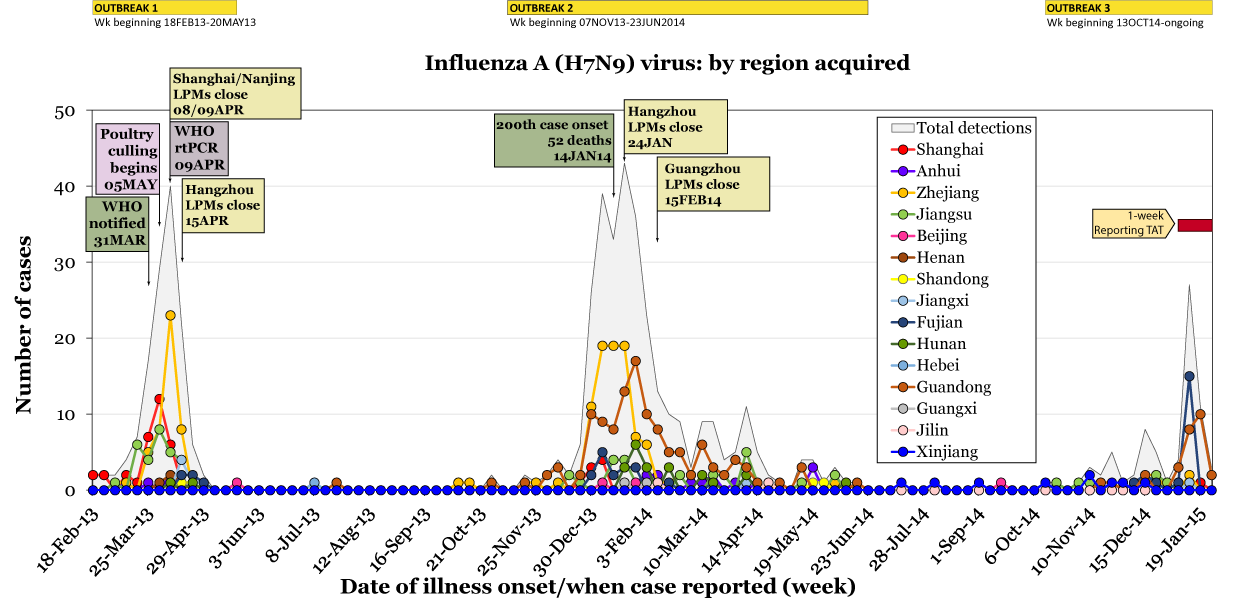
For influenza A(H7N9) virus cases, it is the habit of obtaining live poultry from retail markets where rare virus-laden chooks are culled and handed over because of a desire to see, choose and purchase the tastiest fresh chicken. 

There is a common thread among these stories about direct contact or inefficiently droplet-transmitting virus infections: we can stop their spread. 

But we also amplify and prolong their spread. 

However, when it comes to human-adapted, efficient droplet-spread or airborne-transmitted viruses - well, then we're in trouble. Of course we could all just lock ourselves in a room for a few weeks but that won't ever happen.

So its very important to head off these "emerging" viruses while we still have a modicum of control over them. Once they get away from that control, and theoretically that could happen in the blink of an eye-right now even-no amount of fancy infra red cameras, poorly donned surgical masks or fancy hospitals laden with machines that blink and go ping, will stop them from spreading globally.

Cheery.

In the meantime - here's hoping China speeds up the closure of those live poultry markets. Habits can be changed but death is forever.

Click on image to enlarge.

Like Us

Blog Archive