v2 251014
References..
Showing posts with label Zaire ebolavirus. Show all posts
Ebola: Blood, sweat and tears...
This post follows up the recent one on convalescent semen being able to harbour infectious Ebola virus (EBOV; although I am not aware of any infection resulting from this route of transmission there has been at least one report for Marburg virus [4]).
I thought I'd give the same treatment to tears and sweat which are also fluids intermittently listed as possible sources of EBOV infection for humans. Some examples of the scientific literature which support the risk messaging, follow.
Blood...
I think we are all pretty clear that the blood of an advanced case of Ebola virus disease (EVD) is heavily laden with virus and is the most serious of the risk factors for acquiring infection by an ebolavirus.
Viral loads (amount of virus in the sample) in blood can be above 106-108 plaque forming units or copies (pfu; a measure of infectious virus present using a lab test that measure the impact of virus on infected cells; copies measure viral genome and cannot prove infectious virus is present) per millilitre of blood in acute phase disease patients and non-human primates.[5,6]
Sweat...
There is not a lot on sweat containing signs of an ebolavirus.
There is also very little I have found on this one.
I thought I'd give the same treatment to tears and sweat which are also fluids intermittently listed as possible sources of EBOV infection for humans. Some examples of the scientific literature which support the risk messaging, follow.
Blood...
I think we are all pretty clear that the blood of an advanced case of Ebola virus disease (EVD) is heavily laden with virus and is the most serious of the risk factors for acquiring infection by an ebolavirus.
Viral loads (amount of virus in the sample) in blood can be above 106-108 plaque forming units or copies (pfu; a measure of infectious virus present using a lab test that measure the impact of virus on infected cells; copies measure viral genome and cannot prove infectious virus is present) per millilitre of blood in acute phase disease patients and non-human primates.[5,6]
Sweat...
There is not a lot on sweat containing signs of an ebolavirus.
- Bausch and colleagues found no trace of EBOV in a single acute sweat sample.[1]
- Jaax and colleagues found that in experimentally infected non-human primates (NHPs; rhesus macaques), that connective tissues next to hair follicles and sweat glands in the skin as well as the cells lining ducts of glands in the skin were sometimes positive for EBOV antigens (proteins).[2]
- Davis and colleagues infected NHPs (African green monkeys) and found signs of EBOV antigens in the cells lining the sweat gland ducts and in cells in the connective tissues next to hair follicles, but no virus particles by electron microscopy.[3]
- Zaki and colleagues found heavy signs of EBOV antigens (proteins) in the tissues around the sweat glands, but rarely also within sweat glands and ducts.[8] No virus particles were seen in the sweat glands or ducts when examined by electron microscopy.
There is also very little I have found on this one.
- Bausch and colleagues found EBOV RNA in tears from 1 sample, but no infectious virus could be isolated.[1]
- Jaax and colleagues found some signs of virus in macrophages in the ciliary body of the eye of experimentally infected NHPs
Spit...
- Bausch and colleagues found infectious EBOV in 1 of 12 acute saliva samples (from 10 patients; none from 4 convalescent samples) and EBOV RNA in 8 of 12 (67%) of acute samples (none from convalescent samples).[1] RT-PCR positivity was significantly associated with fatal outcome.
- Formenty and colleagues found EBOV antigens and EBOV RNA in oral fluids from fatal cases and those who survived infection.[7]
References...
- http://www.ncbi.nlm.nih.gov/pmc/articles/PMC2395567/pdf/bullwho00439-0113.pdf
- http://www.ncbi.nlm.nih.gov/pubmed/8712894
- http://www.ncbi.nlm.nih.gov/pubmed/9278608
- http://link.springer.com/article/10.1007/BF01734141
- http://www.sciencemag.org/content/suppl/2014/08/27/science.1259657.DC1/Gire.SM.pdf
- http://www.nature.com/nature/journal/vnfv/ncurrent/pdf/nature13777.pdf
- http://www.ncbi.nlm.nih.gov/pubmed/16652308
- http://www.ncbi.nlm.nih.gov/pubmed/9988163
The fifth I give you...[UPDATED]
Senegal.
According to it's Minister of Health, Awa Marie Coll Seck[1,2], a case of Ebola virus disease (EVD) has been imported from Guinea and it is confirmed by testing at the World Health Organization's collaboration Centre, the Pasteur Institute in Dakar.
Interesting that this occurred one week after Senegal closed its borders (again) with Guinea.[3,4] The infected 21-year old Guinean student travelled on 21-August to Dakar. On the 23rd he presented to a hospital but did not admit to being in contact with known EVD cases; Guinea issued an alert that a person with EVD contact has escaped surveillance 27-Aug; Senegal closed its borders around 22-August.[5,6,7,8].
[WHO Disease Outbreak News places his movements ahead of the closure of the border, arriving in Senegal 20-Aug [8]]
These borders are leaky and so the effect of "closure" essentially hinders aid, trade and economy (all very important to the region, especially right now) butvery clearly does may not stop the spread of human hosts-as we have seen here.
Humans are the variable in outbreaks.
They behave differently each time.
They respond differently each time.
This is why no two outbreaks are identical.
It's why you're a mug to assume this outbreak will be like the last outbreak.
While it looks like this is now a case study in why closing a border is ineffective, I maintain a position that border closures can't contain infectious disease. And please, do not point me to "temperature measurement" as a way to ensure capture of infected individuals. You could easily be harbouring an infection that does not yet express the symptom of fever.
The contact tracing starts in Senegal now. A 42-day clock starts for the country and a signs and symptoms watch continues on all this case's contacts for 21-days.
References...
According to it's Minister of Health, Awa Marie Coll Seck[1,2], a case of Ebola virus disease (EVD) has been imported from Guinea and it is confirmed by testing at the World Health Organization's collaboration Centre, the Pasteur Institute in Dakar.
Interesting that this occurred one week after Senegal closed its borders (again) with Guinea.[3,4] The infected 21-year old Guinean student travelled on 21-August to Dakar. On the 23rd he presented to a hospital but did not admit to being in contact with known EVD cases; Guinea issued an alert that a person with EVD contact has escaped surveillance 27-Aug; Senegal closed its borders around 22-August.[5,6,7,8].
[WHO Disease Outbreak News places his movements ahead of the closure of the border, arriving in Senegal 20-Aug [8]]
These borders are leaky and so the effect of "closure" essentially hinders aid, trade and economy (all very important to the region, especially right now) but
Humans are the variable in outbreaks.
They behave differently each time.
They respond differently each time.
This is why no two outbreaks are identical.
It's why you're a mug to assume this outbreak will be like the last outbreak.
While it looks like this is now a case study in why closing a border is ineffective, I maintain a position that border closures can't contain infectious disease. And please, do not point me to "temperature measurement" as a way to ensure capture of infected individuals. You could easily be harbouring an infection that does not yet express the symptom of fever.
| Click on image to enlarge. Graphic lifted from a great CNN video narrated by Dr Sanjay Gupta. The video describes an example of contact tracing and its importance to the fight to contain EVD.[2] |
The contact tracing starts in Senegal now. A 42-day clock starts for the country and a signs and symptoms watch continues on all this case's contacts for 21-days.
References...
- http://in.reuters.com/article/2014/08/29/us-health-ebola-senegal-idINKBN0GT1CD20140829?feedType=RSS&feedName=health&utm_source=dlvr.it&utm_medium=twitter&dlvrit=309303
- http://edition.cnn.com/2014/08/29/health/ebola-outbreak-senegal/
- http://www.washingtonpost.com/news/world/wp/2014/08/29/the-ebola-virus-has-spread-to-senegal-as-the-deadliest-outbreak-in-history-gets-worse/
- http://www.washingtonpost.com/world/africa/alarm-grows-as-ebola-outbreak-spurs-more-flight-cancellations-border-closures/2014/08/25/87e6d020-2c66-11e4-994d-202962a9150c_story.html
- http://www.bbc.com/news/world-africa-28893835
- http://fox59.com/2014/08/22/senegal-closes-its-borders-with-guinea-over-ebola-fears/
- https://www.internationalsos.com/ebola/index.cfm?content_id=434&language_id=ENG
The battle of Ebola gains a second front...the Democratic Republic of Congo (DRC; formerly Zaire) [UPDATE #3]
So there are three reasons for this post.
An 24-Aug report quoted the Minster for Heath, Felix Kabange Numbi.[2] This latest outbreak occurs in a country that was the site of the first (known) outbreak of a virus of species Zaire ebolavirus (called Ebola virus [1] or EBOV), and which has had six other battles with Ebola virus disease (EVD).
- It may be a little while before we get solid confirmed information from the DRC and I think maps are useful for those of us who are ignorant of where countries live! [See below for update from WHO]
- I'm looking for a quick post so I can move the previous post's grisly pictures down the page!
- Mike Reid (see comments below; many thanks) brought to my attention that the range of the hammer-headed bat (Hypsignathus monstrosus; [5]) overlays the current ebolavirus outbreak areas strikingly well. I lifted that range graphic and (imperfectly, in pink) overlaid it onto my map - et voila!
![]() |
| Data for the hammer head bat's (Hypsignathus monstrosus) range come from The International Union for Conservation of Nature (IUCN) Red List of Threatened Species. I adapted the graphic for VDU from Wikipedia [3] |
One of the two viruses was reported to have been genotyped as a member of the species Sudan ebolavirus (SUDV) and the second was a "mixed" infection of SUDV and an EBOV.[2] A mixed natural infection of a human would be very...unheard of. Can't really say much more though, until we get this all clarified.
A 26-Aug WHO-AFRO update noted that the index case, a woman from Ikanamongo village, died 11-Aug sometime after butchering a bush animal.[6] 24 suspected cases of haemorrhagic fever occurred between 28-Jul and 18-Aug.
The latest updates define that the outbreak is solely due to viruses from the species Zaire ebolavirus.[7,8,9] The EBOV viral variants share 99% nucleotide identity with the Kikwit lineage of viruses from this same species (not "strain"). Put simply, this is the evidence needed to be able to state that the two concurrent EVD outbreaks (indicated in the map above as distinct events), are indeed due to genetically distinct viral variants of Zaire ebolavirus and are not related outbreaks.
For more on naming ebolaviruses - check out my earlier post "Behind the naming of ebolaviruses".[10]
A 26-Aug WHO-AFRO update noted that the index case, a woman from Ikanamongo village, died 11-Aug sometime after butchering a bush animal.[6] 24 suspected cases of haemorrhagic fever occurred between 28-Jul and 18-Aug.
The latest updates define that the outbreak is solely due to viruses from the species Zaire ebolavirus.[7,8,9] The EBOV viral variants share 99% nucleotide identity with the Kikwit lineage of viruses from this same species (not "strain"). Put simply, this is the evidence needed to be able to state that the two concurrent EVD outbreaks (indicated in the map above as distinct events), are indeed due to genetically distinct viral variants of Zaire ebolavirus and are not related outbreaks.
For more on naming ebolaviruses - check out my earlier post "Behind the naming of ebolaviruses".[10]
This latest outbreak was previously and relatively quickly (too quickly? Perhaps a message in there for all of us) described by the World Health Organization as being due to gastroenteritis with haemorrhaging...
.@Fla_Medic It is febrile gastroenteritis with haemorrhaging. If i can find the notice, I will posting. DRC is definitely not #Ebola. Best
� Gregory H�rtl (@HaertlG) August 21, 2014
SitRep on #DRC and febrile gastroenteritis with haemorrhaging is only available in French. I can send by email if u ask me. It is not #Ebola...but subsequently we learn today that...
� Gregory H�rtl (@HaertlG) August 21, 2014
.@Potrblog @WHO I was given premature information from the field. National lab has now tested + for #Ebola. Will be confirmed in a 2nd lab.
� Gregory H�rtl (@HaertlG) August 24, 2014
The outbreaks share at least one common potential animal vector range. This is one of three bat species often pointed to as a possible natural host for ebolaviruses.
Since this is not the first time concurrent outbreaks of ebolaviruses have occurred, I was wondering about seasonal factors and whether they attract or affect bats. This new information adds another piece of of the puzzle.
References
- http://newsmedicalnet.blogspot.com.au/2014/08/behind-naming-of-ebola-virusesnot-yet.html
- http://www.aljazeera.com/news/africa/2014/08/congo-ebola-outbreak-2014824183430461469.html
- http://en.wikipedia.org/wiki/File:Hammer-headed_Bat_area.png
- http://www.iucnredlist.org
- http://en.wikipedia.org/wiki/Hammer-headed_bat
- http://www.afro.who.int/en/clusters-a-programmes/dpc/epidemic-a-pandemic-alert-and-response/outbreak-news/4263-ebola-virus-disease-drc.html
- http://reliefweb.int/report/democratic-republic-congo/update-ebola-virus-disease-drc-no-5-30-august-2014
- http://www.who.int/mediacentre/news/ebola/2-september-2014/en/
- http://reliefweb.int/report/democratic-republic-congo/virological-analysis-no-link-between-ebola-outbreaks-west-africa
- http://newsmedicalnet.blogspot.com.au/2014/08/behind-naming-of-ebola-virusesnot-yet.html
Ebola virus in semen is the real deal.... [UPDATED]
The World Health Organization (WHO) Ebola virus disease factsheet notes that ebolaviruses may be transmitted via the semen of a male who is getting over an ebolavirus infection, for a period of 7-weeks (~49-days).[1]
The European fact sheet for health professionals and a Public Health Agency of Canada Pathogen Safety Data Sheet both note the 7-week figure, the latter also adds a 61-day figure.[2,3]
The United States Army Medical Research Institute of Infectious Diseases (USAMRIID) Medical Managements of Biological Casualties Handbook (7th edition) notes a 3-month (~80-days) period, during which one should probably avoid sexual relations so as not to deliver virus directly to a mucosal surface.[4]
Semen is therefore listed as one of the body fluids from which Ebola virus disease may be contracted.
While convalescent patients seem to be discharged before 7-weeks have elapsed, I presume the men are made very aware of this risk. This was specifically noted in one of the studies below. [8]
But I find it hard to just accept things.
As a scientist I'm used to looking for the little bracketed or superscripted numbers or perhaps "(Scientist et al)", at the end of sentences. Then I can check out the information source for myself. So here, I thought I'd try and add those and pt it altogether in one place here - and you can do your own checking out if you feel the need.
Here are the research papers I've found for EBOV so far (there are also Marburg virus studies) - by all means send me any others I've missed and I'll add them.
References...
The European fact sheet for health professionals and a Public Health Agency of Canada Pathogen Safety Data Sheet both note the 7-week figure, the latter also adds a 61-day figure.[2,3]
The United States Army Medical Research Institute of Infectious Diseases (USAMRIID) Medical Managements of Biological Casualties Handbook (7th edition) notes a 3-month (~80-days) period, during which one should probably avoid sexual relations so as not to deliver virus directly to a mucosal surface.[4]
Semen is therefore listed as one of the body fluids from which Ebola virus disease may be contracted.
While convalescent patients seem to be discharged before 7-weeks have elapsed, I presume the men are made very aware of this risk. This was specifically noted in one of the studies below. [8]
But I find it hard to just accept things.
As a scientist I'm used to looking for the little bracketed or superscripted numbers or perhaps "(Scientist et al)", at the end of sentences. Then I can check out the information source for myself. So here, I thought I'd try and add those and pt it altogether in one place here - and you can do your own checking out if you feel the need.
Here are the research papers I've found for EBOV so far (there are also Marburg virus studies) - by all means send me any others I've missed and I'll add them.
- Bausch and colleagues [5] were able to isolate, in cell culture in the laboratory, infectious Ebola virus (EBOV) from the semen of 1 of 2 samples from a single recovering patient who had EVD.
- The sample was collected 40-days after disease onset; at 45-days he was no longer positive for EBOV
- No acute phase (active infections) samples were tested.
- 1 of 2 samples were also positive for EBOV RNA by RT-PCR (detecting a portion of the virus's RNA genome)
- Rodriguez and colleagues [6] could isolate infectious EBOV from seminal fluid 82 days after disease onset from a 27-year old male (also RT-PCR positive then). A sample at 51-days after onset was RT-PCR positive, but did not yield infectious virus.
- EBOV RNA , but not virus, in 3 other convalescent cases (33, 29 and 25-years of age) at times ranging from 57 to 101-days after disease onset.
- Rowe and colleagues [7], who examined the same patients, detected EBOV RNA by RT-PCR from 4 convalescent cases (27, 25, 29 and 33-years of age as above) at times ranging from 47 to 91-days after disease onset
- No infectious virus could be isolated and no viral antigens were found
- Emond and colleagues [8] were able to isolate infectious EBOV from seminal fluid collected 39 and 61 days after disease onset
- No EBOV was isolated 76, 92 or 110-days later
References...
- http://www.who.int/mediacentre/factsheets/fs103/en/
- http://ecdc.europa.eu/en/healthtopics/ebola_marburg_fevers/factsheet-for-health-professionals/Pages/factsheet_health_professionals.aspx
- http://www.phac-aspc.gc.ca/lab-bio/res/psds-ftss/ebola-eng.php
- http://www.usamriid.army.mil/education/bluebookpdf/USAMRIID%20BlueBook%207th%20Edition%20-%20Sep%202011.pdf
- http://jid.oxfordjournals.org/content/196/Supplement_2/S142.full
- http://jid.oxfordjournals.org/content/179/Supplement_1/S170.long
- http://www.ncbi.nlm.nih.gov/pubmed/9988162
- http://www.ncbi.nlm.nih.gov/pubmed/890413
Ebola, pigs, primates and people
This is a companion piece to my collaborative article, Ebola virus may be spread by droplets, but not by an airborne route: what that means, posted a couple of days ago. I suggest you read the both together.
In this post, I'd like to make sure we all understand that an airborne route of Ebola virus infection has been used to deliberately infect non-human primates (NHPs). It is possible and it can be done. Okay? I'm not covering up any secret knowledge or trying to conceal facts that only we few evil-society-of-science types know. I don't secretly work for an agency aiming to delude you dear readers into feeling falsely safe about the risks associated with being near an Ebola virus infected person (which most reading this will likely never be). Frankly, I'm learning this as I go.
Don't expect perfection from risk mitigation advice.
Like all things that involve biology, there are hardly ever clear-cut lines and yes or no definitions and explanations. Sometimes that's because things vary...because biology! Sometimes that's because we haven't yet done enough science to know those answers. I'm not an expert on ebolaviruses nor on Ebola virus disease (EVD) - but in my time learning about the viruses and the disease, its clear that this is (yet another) area that is lacking in all sorts of information. So risks are judged using what we do know and can support and verify, with softer language used when decision makers don't know for certain; less so when they think they do.
When that message of risk gets passed to the public, it is important to be accurate, clear, concise but not to over-simplify things because that may degrade trust in the body(s) sending the message if things change later. That's a very tough balance when dealing with biological risks.
So having said that, let's talk pigs.
Pigs are not primates.
In ebolaville - the virtual world created by social and mainstream media stories and discussion about ebolaviruses - a lot of people have been throwing the 2012 pig to macaque study (8) around as an argument for why we should admit that ebolaviruses spread by an airborne route and run for the hills. This is why that is not a good comparison:
Where does that leave us?
I admit to being very uneasy saying that there is no risk at all of an airborne route of ebolavirus infection. Clearly it can be forced to happen, but we have no evidence that it has ever happened in humans in an outbreak. But let's put that into context. An absence of evidence is not evidence of absence. Outbreaks of ebolaviruses are not particularly conducive to large careful research projects measuring infectious droplet nuclei around critically ill people, especially when the occur in exotic locations in someone else's back yard.
So have I deserted by position from yesterday's post stating no airborne role for ebolavirus transmission between humans? No, not at all. What we know is that the overwhelming majority of human EVD cases acquire their infection during the time they are in direct contact with the fluids of a very ill EVD case; be that through physical contact or wet droplet spray impact. Beyond that fact, it may just be a discussion based on academic musings and hand-waving. But it is a discussion we should be having a little more I feel. A back-and-forth rather than messages with guarantees and statements dealing in black and white absolutes. I'm not sure the public believe in or feel safer with such absolutes today. We're all a bit too cynical for that.
If infection can happen between primates via the air, it is a very, very inefficient process as a study of 78 people from 27 households with EVD cases during the 1995 Kikwit revealed.(10) Those 78 household members had no physical contact with the cases, and they did not get sick. Others who had physical contact, got EVD.
In a recent study by the authors of the 2012 pig/macaque study we started this post with, infected NHPs did not pass EBOV to uninfected NHPs only 30cm away.[21] Not only was there no disease in the inoculated animals but no antibodies were detectable in the uninfected NHPs 4-weeks later. There had been no infection at all.
While at some point we'll need to be more sure of all this for humans than we are now, we can say that pigs aren't primates and airborne route has not been shown to be a risk for human acquisition of an EBOV.
In this post, I'd like to make sure we all understand that an airborne route of Ebola virus infection has been used to deliberately infect non-human primates (NHPs). It is possible and it can be done. Okay? I'm not covering up any secret knowledge or trying to conceal facts that only we few evil-society-of-science types know. I don't secretly work for an agency aiming to delude you dear readers into feeling falsely safe about the risks associated with being near an Ebola virus infected person (which most reading this will likely never be). Frankly, I'm learning this as I go.
Don't expect perfection from risk mitigation advice.
Like all things that involve biology, there are hardly ever clear-cut lines and yes or no definitions and explanations. Sometimes that's because things vary...because biology! Sometimes that's because we haven't yet done enough science to know those answers. I'm not an expert on ebolaviruses nor on Ebola virus disease (EVD) - but in my time learning about the viruses and the disease, its clear that this is (yet another) area that is lacking in all sorts of information. So risks are judged using what we do know and can support and verify, with softer language used when decision makers don't know for certain; less so when they think they do.
When that message of risk gets passed to the public, it is important to be accurate, clear, concise but not to over-simplify things because that may degrade trust in the body(s) sending the message if things change later. That's a very tough balance when dealing with biological risks.
So having said that, let's talk pigs.
Pigs are not primates.
In ebolaville - the virtual world created by social and mainstream media stories and discussion about ebolaviruses - a lot of people have been throwing the 2012 pig to macaque study (8) around as an argument for why we should admit that ebolaviruses spread by an airborne route and run for the hills. This is why that is not a good comparison:
- Pigs have a different disease and replication process to humans.
- Pigs tend to have much more virus growing in their lungs.(12)
- Pigs tend to cough and sneeze and generally propel more of said pathogen from their lungs.(11)
- Pigs may eject more infectious viruses in their droplets than do primates
If we look at the study of disease occurrence and spread in previous outbreaks, that epidemiology does not suggest an airborne spread - the numbers and nature of human-to-human spread don;t show it as any sort of major contributor to spread. Might it be a minor contributor? Possibly. We don;t know either way with 100% surety. But we do know some other things. One of these is that it takes very little virus to infect pigs and NHPs. If there are not obvious signs of an airborne spread in humans, we just not have detected it yet or, it may have a biological basis. It is possible that the infectious dose (amount of virus needed to get a foothold and start an infection) may be much higher for humans; infected and severely ill human cases may not breathe out infectious virus or ebolaviruses may not survive for long in the aerosols expired by humans,(19) even if they can survive on hard surfaces or in generated aerosols under laboratory conditions.(20)
Non-human primates can be infected with ebolaviruses via a lab-made aerosol with lots of lab virus at lab temperatures and lab humidity and other lab conditions in a lab.
You get that this is done in a lab? Cool.
It apparently does not take much virus to infect a human via an aerosol according to the Public Health Agency of Canada's (PHAC) Pathogen Safety Data Sheet (PSDS) on ebolavirus.(1) Only 1-10 infectious organisms (see above). But one problem with that PSDS is that it cites only 1 paper to support that range. Ref 21 from the PSDS is entitled Clinical recognition and management of patients exposed to biological warfare agents.(2) It is 1997 review that does not specify if this range is specific to any 1 or more of the ebolaviruses, just "viral hemorrhagic fevers". The PSDS seems to rely on that 1 line. In that reference, there are no further links to studies that define this range for humans, ebolaviruses or an Ebola virus (EBOV) of the species Zaire ebolavirus. I've sent a couple of emails in the past week, seeking further clarification from ebolavirus experts, but have yet to hear anything back.
In a laboratory experiment reported in 1995, transmission of an EBOV from one set NHPs infected by injection, to another set resulted in 2 of 3 NHPs (1 with a heavy load of virus in the lung) becoming infected and that seemed to have occurred through some kind of airborne route as the 2 groups of animals were separated by 3m and care was taken to avoid creating bigger droplets and splashes during cage cleaning.(15) While the authors noted that fomites (contaminated objects and surfaces) or contact droplet transmission of virus was unlikely, the exact mode of transmission to the second group of NHPs could not be determined. In a follow-up study, the authors were able to prove that conjunctival and oral exposure to an EBOV could indeed result in infection in NHPs.(18) Thus we have plenty of reason for the use of masks, goggles and face shields that are already part of the recommended personal protective equipment (PPE) items for dealing with infected humans.
However, there are a number of issues related to forced aerosol infection of NHPs, many of which can be found in a massive and detailed 2008 review by Dr. Jens Kuhn.(3) These include:
Some NHP studies that have successfully caused initial respiratory infection using an airborne route to infect NHPs under controlled experimental conditions include the following:
It apparently does not take much virus to infect a human via an aerosol according to the Public Health Agency of Canada's (PHAC) Pathogen Safety Data Sheet (PSDS) on ebolavirus.(1) Only 1-10 infectious organisms (see above). But one problem with that PSDS is that it cites only 1 paper to support that range. Ref 21 from the PSDS is entitled Clinical recognition and management of patients exposed to biological warfare agents.(2) It is 1997 review that does not specify if this range is specific to any 1 or more of the ebolaviruses, just "viral hemorrhagic fevers". The PSDS seems to rely on that 1 line. In that reference, there are no further links to studies that define this range for humans, ebolaviruses or an Ebola virus (EBOV) of the species Zaire ebolavirus. I've sent a couple of emails in the past week, seeking further clarification from ebolavirus experts, but have yet to hear anything back.
In a laboratory experiment reported in 1995, transmission of an EBOV from one set NHPs infected by injection, to another set resulted in 2 of 3 NHPs (1 with a heavy load of virus in the lung) becoming infected and that seemed to have occurred through some kind of airborne route as the 2 groups of animals were separated by 3m and care was taken to avoid creating bigger droplets and splashes during cage cleaning.(15) While the authors noted that fomites (contaminated objects and surfaces) or contact droplet transmission of virus was unlikely, the exact mode of transmission to the second group of NHPs could not be determined. In a follow-up study, the authors were able to prove that conjunctival and oral exposure to an EBOV could indeed result in infection in NHPs.(18) Thus we have plenty of reason for the use of masks, goggles and face shields that are already part of the recommended personal protective equipment (PPE) items for dealing with infected humans.
However, there are a number of issues related to forced aerosol infection of NHPs, many of which can be found in a massive and detailed 2008 review by Dr. Jens Kuhn.(3) These include:
- Often unrealistically high viral loads - the exact amount of infectious virus humans are exposed to during outbreaks has not been defined.
- Temperature and humidity conditions that were unlikely to reflect conditions during outbreaks in Africa - but may reflect conditions in hospitals.
- An initially lung-focussed pattern of viral replication (7) results from direct aerosol delivery of virus to NHP airways which seems different to infection of humans via the more frequent natural direct contact route. Systemic spread to multiple organs then follows via infected dendritic cells and macrophages and blood monocytes.
- Different routes of virus acquisition can lead to different incubation periods.
- Different virus isolates, sources and preparations may affect the course of infection and disease
- Because of the small and enclosed space and air throughput in head-only chambers, droplets rather than droplet nuclei may be the vehicle carrying infectious virus. This is important because, as you can read in the companion piece, droplet nuclei are the component of a lingering "airborne route" of acquisition and if NHPs are in fact infected by the droplets, that may be more indicative of direct fluid contact than true airborne travel.
![]() |
| A head-only inhalation chamber of the sort used in NHP aerosol inoculation studies. Biaera Technologies. Image from http://www.biaera.com/our-technology/peripheral- aerosol-instruments/head-only-chamber/. See also (17) Click on image to enlarge. |
- 1,000 plaque forming units (PFU; a measure of how much virus is in a preparation using cell culture methods in the lab) of either a Kikwit EBOV isolate or a Boniface isolate of Sudan virus (SUDV; species Sudan ebolavirus) isolate were delivered using a Collison nebulizer (producing small droplets) after intramuscular immunization with a recombinant adenovirus vaccine.(5)
- 1,000 PFU of a Kikwit EBOV isolate was delivered with a Collision nebulizer via a head-only aerosol chamber, after intramuscular immunization with a recombinant vesicular stomatitis virus (VSV) vaccine.(6)
- 743-274,000 PFU of a Kikwit EBOV isolate was delivered to with a Collision nebulizer via a head-only aerosol chamber, to examine aerosol-related pathology.(7)
- ~50 or ~500 PFU of a Boniface SUDV isolate were delivered to 3 different NHP species using a Collison nebulizer via a head-only chamber to compare species-specific effects.(14)
- 0.8-128 PFU of a Kikwit EBOV isolate was delivered to 3 different NHP species using a Collision nebulizer via a head-only aerosol chamber, to examine disease course between species.(9)
- ~300-50,000 PFU of an EBOV isolate was delivered to with a Collision nebulizer (0.8-1.2um droplets) via a head-only aerosol chamber, to examine aerosol-related pathology.(16)
Are primates humans?
Judging by the effort we put into getting rid of our fur compared to an NHP, I'd say we're not!
But on the topic of EVD, some NHPs that we infect with an ebolavirus, show very similar disease signs, symptoms and disease progression to those of EVD in humans; especially rhesus macaques [Macaca mulatta] although oneo f the studies above showed that 3 different NHP species were not that different in the way they responded to infection (rhesus macaques as well as cynomolgous macaques [Macaca fascicularis] and African green monkeys [Chlorocebus aethiops]).(9)
Rhesus macaques become febrile, anorexic, lethargic, viraemic, develop a rash and sometimes develop diarrhoea and melena (gastrointestinal bleeding).(3)
But no animal model seems to completely capture other components of human disease which have historically included conjunctivitis, diarrhoea and vomiting and coughing up blood. Vomiting up blood and having bleeding gums occurs more often in fatal cases than in survivors.(3)
Bleeding only occurred in 41% of 103 observed human patients during the 1995 Kikwit outbreak of an EBOV.(3)
So the answer is, primates are not humans when it comes to EVD, but they are pretty close. Yet within that "pretty close" lies an immeasurable amount of variation that may mislead when trying to map the course of NHP disease onto that of humans.
But on the topic of EVD, some NHPs that we infect with an ebolavirus, show very similar disease signs, symptoms and disease progression to those of EVD in humans; especially rhesus macaques [Macaca mulatta] although oneo f the studies above showed that 3 different NHP species were not that different in the way they responded to infection (rhesus macaques as well as cynomolgous macaques [Macaca fascicularis] and African green monkeys [Chlorocebus aethiops]).(9)
Rhesus macaques become febrile, anorexic, lethargic, viraemic, develop a rash and sometimes develop diarrhoea and melena (gastrointestinal bleeding).(3)
But no animal model seems to completely capture other components of human disease which have historically included conjunctivitis, diarrhoea and vomiting and coughing up blood. Vomiting up blood and having bleeding gums occurs more often in fatal cases than in survivors.(3)
Bleeding only occurred in 41% of 103 observed human patients during the 1995 Kikwit outbreak of an EBOV.(3)
So the answer is, primates are not humans when it comes to EVD, but they are pretty close. Yet within that "pretty close" lies an immeasurable amount of variation that may mislead when trying to map the course of NHP disease onto that of humans.
Where does that leave us?
I admit to being very uneasy saying that there is no risk at all of an airborne route of ebolavirus infection. Clearly it can be forced to happen, but we have no evidence that it has ever happened in humans in an outbreak. But let's put that into context. An absence of evidence is not evidence of absence. Outbreaks of ebolaviruses are not particularly conducive to large careful research projects measuring infectious droplet nuclei around critically ill people, especially when the occur in exotic locations in someone else's back yard.
So have I deserted by position from yesterday's post stating no airborne role for ebolavirus transmission between humans? No, not at all. What we know is that the overwhelming majority of human EVD cases acquire their infection during the time they are in direct contact with the fluids of a very ill EVD case; be that through physical contact or wet droplet spray impact. Beyond that fact, it may just be a discussion based on academic musings and hand-waving. But it is a discussion we should be having a little more I feel. A back-and-forth rather than messages with guarantees and statements dealing in black and white absolutes. I'm not sure the public believe in or feel safer with such absolutes today. We're all a bit too cynical for that.
If infection can happen between primates via the air, it is a very, very inefficient process as a study of 78 people from 27 households with EVD cases during the 1995 Kikwit revealed.(10) Those 78 household members had no physical contact with the cases, and they did not get sick. Others who had physical contact, got EVD.
In a recent study by the authors of the 2012 pig/macaque study we started this post with, infected NHPs did not pass EBOV to uninfected NHPs only 30cm away.[21] Not only was there no disease in the inoculated animals but no antibodies were detectable in the uninfected NHPs 4-weeks later. There had been no infection at all.
While at some point we'll need to be more sure of all this for humans than we are now, we can say that pigs aren't primates and airborne route has not been shown to be a risk for human acquisition of an EBOV.
References..
- http://www.phac-aspc.gc.ca/lab-bio/res/psds-ftss/ebola-eng.php#note21
- http://www.ncbi.nlm.nih.gov/pubmed/9244332
- http://www.ncbi.nlm.nih.gov/pubmed/18637412
- http://www.ncbi.nlm.nih.gov/pubmed/9988155
- http://www.ncbi.nlm.nih.gov/pubmed/20181765
- http://www.ncbi.nlm.nih.gov/pmc/articles/PMC3398796/pdf/nihms390624.pdf
- http://vet.sagepub.com/content/50/3/514.long
- http://www.nature.com/srep/2012/121115/srep00811/full/srep00811.html
- http://www.ncbi.nlm.nih.gov/pubmed/21651988
- http://jid.oxfordjournals.org/content/179/Supplement_1/S87.long
- https://www.sciencenews.org/article/airborne-transmission-ebola-unlikely-monkey-study-shows
- http://www.vox.com/2014/8/10/5980553/ebola-outbreak-virus-aerosol-airborne-pigs-monkeys/in/5712456
- http://www.nature.com/srep/2014/140725/srep05824/full/srep05824.html
- http://www.ncbi.nlm.nih.gov/pubmed/23202456
- http://www.ncbi.nlm.nih.gov/pubmed/8551825
- http://www.ncbi.nlm.nih.gov/pubmed/7547435
- http://www.mdpi.com/1999-4915/4/8/1305/htm
- http://www.ncbi.nlm.nih.gov/pubmed/8712894
- http://www.ncbi.nlm.nih.gov/pubmed/15588056
- http://www.ncbi.nlm.nih.gov/pubmed/20553340
- http://www.ncbi.nlm.nih.gov/pubmed/25059478
Ebola virus may be spread by droplets, but not by an airborne route: what that means
An article collaboratively written by (alphabetically)..
Dr. Katherine Arden
A postdoctoral researcher with interests in the detection, culture, characterization and epidemiology of respiratory viruses.
Dr Graham Johnson
A post-doctoral scientist with extensive experience investigating respiratory bioaerosol production and transport during breathing, speech and coughing and determining the physical characteristics of these aerosols.
Dr. Luke Knibbs
A Lecturer in Environmental Health at the University of Queensland. He is interested in airborne pathogen transmission and holds an NHMRC Early Career Fellowship in this area.
A. Prof Ian Mackay
A virologist with interest in everything viral but especially respiratory, gastrointestinal and central nervous system viruses of humans.
The flight of the aerosol
Understanding what we mean when we discuss airborne virus infection risk
A variant Ebola virus belonging to Zaire ebolavirus (EBOV) is active in four West African countries right now. Much is being said and written about it, and much of that revolves around our movie-influenced idea of an easily spread, airborne horror virus. Many people worry about their risks of catching EBOV, particularly since it hopped on a plane to Nigeria. However, all evidence suggests that this variant is not airborne. The most frequent routes to acquire an EBOV infection involve direct contact with the blood, vomit, sweat or stool of a person with advanced Ebola virus disease (EVD). But what is direct contact? What is an �airborne� route? For that matter what is an aerosol and what role do aerosols play in spreading EVD? How is an aerosol different from a droplet spray? Can droplets carry EBOV through the air?
[UPDATE #1 9-Sept-2014]
Dr. Katherine Arden
A postdoctoral researcher with interests in the detection, culture, characterization and epidemiology of respiratory viruses.
Dr Graham Johnson
A post-doctoral scientist with extensive experience investigating respiratory bioaerosol production and transport during breathing, speech and coughing and determining the physical characteristics of these aerosols.
Dr. Luke Knibbs
A Lecturer in Environmental Health at the University of Queensland. He is interested in airborne pathogen transmission and holds an NHMRC Early Career Fellowship in this area.
A. Prof Ian Mackay
A virologist with interest in everything viral but especially respiratory, gastrointestinal and central nervous system viruses of humans.
________________________
PLEASE NOTE. There is an important follow-up to this post, "Ebola, pigs, primates and people", that continues this story. I recommend you read it next. There are other posts on VDU as well that deal with Ebola virus disease and different fluids (semen and blood/sweat) that may contain and spread the virus. Please do search them out.The flight of the aerosol
Understanding what we mean when we discuss airborne virus infection risk
A variant Ebola virus belonging to Zaire ebolavirus (EBOV) is active in four West African countries right now. Much is being said and written about it, and much of that revolves around our movie-influenced idea of an easily spread, airborne horror virus. Many people worry about their risks of catching EBOV, particularly since it hopped on a plane to Nigeria. However, all evidence suggests that this variant is not airborne. The most frequent routes to acquire an EBOV infection involve direct contact with the blood, vomit, sweat or stool of a person with advanced Ebola virus disease (EVD). But what is direct contact? What is an �airborne� route? For that matter what is an aerosol and what role do aerosols play in spreading EVD? How is an aerosol different from a droplet spray? Can droplets carry EBOV through the air?
Direct contact includes physical touch but also contact with infectious droplets; the contact is directly from one human to the next, rather than indirectly via an intermediate object or a lingering cloud of infectious particles. You cannot catch EVD by an airborne route, but you may from droplet sprays. Wait, what?? This is where a simple definition becomes really important.
Airborne, aerosols, droplets, nuclei and confusion
Whether propelled by sneezing, coughing, talking, splashing, flushing or some other process, aerosols (an over-arching term) include a range of particle sizes. Those droplets larger than 5-10 millionths of a meter (a micron [�m]; about 1/10 the width of a human hair), fall to the ground within seconds or impact on another surface, without evaporating (see Figure). The smaller droplets that remain suspended in the air evaporate very quickly (< 1/10 sec in dry air), leaving behind particles consisting of proteins, salts and other things left after the water is removed, including suspended viruses and bacteria. These leftovers, which may be more like a gel, depending on the humidity, are called droplet nuclei. They can remain airborne for hours and, if unimpeded, travel wherever the wind blows them. Coughs, sneezes and toilet flushes generate both droplets and droplet nuclei. Droplets smaller than 5-10�m almost always dry fast enough to form droplet nuclei without falling to the ground, and it is usual for scientists to refer to these as being in the airborne size range. It is only the droplet nuclei that are capable of riding the air currents through a hospital, shopping centre or office building.
The droplet nuclei and the air that surrounds them are correctly referred to as an aerosol, but so are lots of other things and this is where confusion grows. The term aerosol is used to refer to any collection of particles suspended in air, and particle sizes vary enormously. Spray paint from a can is produced in droplets a few hundred microns in diameter so as to quickly coat the intended surface rather than undesirably linger in the air. A can of fly spray on the other hand produces smaller droplets, because that aerosol should stay suspended for long enough to make contact with insects. �Aerosol� is a confusing term, and its varied usage does not help when discussing risk of EBOV infection.
The simplest definition for public understanding of infection risk is to use �airborne� to refer only to the droplet nuclei component.(4)
For EBOV at least, airborne droplet nuclei are apparently not infectious to primates under natural or near-natural circumstances (see here for more detail about non-human primates and aerosols used under highly unnatural laboratory conditions).
Why that is so is not known, but perhaps it is because this virus does not survive being dried down, or that primates don�t produce enough virus in what is coughed out to make infectious droplet nuclei. To be clear, there may be some EBOV in these droplet nuclei - but it has never been shown to cause disease, even when that route has been looked for in the same household as a case of EVD.
How the science helps and also hinders understanding.
The scientific literature has a number of very specific examples where droplet nuclei have been used to infect non-human primates with ebolaviruses in order to study the effectiveness of vaccines or antivirals.(1,7,8) These infections are under idealised laboratory conditions, often with what we think are unrealistically high levels of virus. Although airborne infection can be made to occur in a lab, there is no evidence for airborne droplet nuclei spreading EBOV from person-to-person or between non-human primates whether inside or outside the lab.
Protection and clarification.
Included in guidelines issued by the WHO (7) and CDC (5) is the need for droplet precautions (Figure). This is very important for healthcare workers, family and other caregivers who stay close and are frequently exposed for lengthy periods of time with severely ill, highly virulent cases of EVD. These cases may actively propel infectious droplets containing vomit and blood across the short distances separating them from caregivers. But this is a form of direct transmission, and is not airborne transmission.
Messaging the masses.
Leaving aside other issues around acquiring a rare disease like Ebola when outside of the current outbreak region, the case definitions and risk assessments have raised confusion. There are questions around how otherwise apparently well-protected healthcare workers in West Africa are acquiring an EBOV. For a virus described as spreading only through direct contact, recommendations for the use of masks, implying airborne spread to many, fuel such questions. In fact, face protection is recommended to prevent infectious droplets landing on vulnerable membranes (mouth and eyes).
It�s important to pass a message that is correct, but also to ensure distrust does not result from a public reading apparently contradictory literature. Such distrust and real concern have been rampant among a hyperactive #ebola social media. Simple, clear phrases like �ebolaviruses cannot be caught from around a corner� (h/t @Epidemino), may help uncomplicate the communication lines. And it works on Twitter.
[UPDATE #1 9-Sept-2014]
References
- http://www.ncbi.nlm.nih.gov/pubmed/21651988
- WHO page
http://www.phac-aspc.gc.ca/lab-bio/res/psds-ftss/ebola-eng.php#note21 - http://www.who.int/csr/resources/publications/WHO_CDS_EPR_2007_6c.pdf?ua=1
- http://www.cdc.gov/vhf/ebola/hcp/infection-prevention-and-control-recommendations.html
- http://www.who.int/csr/resources/who-ipc-guidance-ebolafinal-09082014.pdf?ua=1
- http://www.ncbi.nlm.nih.gov/pubmed/24462697
- http://www.ncbi.nlm.nih.gov/pubmed/20181765
Ebola virus disease (EVD) 2014 West African outbreak..
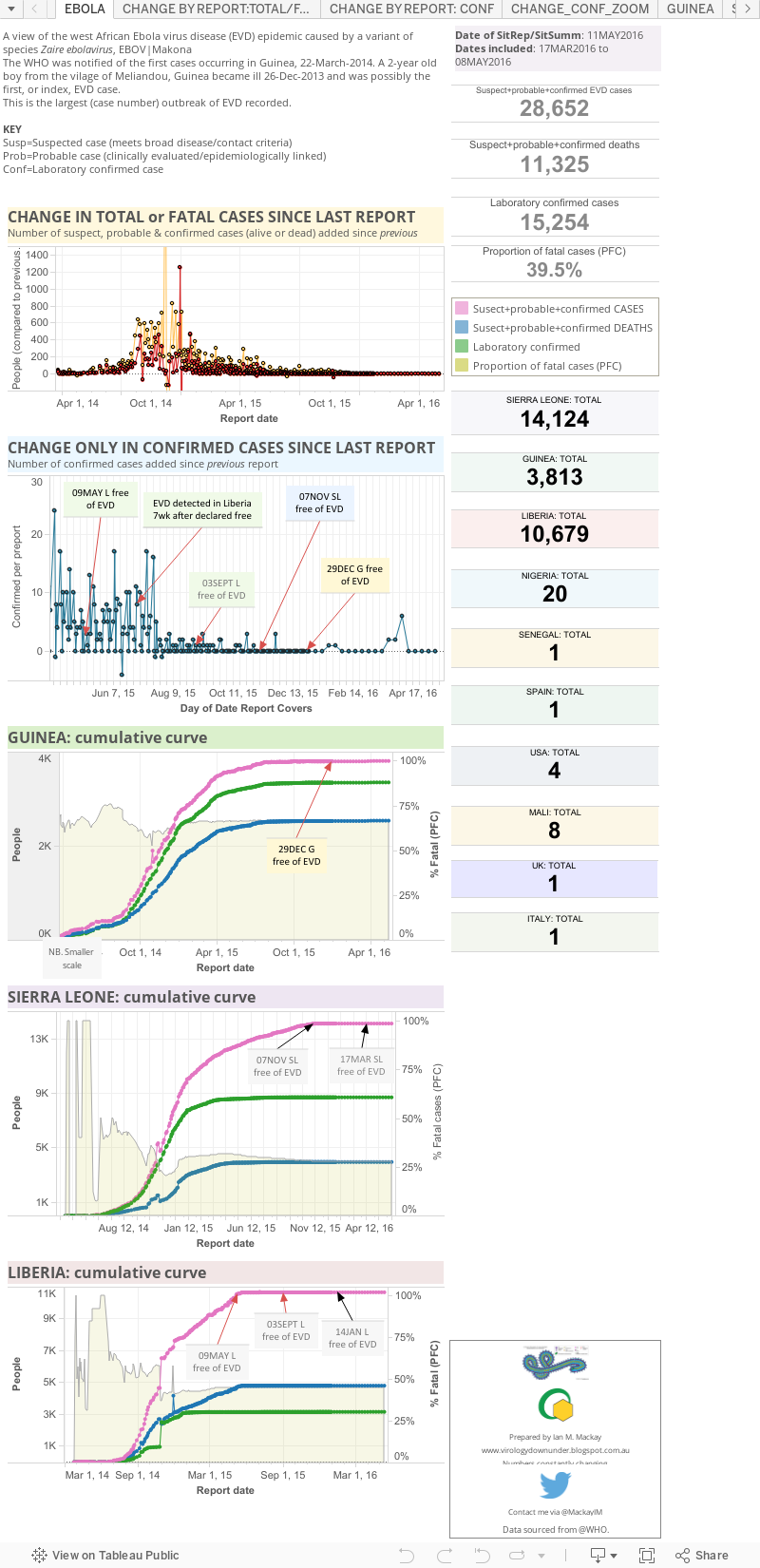
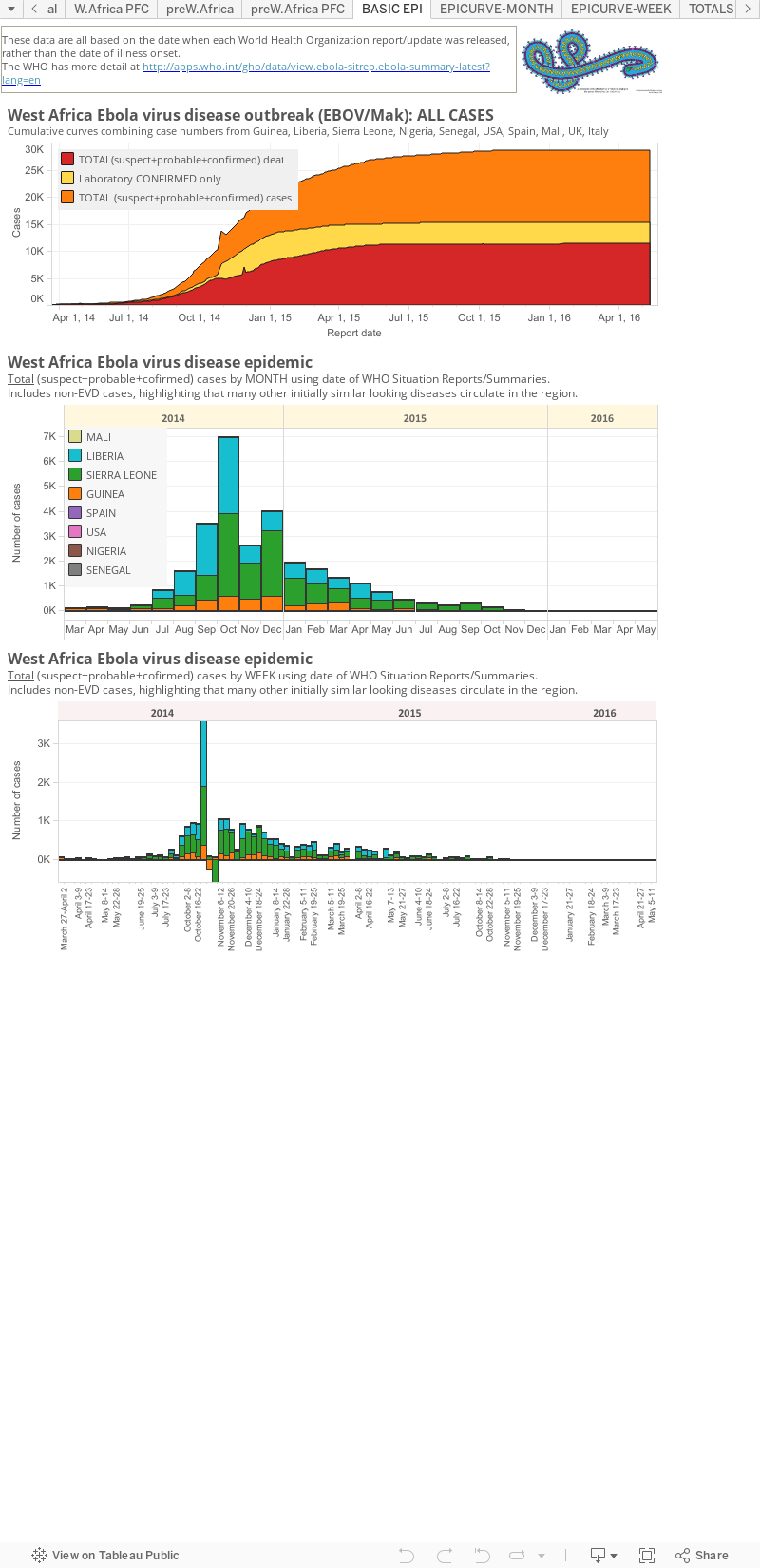
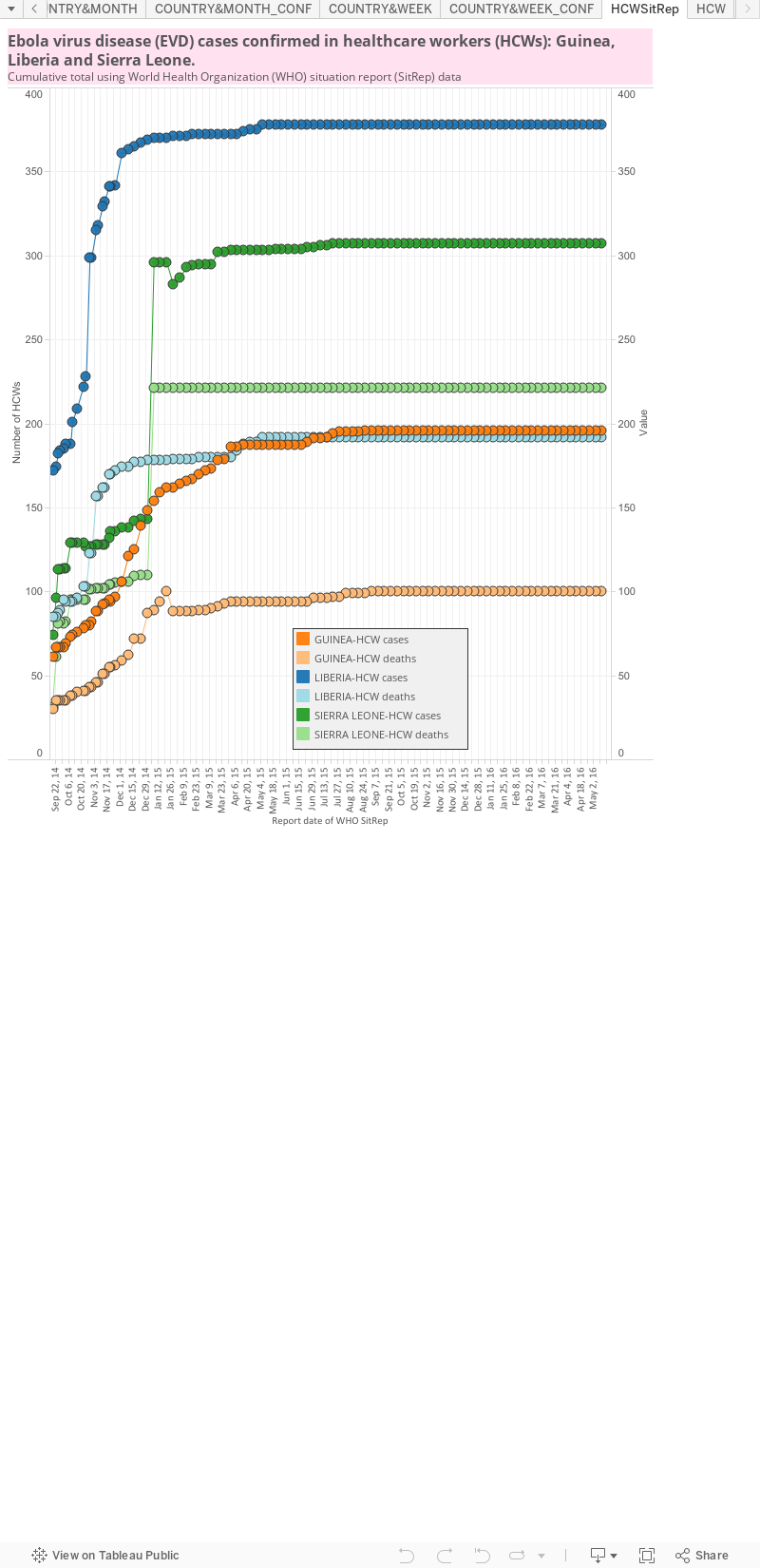
I will update this static page (link won't change so you can bookmark it) with the 2014 West African Ebola virus disease (EVD) numbers after they are released by the World Health Organization (WHO). The date these graphs were last updated is listed at the top of the first panel or "dashboard" of graphs an totals .
The WHO create multi-page Situation Reports [2] and brief Situation Summaries.[3] The SitRep's are currently presented on Wednesday and "additional updated figures" will be posted" a SitSumm when they become available any day of the week" (via eMail to journalists from WHO).
My totals include all countries that have hosted a case in, or sourced from, a West African nation. Countries include Guinea, Liberia, Sierra Leone, Nigeria (now EVD-free), Senegal (now EVD-free), the United States of America, Spain (now EVD-free), Mali (now EVD-free) and the United Kingdom. 'EVD-free means there are no known cases of EVD in the country. Some countries bring in cases of EVD to treat them; they can be defined as free of Ebola virus transmission, but not technically free of the EVD.
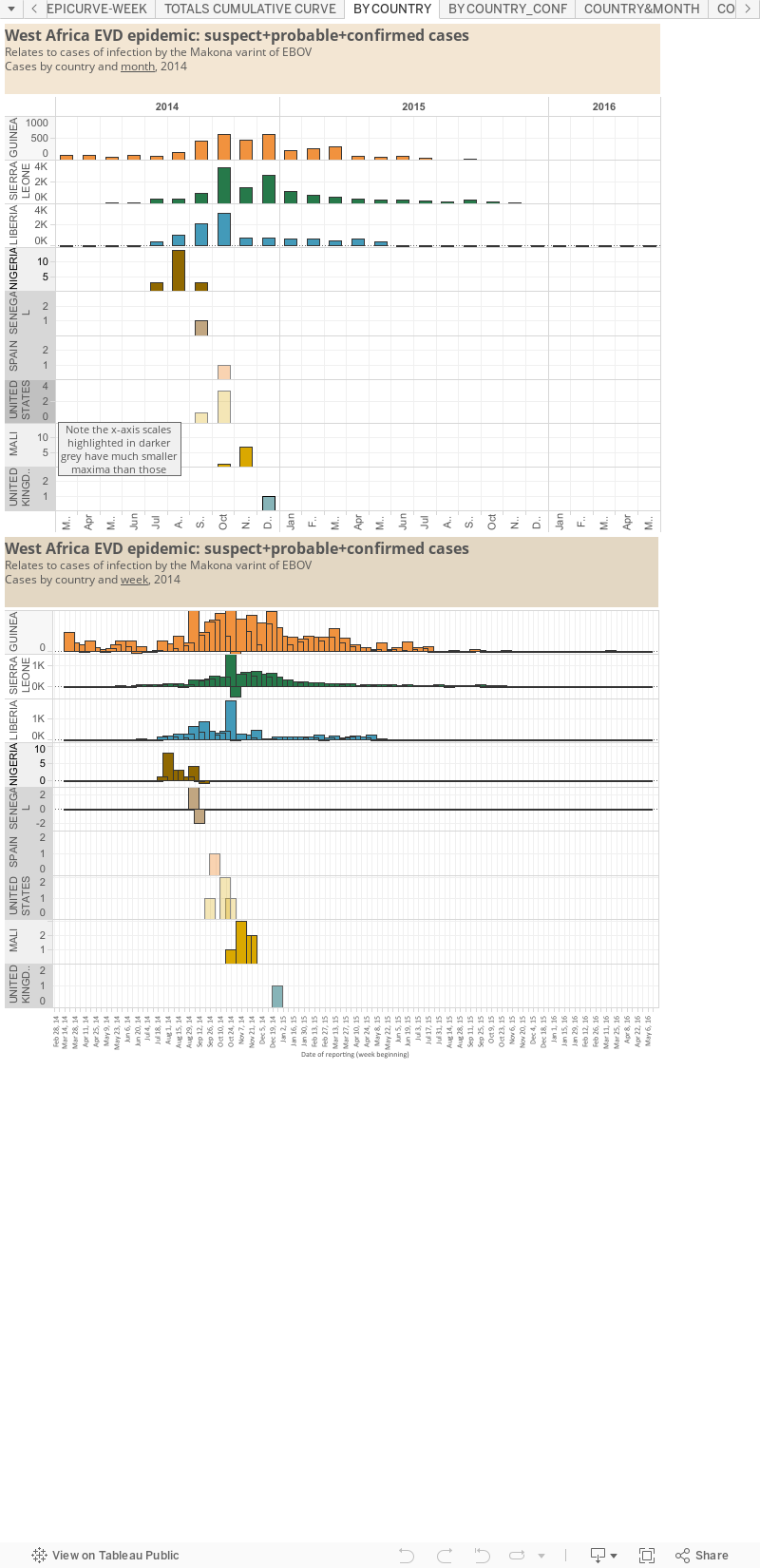
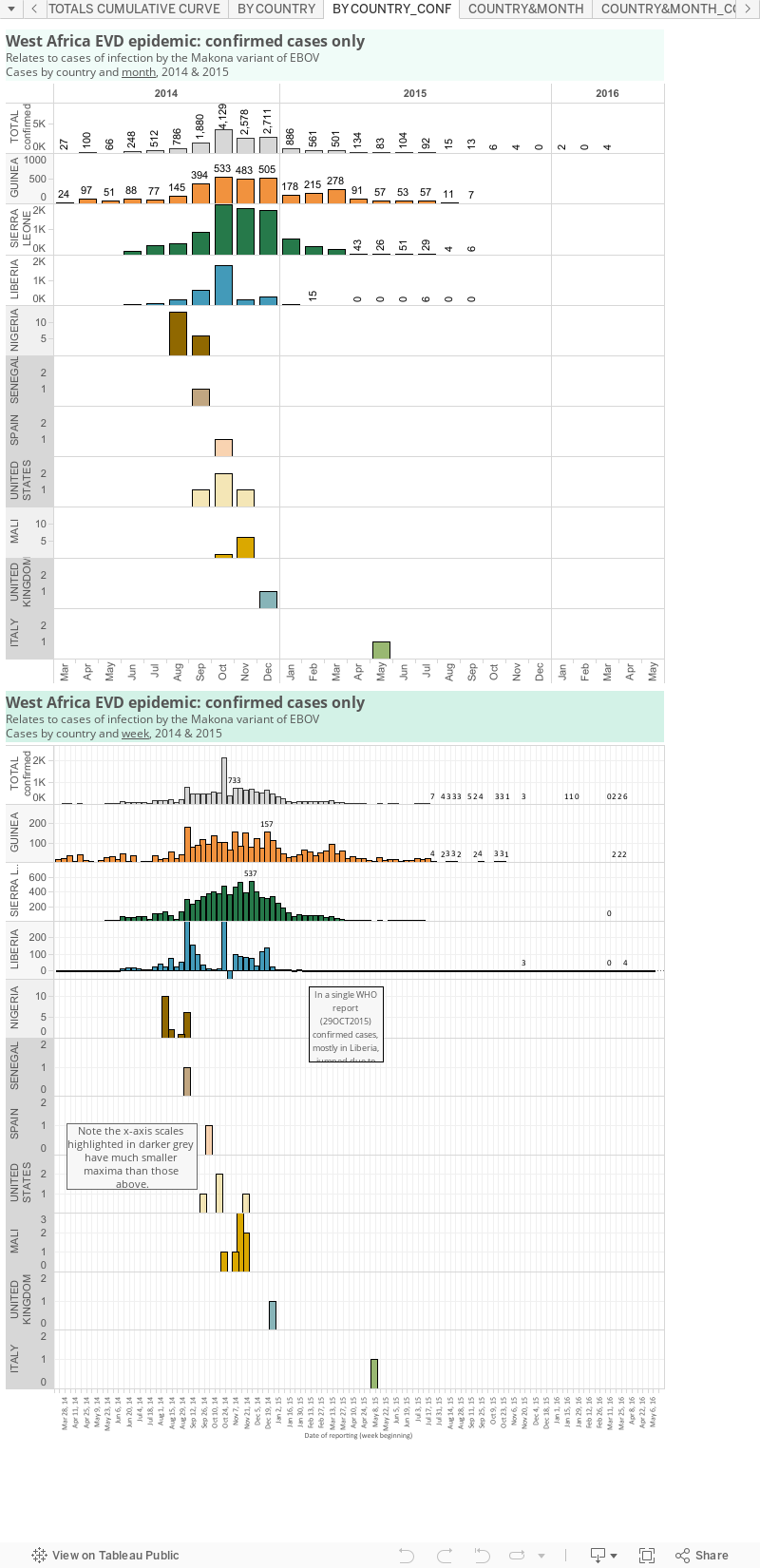
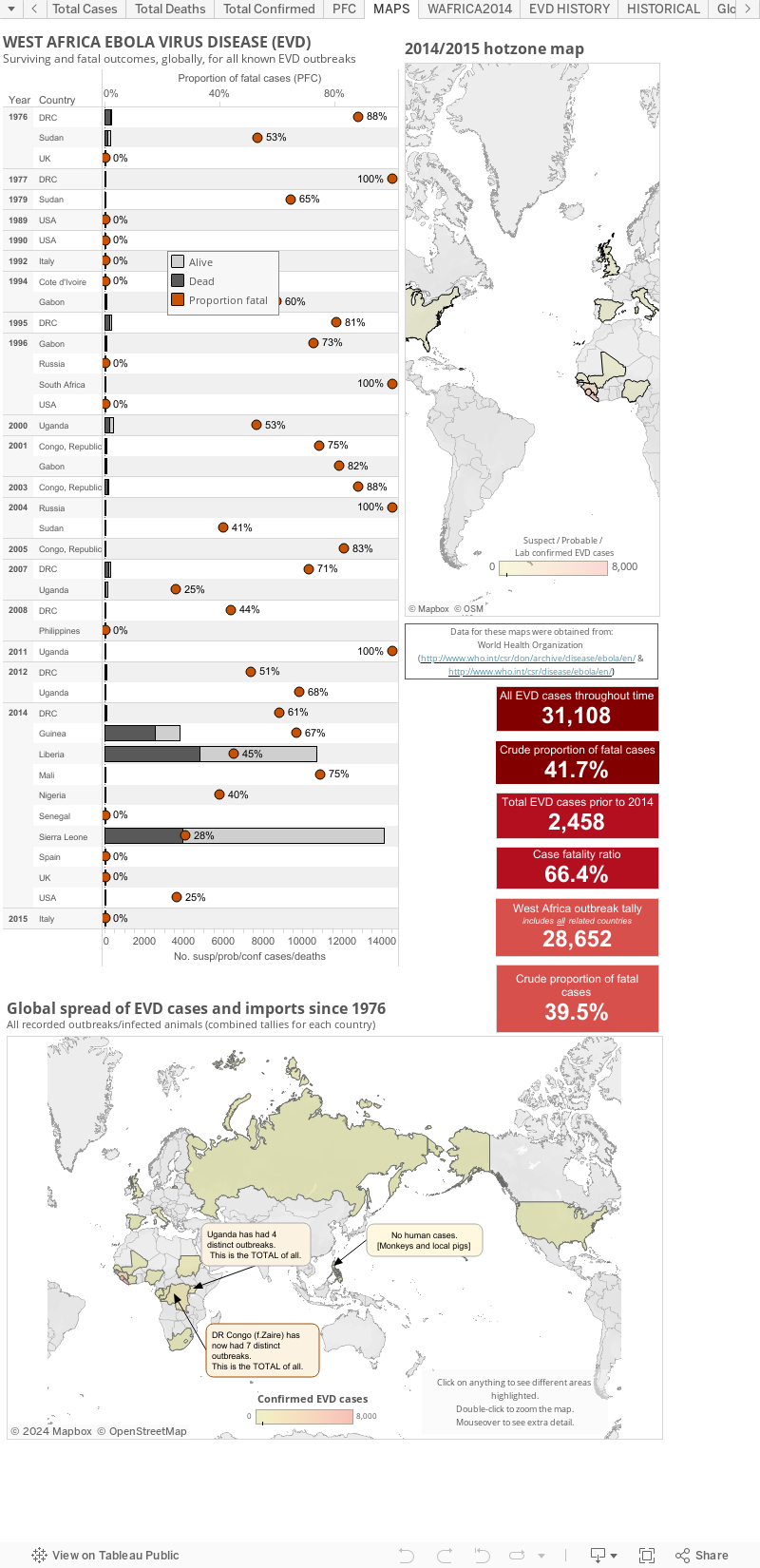
The West African region epidemic (top map below), including countries with imported cases and the totals from past Ebola virus disease outbreaks and the few imported monkey cases (the US & Philippines [hence zero human cases]) plotted by total numbers and country (bottom map).
A note about the proportion of fatal cases (PFC): On these graphs, my PFC calculations for West African countries and the DRC are based on dividing the total number of suspected+probable+confirmed deaths by the number of total suspected+probable+confirmed cases on the same date. This is crude and is an underestimate of the true case fatality ratio (CFR) which has stood at ~70% throughout the epidemic.[2]
Reminders:
The WHO create multi-page Situation Reports [2] and brief Situation Summaries.[3] The SitRep's are currently presented on Wednesday and "additional updated figures" will be posted" a SitSumm when they become available any day of the week" (via eMail to journalists from WHO).
My totals include all countries that have hosted a case in, or sourced from, a West African nation. Countries include Guinea, Liberia, Sierra Leone, Nigeria (now EVD-free), Senegal (now EVD-free), the United States of America, Spain (now EVD-free), Mali (now EVD-free) and the United Kingdom. 'EVD-free means there are no known cases of EVD in the country. Some countries bring in cases of EVD to treat them; they can be defined as free of Ebola virus transmission, but not technically free of the EVD.
The West African region epidemic (top map below), including countries with imported cases and the totals from past Ebola virus disease outbreaks and the few imported monkey cases (the US & Philippines [hence zero human cases]) plotted by total numbers and country (bottom map).
A note about the proportion of fatal cases (PFC): On these graphs, my PFC calculations for West African countries and the DRC are based on dividing the total number of suspected+probable+confirmed deaths by the number of total suspected+probable+confirmed cases on the same date. This is crude and is an underestimate of the true case fatality ratio (CFR) which has stood at ~70% throughout the epidemic.[2]
Reminders:
- The graphs above, as with all made by me VDU, are made for general interest only. It is also freely available for anyone's use, just cite the blog (http://newsmedicalnet.blogspot.com.au/) and me (Dr. Ian M Mackay, PhD) please. It may be that I have misinterpreted the language in the reports (sometimes a little tricky to wade through) or miscalculated some totals based on the way data have been presented.
- Sometimes there are very country-specific differences in what gets presented to/via the World WHO DONs/SitReps which make this process less clear than it could be. I recommend you have a read and compare the data from each of the countries for yourself to understand these issues.
- As I've talked about previously,[1] these numbers are all volatile for a variety of reasons, some Ebola-specific, so regard this chart for its trends only.
- I am only able to plot what is publicly available. To date, this does not include granular data with dates of onset, or daily data of any kind. The WHO have these data and you will see them become more available through their Situation Reports found here http://www.who.int/csr/disease/ebola/situation-reports/en/
- References...
- Ebola virus disease and lab testing...
http://newsmedicalnet.blogspot.com.au/2014/04/ebola-virus-disease-and-lab-testing.html - Ebola virus disease outbreak Situation Reports (SitRep)
http://apps.who.int/ebola/en/current-situation - Ebola virus disease outbreak Situation Summaries (SitSumm)
http://apps.who.int/gho/data/view.ebola-sitrep.ebola-summary-latest?lang=en
- Ebola virus disease and lab testing...
Ebola Virus Disease (EVD) West Africa update for 1-July-2014... [UPDATED]
Some quick visualizations of the Zaire ebolavirus outbreak data based, as previously,[1] on the World Health Organization's publicly available data.
The presentation below is made using Tableau, a new platform for me so please let me know of anything that has failed, numbers that are wrong, something that's translated / formatted badly on your device...whatever. Tableau certainly allows for much faster updating of charts...once you've put a leash on it anyway.
References...
The presentation below is made using Tableau, a new platform for me so please let me know of anything that has failed, numbers that are wrong, something that's translated / formatted badly on your device...whatever. Tableau certainly allows for much faster updating of charts...once you've put a leash on it anyway.
PLEASE NOTE: I now have these same data on a static page (one with a webpage address that does not change with each updated blog).
Please vist the links below for the latest EVD numbers and maps.
References...
- Ebola virus disease (EVD) West Africa update for 24-June, WHO-AFRO update...
http://newsmedicalnet.blogspot.com.au/2014/06/ebola-virus-disease-evd-west-africa_25.html - Ebola virus disease, West Africa � update | Disease outbreak news | 1 July 2014
http://www.who.int/csr/don/2014_07_01_ebola/en/ - Ebola virus disease and lab testing...
http://newsmedicalnet.blogspot.com.au/2014/04/ebola-virus-disease-and-lab-testing.html
Ebola virus disease (EVD) West Africa update for 02-May, WHO-AFRO update...
![]() |
| Click on image to enlarge. |
Summary..
Total suspected/probable/confirmed cases: 244
Total suspected/probable/confirmed deaths: 162 (66.4%)
Total lab confirmations: 133 (54.5% of 227)
These figures are very important for two reasons...
Firstly they show a drop in suspect/probable cases after data scrubbing by the Liberian Ministry of Health and Social Welfare. This reinforces that the outbreak is being well controlled.;The date of isolation of the most recent confirmed cases is 30-April from Conakry and Guekedou (Guinea).
Secondly there has been a concomitant rise in the proportion of fatal cases of EVD due toZaire ebolavirus (see the percentages above the orange line in the chart). This is not because the numbers have jumped, it's because the denominator has shrunk for the relevant calculation:
No. EVD fatalities/No. total susp/prob/conf cases.We've known this rise in proportion was coming because it was highly likely that case numbers would change as the dust settles and the susp/prob EVD patient numbers get discarded because they are found to be infected by something else; clinically similar disease, but not because of infection with Zaire ebolavirus. I've written about it previously if you'd like some background.
This will be my last update on this outbreak linked to the WHO-AFRO announcements unless anything major happens.
A reminder - the chart above is made for general interest. It may be that I have misinterpreted the language in the report (sometimes a little tricky to wade through these reports) but the trends should still be informative even if a number or data point is out of place.
Sources...
A reminder - the chart above is made for general interest. It may be that I have misinterpreted the language in the report (sometimes a little tricky to wade through these reports) but the trends should still be informative even if a number or data point is out of place.
Sources...
- http://www.who.int/csr/don/don_updates/en/
- http://reliefweb.int/report/liberia/unicef-liberia-ebola-virus-disease-sitrep-20-2-may-2014
- http://newsmedicalnet.blogspot.com.au/2014/04/ebola-virus-disease-and-lab-testing.html