Medical News Blog Information

Showing posts with label MERS. Show all posts

Editor's Rant: Communicating the data and about the data...

It is pretty damn hard work trying to get hold of data on virus outbreaks around the world. 

When it is, it may be available in unfriendly formats. It may not be made public at all. When it is available, it is often slow to appear or it may have random reporting gaps, or be partially incomplete. The style of the released data can change overnight as well, sometimes going from detail to summary.

So why bother about trying to get hold of these numbers at all? It's not like I work in the field. Well, that is a question I'm increasingly asking myself of late too. My personal reason has been because I think there need to be more voices in the vacuum between the numbers being reported and the often dry public health reports. I think scientists, even if they are not lifetime experts on a given virus or outbreak, still have much to offer when they come out from behind their manuscripts and apply their skills to interpreting what's happening. Well, many do anyway. And they should do it more. Now, perhaps more than ever, science needs steer away from its cold, dense and boring niche writing to a chattier, more helpful and community-based style of engagement. It astonishes me how often the public's interpretation of outbreak numbers must come from the media or from hobbyists, or even professionals who work in other areas and give of their own time to help explain something to us in their personal time. Helpful and engaging information and better access should come from the source of the data.

So it becomes really annoying (you would have to know me quite well to know how many times I just rewrote those words) when data are given out for public use that are a total mess...and there is not one tiny mote of explanation for it. I called it appalling on Twitter tonight. And at other times there are no explanations for why there are gaps, why data are delayed, why the format may have changed today compared to last week, why a line list is missing a case, using a new and totally independent numbering scheme or suddenly reshuffled, why there is no news about a new outbreak. No word. No contact. No-one taking the lead. No...communication.

I have met a lot of people since I have been blogging who, in various ways, have put in their own personal time to help out bigPublicHealth, to help take up the slack in communicating to the media and to the public. It is hard to quantify the impact of that combined help-but I can assure you that it reaches far and wide and is not insignificant. One would think that it should be easier to provide this help when one is willing to make use of their own time and use their own resources, or that those people should be shown enough respect to be able to simply find and apply reliable raw data so they can help out. But one would be an idiot. I very clearly remember a time when I could send a public Tweet to WHO's Head of Public Relations, Gregory Haertl, and get an informed reply. Those days have passed. I remember there being an #AskEbola channel on Twitter that gave answers. That engagement is just not there anymore. I'm sure its funding and resources and blah blah...but not as sure as I could be if that were spoken about in public. Communication. Someone needs to step up on this. As the quotes above allude to, 2015 is not 2014. And one of those differences is that everyone wants timely and comprehensive information they can rely on during times of outbreak. This hasn't been discusses enough but it should be.
 

Matching MERS case identification numbers from two differing sources...

Update #1 27JUNE2015
Update #2 28JUNE2015
Sometimes people work from different playbooks.
Figure 1. MERS in South Korea. Most cases now plotted
on graph using their dates of illness onset.
An outbreak in decline. This is up-to-date - 3 new cases
from 21JUN2015 added (column at right hand side -
onset dates unknown)
Click on graph to enlarge

In this instance, the data from the World Health Organization's (WHO) new list of Middle East respiratory syndrome (MERS) cases - with extra detail - uses a case identification key that's out of synchrony with that produced by the South Korean (SK) Health Authority which can be found in each of its posts announcing new MERS cases and deaths. 

Attempting to link the two lists has mostly been an exercise in pedantry, but sometimes it is useful to know which case one is talking about when discussing an outbreak or cluster of disease....'Hey Bill, what didja think of that 70 year old MERS case who drove the ambulance carrying that infected 75 year old MERS case and then those others got MERS as well..?' doesn't really roll off the tongue does it?


Embedded image permalink
Figure 2. What the graph above looked like before
we had dates of illness onset. Many cases
were 'moved' to earlier time points because
report dates always follow onset of illness dates
and they can follow by varying periods of time -
sometimes a day, sometimes a week or more.
Two file formats are in the folder I've linked to below. This is my first attempt - yes, it is a work in progress - to match up the new WHO case list from the 19th June which includes the highly prized date of illness onset (DOOs) for most cases - with that of the South Korean (SK) Health Authority. They do differ. Quite a bit. And in several ways. For example, the numbering scheme is off by one or more, SK69 seems to be missing from the WHO list, there is a question mark hanging over SK152 & SK156 and the WHO data seem to have a number of different ages from the SK data- mostly differing by one year (presumably someone is rounding up or down). 

If I've stuffed anything up or if you can solve my problem cases - please pass that info along and I'll update the files on this page. Hopefully the next WHO version will have addressed all of this anyway (it didn't but perhaps a future one will).

These are publicly available and you can download them for your own interest.


There is a download arrow at the top of the Google Drive page.

  1. Google Drive folder with MERS data files
    https://drive.google.com/open?id=0B5sEcTjB5Ailfm1PcU1oNDF6M2hiaDduUDgzQUdxNlZxeHBkU0FHeVBRRFJkbHIxTmdjX3c&authuser=0
Updates...
  1. With the help of FluTrackers updated line list to cross check against, the first half of my list has been updated - some bugs fixed. 
  2. After about 5 hours - on and off - FluTrackers helped me sort out a few errors and the latest version of my list has been uploaded into the the folder linked above. Some typos corrected.

MERS-CoV in South Korea - other data formats for data provided by WHO...

The following links take you to different version of the PDF if you want to harvest those data...

  1. Excel version, Office 2010
    https://drive.google.com/open?id=0B5sEcTjB5Aila3c5WXI4bzlkLWc&authuser=0
  2. MS DOS CSV file
    https://drive.google.com/open?id=0B5sEcTjB5AilTHRub1FRZnhpQmM&authuser=0
  3. Original WHO PDF
    https://drive.google.com/open?id=0B5sEcTjB5AilWlo0UDZwVzRpdVE&authuser=0
Its taken a week to get these data, and its unclear why detail data dried up from the 12th June to the 19th, or why the data have appeared now, but they are here at last and that's great.

Middle East respiratory syndrome (MERS) coronavirus: Outbreak in South Korea

This data visualization was created using data from FluTrackers, the World Health Organization and the Korean Broadcasting System (KBS).

Wherever possible, the dates are those for a case's onset of illness, but if that is unavailable then the date for hospitalization or if that is unclear, the date that case was reported.


Because the WHO obviously have more detailed information, I recommend you keep an eye on their site, so long as it is being maintained, for more accurate epidemic curves.


.
References...

3.  World Health Organization pages
Main landing page on MERS and MERS-CoV (includes link to WHO line list under General Information)
http://www.who.int/emergencies/mers-cov/en/
Disease Outbreak News pages
http://www.who.int/csr/don/don_updates/en/
 
News on the current situation
http://www.wpro.who.int/outbreaks_emergencies/wpro_coronavirus/en/
Summary of Korean statistics-rapidly updated

http://www.wpro.who.int/outbreaks_emergencies/summary.of.MERS.stats/en/

Translating from the Korean for MERS epidemiology...

I absolutely love the graphic the Korean Broadcasting Service (KBS) have been putting up. Love 'em. Great job!  I just wish they were in English too. I understand that the first priority is to your own population - totally get that. But I do wish that, like the Saudi Ministry of Health, every country could do an English version as well as the native language. 

But processes, time money and stuff...

Anyway - to help me try and get more detail on the South Korean clusters I have added some translation to one of the KBS pages which, when you click on the icon of a person, gives you a popup box with some detail. I've added translation to the contents of that box (see the figure below). 

I don't know how accurate the "Date of infection" field is but will be comparing it to the World Health Organization (WHO) data from earlier to see if it can be useful. This is all because the date of reporting is almost always different from the date of illness onset - and the latter are much better to plot to get an idea of whether an outbreak is rising, peaking or slowing. Having the ability to crowd-plot these numbers is great and (I think) useful to inform the public and our clinical and scientific peers when included alongside some discussion about trends and reason for changes, risk etc. Often (always?) more personable banter, and engagement, seems to be lacking from 'bigPublicHealth' sources.

Click on image to enlarge.
Adapted from http://dj.kbs.co.kr/resources/2015-06-08/[1]

This sort of data mining seems essential if the recent WHO publication of a minimalist 33-word summary of the last 62 cases is now the norm - or perhaps the provision of information from the South Korean health authority to the WHO has changed in format. And that has become acceptable to the WHO, who have not commented on the change. Such summaries, and lack of comment, are also business-as-usual for 'updating' us on human cases of influenza A(H7N9) virus in China.

References...
  1. http://dj.kbs.co.kr/resources/2015-06-08/

Tracing the MERS-CoV cases in South Korea...

The Korean Broadcasting System (KBS) News channel has made an awesome "bump map" or force diagram (thanks @Casillic) showing the layout of cases and the hospitals they passed through or were admitted to or transferred to.[1] It shows sex, deaths (9 across multiple facilities), profession, rounds of transmission and some dates (written as month.day)

Unfortunately for some of us, it's in Korean. If you, like me, are having trouble remembering your grade school Korean, I'm here to help (a little).

I've put together a screenshot of this awesome map as of today's count of  - no doubt the values will change tomorrow - and added onto it the hospital names in English. I highly recommend you visit the actual site though - the map is scalable and interactive. This snapshot does not do it justice and won't be updated like the map seems to be.

I've interpreted the hospital names by eye from the Hong Kong Centre for Health Protection's (CHP) excellent multi-lingual list of all the "MERS hospitals" released by the Korean health authority.[2,3] They may not be perfect and I'd be happy to take any suggestions and corrections (including what is in the orange boxes).

The index case, #1, is shown in green and is linked here to 2 clinics and a hospital - which differs a bit from the WHO story which includes a final move..."whereupon he was transferred to the nationally designated treatment facility for isolation".

The most recent additions seem to have a pulsing arrow (only visible at the source).

Made using a combination of sources. [1,2]
Click on image to enlarge.

References...

  1. http://dj.kbs.co.kr/resources/2015-06-04/
  2. http://www.chp.gov.hk/files/pdf/distribution_of_mers_cases_en.pdf
  3. http://www.chp.gov.hk/files/pdf/korean_hospital_list.pdf

MERS-CoV and opportunity to spread...

1,500 people were exposed via direct or indirect contact, to one Doctor who was already ill and later tested positive for the Middle East respiratory syndrome coronavirus (MERS-CoV).[1]

So what?

If this were measles virus - that sort of exposure could spell disaster for infection control and measles containment. In measles, every infected person can infect about 18 other people...but that's an average of course and on an individual basis, the number of new cases can move around that value depending on the number of contacts each person has...and the type of contact...and how much virus the index case sheds... and everyone's their immune function...etc, etc, etc.

But MERS-CoV ain't no measles virus. 

Time and again we've seen that MERS-CoV does not pass easily to new people. Around 4% of household contacts were deemed infected, across 26 households,  in a study from 2014.[2] About 2-3% in some other analyses.[3] And by 'easily' I mean lots and lots of contact becoming ill from each case they are exposed too. If 4% of those 1,500 hundred contacts of the South Koran Doctor had been exposed to an infectious dose of MERS-CoV from this Doctor - who really does get around - and the incubation period is as short as the 3 or 4 days it has been in some cases in South Korea...then any minute now, we'll expect to see 60 more cases in the community and in hospitals, all with links to this health professional. 

I'm not holding my breath (pardon the pun) for this though, because I doubt the contact was often very close. I also won't go into the fact that there maybe no actual testing of contacts happening - we have no idea of that aspect of the South Korean incident. I really hope the South Koreans are testing. It would be a great study producing some valuable transmission data outside of Saudi Arabia. And not just PCR testing but collecting blood for serology (antibody studies) testing later too.

Google tells me that South Korea has a population of 50,220,000 in 2013. So there have been 87 cases of MERS since May...about 0.0002% of the population are infected. At this point, perhaps we should start assembling a list of how many people went through the hospitals with the most cases, that did not acquire MERS-CoV...just to provide some added context to the cluster. In other words - the past few days have seen case numbers growing day on day - but infections are still contained within the hospital setting. Close contact. No community spread. No camels infected in zoos.

Tomorrow is another day and we'll see what is added to the tally resulting from the arrival of a single infected traveller.

References..

  1. http://www.koreaherald.com/view.php?ud=20150604001315 
  2. MERS-CoV around the house-yes, it does transmit at home
    http://newsmedicalnet.blogspot.com.au/2014/08/mers-cov-around-house-yes-it-doers.html
  3. If this is what MERS-CoV detections look like with more testing...what is the "normal" community level of virus?? [UPDATED]
    http://newsmedicalnet.blogspot.com.au/2014/04/if-this-is-what-mers-cov-detections.html

Middle East respiratory syndrome coronavirus (MERS-CoV): unhappy trails...

An updated map of the countries that have had a visit from, and in 52% of those, had some local transmission of, the MERS-CoV.

South Korea is the first country I have seen that has jumped three colour levels between updates. No mean feat.

So we have 25 countries that have hosted a MERS-CoV infected person, and 13 of those have gone on to have local transmission - new cases from that case on their soil.

Click on it!
It gets bigger!!!
In the meantime, 7,000,000 pilgrims are expected in Saudi Arabia to perform Umrah between mid-May (around the 19th May) and mid-July.[1] Over 2,000,000 had already performed the Umrah pilgrimage to The Holy City of  Makkah in Makkah province, between November 2014 and May 2015.[1,2] We're in the second phase of Umrah now - in the lead-up to the fasting month of Ramadan which begins on the 18th June 2015. 

Remember Saudi Arabia? That's where over 80% of all MERS-CoV cases have originated. That percentage has dropped a little of late thanks to the clusters in South Korea. Given the amazingly, incredibly, ultra-tiny (yes, that small) number of cases that have reportedly arisen during Umrah or Hajj (Septembee 21-26 in 2015)  in previous years, there is absolutely no reason to think 2015 will differ. Even if there have been recent cases in Makkah province. And a hospital cluster in Ash Sharqiyah (eastern province).

Clearly, MERS-CoV is not easy to catch even when so many different people, so many different states of underlying chronic disease, immune compromise, pre-existing infection, height, weight, age all come into contact within the zone of hotness that is Saudi Arabia.  

Which leaves me with one comment after a large batch of 23 cases was announced this morning - bringing the total to 87 from South Korea....look to the infection control South Korea!

References..

  1. http://english.alarabiya.net/en/News/middle-east/2015/05/19/7-million-Umrah-pilgrims-expected-in-Saudi-in-next-2-months.html
  2. http://english.alarabiya.net/en/News/middle-east/2015/01/28/Over-one-million-Umrah-pilgrims-pass-through-Jeddah.html

South Korean MERS cluster keeps growing..

version 3.
This cluster of hospital-related infections in South Korea has now reached 64 Middle East respiratory syndrome (MERS) cases. And no camel meat or milk, no route of ingestion yet fond in fact not even a camel to be seen - except the ones quarantined in the South Korean zoo - I can't even....

Anyway, thanks to a week long internet outage in my house (yes, I do these blogs from home) I've been unable to blog on any of this. 

Surprisingly though, after a week, the cluster is still going pretty strong. The recent tallies include 6 cases then 5, then 5, then 6, 9 and last night 14. These include 5 deaths (10%). 

As you'll see from the first 11 cases I've plotted below, this is similar to a bunch of incidents we've followed in Saudi Arabia in 2013 to today (Hafoof seems to have a pretty good cluster going at the moment). They have usually been the result of poor infection prevention and control creating a perfect storm of circumstance for viral spread. 

Timelines of the first 11 cases of MERS-CoV infection in South Korea.Click on image to enlarge based on World Health Organization and  FluTrackers information with help from this timeline. Hospital names have been published here and here - I'm not sure if this is how they are ordered so please consider this a work in progress.
Click on image to enlarge

It's looking like this will be the case in South Korea too. 

A couple of interesting things to note:

  1. Cases are still popping up - a month later
  2. A viral genome sequenced in China (ChinaGD01), from a South Korean case that flew out of South Korea to Guangdong, does not show any obvious genetic differences compared to other MERS-CoV genome sequences. Its sequence identity falls in the range that we can fit around all the MERS-CoV genomes - whether from humans, camels, from Saudi Arabia, Qatar or the United Arab Emirates, 2012 or 2015.
  3. MERS cases in South Korea are tightly linked to hospitals - healthcare workers feature prominently as do other "close contacts" including relatives who stay at the hospital to help care for their loved ones. There are no indications of escape outside those hospitals so the closing of schools, the wearing of masks (which don't cover eyes) and the increased border measures offered to North Korea have no support from science or facts
  4. Some incubation times are pretty short - just 3 or 4 days between exposure (in whatever form that is taking) and symptom onset - yet we haven't seen any not-so-close contacts come down with infections, despite that same time frame having passed long ago for them.
    Spread of virus is not very different to what we've observed in Saudi Arabia for 3 years
  5. A few people have called the index case a "super-spreader" because of all the contacts he's had that have developed MERS (what about those who haven't developed disease by the way, are they being tested?) - I've come to loathe that term. It lazily defines the person as super-spreader while ignoring the context in which that person has been managed - namely whether infection control measures are well used, or in place at all. A super spreading event I like a little more - but even that makes something, special scary or different  out of what may be something completely normal in infectious disease biology
  6. Testing times are all over the place - in just those first 11 cases it could be 9 days before a test result confirmed MERS-CoV infection. Therein may lie a reason for why MERS cases are still appearing now - no-one knew then, nor for a decent while, what they had. Although...they did know that they had an acute respiratory infection and I can't for the life of me work out why these viruses seem to get away from us time and time, and time again. Well, yeah I do - it's because people.

"Are we ready for the next pandemic?" is a question that has been asked a lot since the peak of the peak of Ebola virus disease epidemic in West Africa. The answer is that there is no way in a million years we're ready.

Version history.
  • v2-fixed graphic's transparent background & changed case tally from 50 to 64
  • v3-added in hospital names and a few more cases.


MERS-CoV jumps a flight to South Korea...but from where?

It could be Qatar, Bahrain, the United Arab Emirates (UAE) or the Kingdom of Saudi Arabia (KSA). Any of these may have been the country of origin for the infected person who returned with a bunch of microscopic passengers, to the 24th country to host a case of Middle East respiratory syndrome coronavirus (MERS-CoV) infection - South Korea

The infected man then passed the spiky parasites on to his 63-year old wife and to a 76-year old man with whom he shared his hospital room. Close contact. From what we know of the MERS-CoV - it's a pretty ineffective transmitter among us humans types, preferring instead to give the hump to dromedaries.

Qatar seem less likely as it appears to have only been an airport transit point. If it's Bahrain, then we have 25 countries as Bahrain has not yet reported a MERS-CoV positive person. Both the people and the camels of the UAE and KSA are well known to this virus both in humans and camels. 

We await the clarity of the World Health Organization's analysis in a Disease Outbreak News (DON) article - although this might be a tough one to unravel.

Click on image to enlarge.

Hubei province listed its first H7N9 case in April...some rare detail

A new province was recently added to the list of those reporting cases of avian influenza A(H7N9) virus infection in humans. 

Of course reporting does not mean capturing. Reporting has been weak this season. The cases that have shown seem to be just those who were ill enough to visit a Doctor/hospital and get a laboratory test. This is the same story for most infectious agents. We see just the tip of the iceberg, the beginning, the head of the arrow, we only scratch the surface, the glycoprotein on the envelope of the virus as it leaves the...okay, you get the picture.

This year has seen a very disappointing effort by China to provide useful public data that could permit tracking of what has become the annual outbreak of human cases of avian influenza A(H7N9) virus infection.

The human H7N9 case hotzone, at least since we heard about the virus infecting a human in February of 2013, have been on the east coast of China. We currently stand at 659 reported human cases, and over 200 deaths. Very. Roughly.

Click on image to enlarge.

I remember fondly a time when there were scads of data on H7N9-related human cases and deaths. Okay, China did over-share on a number of occasions....

Click on image to enlarge.
Story to be found here.
Click on image to enlarge. 
Story to be found here.
Click on image to enlarge. 
Story to be found here.

..but things have changed. 

For a comparison take the Kingdom of Saudi Arabia's Ministry of Health and their efforts to provide public data on Middle East respiratory syndrome (MERS) and its coronavirus (MERS-CoV). While there are a few gaping holes in the data set (c'mon guys-fill these in!), there can be as many typos as on this blog (but I'm not a public health Ministry - in case you were wondering) and the data can be intermittent, it represents the best public source of detailed, yet deidentified, human data on an ongoing zoonotic viral emergence. And that's saying something. But congratulations nonetheless!

I'm not including Ebola virus disease data-gathering here - the fact that we have had so much data - despite the initial lack of infrastructure and people trained to collect, collate and report that detail - is a fantastic testament to the efforts of those on the ground in Guinea, Sierra Leone and Liberia.

But this season H7N9 data that have been reported by public health sources have been released in blocks and lack any consistent or useful detail, except the province. Some detail is available when harvested from media reports by the ever assembled FluTrackers team. I rely heavily on their line list (to be found here). 

One example of the poor data quality this season, take a look at this text from a recent Disease Outbreak News provided by BigBlue (that's the World Health Organization, or WHO, for those not accustomed to my street groove)... 


No-one will be reading that and feel overly informed.

One is left to assume that this is how these data are coming out of China - infrequently and without detail. We regularly see that when better data are provided - and again, I hold up MERS-CoV case descriptions here - they get publicly listed by BigBlue. 

And before you head to your keyboard to ask "Why should we have access to these data?"...I will first ask you - why shouldn't we? They are collected and collated internally. They are of interest to epidemiologists, model builders, public health planners and data tinkerers the world over. And it's not as though the details are subsequently released in peer-reviewed publications. They are not. 

It's just disappointing.

MERS in the UAE...

Over my weekend, the Robert Koch Institute (RKI) in Germany reported that they had a Middle East respiratory syndrome case (65 year old returning German) under their care, imported from the United Arab Emirates (UAE).[1,2]

There have been two other MERS cases hospitalized in Germany - 1 from Qatar and the other originating from the UAE, where infections are presumed to have been acquired.

This latest case is nothing astonishing but it does act as a warning that there most likely are other MERS cases circulating in the UAE. Alternatively, this person may have visited the Kingdom of Saudi Arabia (KSA) before travelling to Germany, acquiring an infection there. 

When cases emerge in other countries they can be very telling. They speak of what might be happening in the host country. The UAE has only reported (this is the important word for any outbreak observation) a single case since July last year. Was RKI just "lucky" to pick up the only other MERS-CoV case in the UAE over the past 8 months? Highly doubtful. In the absence of other information (WHO detailed data will surely follow soon), it is much more likely that MERS-CoV is circulating in the UAE, as it is in the KSA and possibly neighbouring countries, but that cases are going either undetected or unreported.


When animals were described alongside human cases.
Click on graph to enlarge.
Taken from MERS number page.
Current MERS-CoV circulation would be in keeping with the popular theory that MERS is a seasonal zoonosis (animal infection that spills over to humans causing disease on occasion), and that more primary human cases, although still relatively rare, emerge during periods when more infections are occurring in camels - which seems to occur around this time of year. That seasonality in camels has not really been established yet and still it is one popular theory among those who do not completely deny any involvement of camels in MERS whatsoever. Also worth repeating is that MERS-CoV appears to be inefficient at transmitting between people - at least so far as the testing done to date has revealed.

From the rare spillover cases acquired by humans from camels, humans proceed to do the lion's share of the work in continuing to spread MERS-CoV among humans. Yay us. 

In recent WHO disease outbreak news reports [3,4], the detailed information reveals multiple instances of cases having shared wards with laboratory-confirmed MERS-CoV cases - and despite assurances that the same healthcare workers did not attend both people, some form of contact has apparently occurred somewhere, somehow. The precise details of what that contact was, still seem to be beyond the capacity of the Saudi disease detectives to capture. But in that detail lies some important hospital (or community) transmission clues - even if those clues are as simple as revealing that the wring question are being asked, too few contacts are being tested, healthcare workers movements are not being tracked sufficiently, or finding that people (patients, contacts and healthcare workers) do not answer the question fully. 

A little thing called infection prevention and control is apparently still not being adequately adhered to in some parts of the region. 

In other words, MERS is a rare but preventable disease.

References...

  1. Flutrackers post
    https://flutrackers.com/forum/forum/novel-coronavirus-ncov-mers-2012-2014/germany-coronavirus/726247-germany-reports-3rd-imported-mers-cov-case?_=1425773133137
  2. Robert Koch Institute [German]
    http://www.rki.de/DE/Content/InfAZ/M/MERS_Coronavirus/MERS-CoV.html
  3. WHO MERS DON 06MAR
    http://www.who.int/csr/don/6-march-2015-mers-saudi-arabia/en/
  4. WHOMERS DON 23FEB
    http://www.who.int/csr/don/23-february-2015-mers-saudi-arabia/en/


A new Middle East respiratory syndrome coronavirus (MERS-CoV) table of graphs stacks up...

My new favourite graphic. 

This shows MERS-CoV detection by month since the virus was identified in 2012. Detections are further broken down by each region of the Kingdom of Saudi Arabia (KSA) in which they were reported  by the KSA Ministry of Health website here.

At the moment its highlights that the KSA has a real problem in the Eastern region (Ash Sharqiyah) and growing issue in Ar Riyad (as always with MERS-CoV detections) but that Al Quassim region is also of growing concern.

This table of graphs is part of my MERS-CoV static page to be found at... http://newsmedicalnet.blogspot.com.au/2014/08/mers-cov-daily-monthly-and-cumulative.html

I try and update these data as often as possible - at the moment detection are rising and February is currently the 4th largest month for new detections - updates occur every day or two.


References...
  1. Kingdom of Saudi Arabia Ministry of Helath MERS-CoV data http://www.moh.gov.sa/en/CCC/pressreleases/pages/default.aspx

MERS-CoV data request: A response from the Ministry of Health

Four days after I posted a blog requesting missing data on retrospective Middle East respiratory syndrome coronavirus (MERS-CoV) detections and deaths, I received a response. 

Dr Anees Sindi, Deputy Commander of the Command and Control Centrer, Ministry of Health, Saudi Arabia replied. With his permission, I have reproduced his reply below.
______________

Sent: Tuesday, 23 September 2014 6:36 PM
To: Ian M Mackay
Subject: Re: your request for missing data on retrospective MERS-CoV detections

Dear Dr. Mackay,

I�m writing in response to your blog posting entitled �A request for missing data on retrospective MERS-CoV detections.�

Thank you for acknowledging the steps that the Ministry of Health�s Command & Control Center has taken to ensure members of the public -- including researchers around the world -- have access to real-time information about MERS-CoV cases in the Kingdom of Saudi Arabia.

These daily postings are a small step on our journey toward full transparency. We want scientists to have access to the data they need to produce meaningful publications that advance our understanding of this disease for the benefit of mankind.

With that in mind, I am happy to inform you that the Ministry of Health is in the process of preparing additional data for public release. I will follow up with you once we have a confirmed release date.

Collaboration with the international research community is a key pillar of our work. In addition to sponsoring more than 30 research projects focused on MERS-CoV, the Ministry of Health has opened its doors to academics and experts from the World Health Organization and U.S. Centers for Disease Control & Prevention. MOH shares more data with the WHO than is required under the International Health Regulations, and we stand ready to support other scientists with an interest in better understanding coronavirus.

Thank you again for your interest in our work.


Best Regards,

Dr. Anees A. Sindi
Deputy Commander
Command and Control Center, Ministry of Health
Saudi Arabia


______________

This is fantastic news and I am very excited to hear that we may soon be able to complete the data picture for MERS-CoV. 

I am most grateful to Dr Sindi, the Minister and the Ministry for taking my request seriously and for replying to it so quickly.


With these data in hand, many of us will be able to build better epidemiological picture of the timing, spread and impact of MERS-CoV over the past 2 years as well as more specifically quantify MERS among fatal cases. 

These data do not answer all the questions we have of course, but they definitely answer some, and for that I'm thankful.

This social media thing does seem to have some impact.

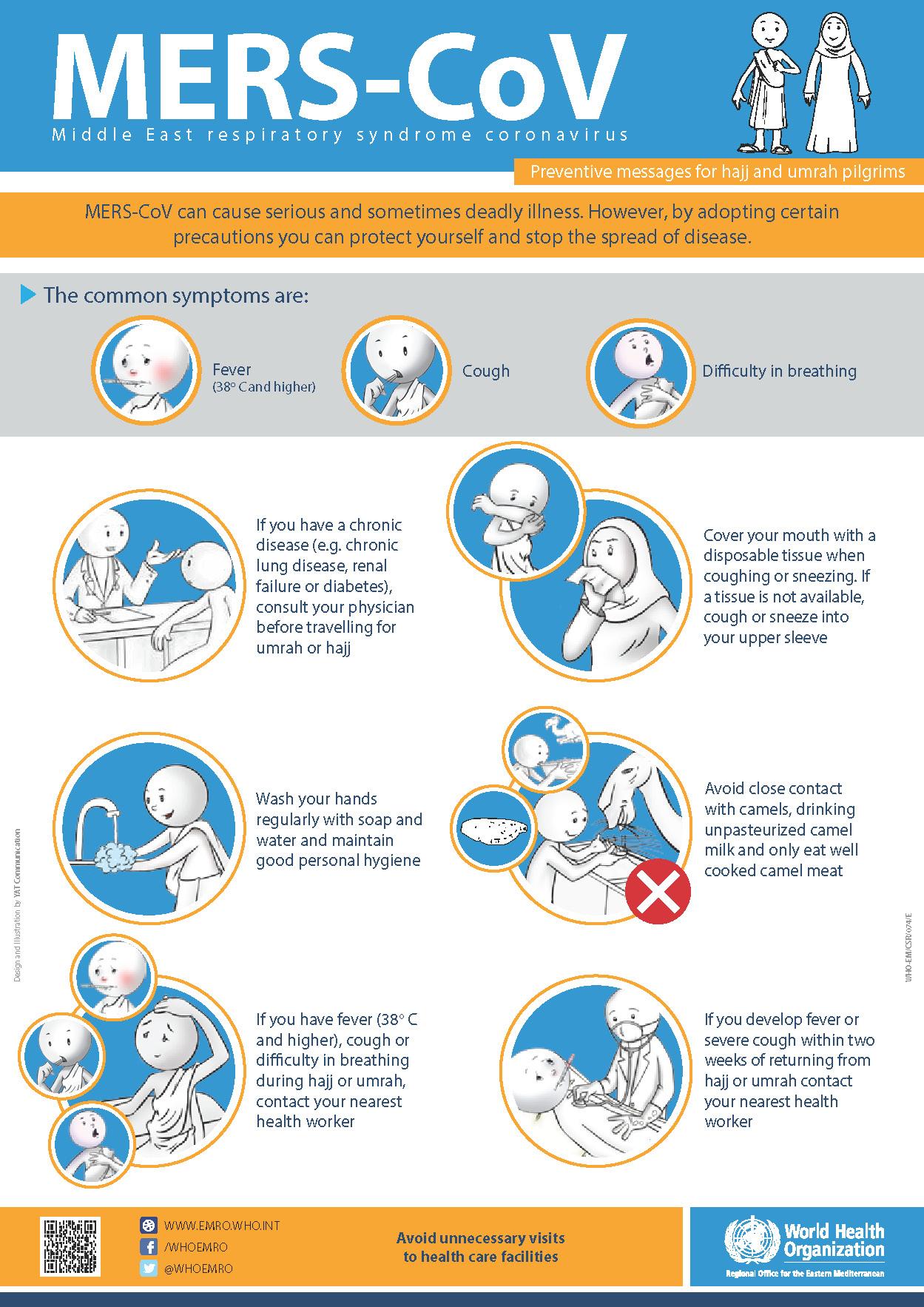
MERS risk reduction and signs of illness to watch for during hajj and umrah...

I love a good infographic and this one ticks a lot of boxes for getting a clear message out about the Middle East respiratory syndrome (MERS) disease and how to avoid catching and spreading the MERS-coronavirus (MERS-CoV).

Thanks World Health Organization.


World Health Organization poster describing risk of infection
 and how to identify when you might have MERS.
Of course, I'd be happier if the poster specifically suggested putting more distance between people and potentially infected camels, rather than just avoiding "close contact".

Granted, close contact can include spending time in the close, but not physically connected, "personal space" of a camel. But "close contact" is, in my opinion, one of those infectious disease terms that needs to be made more simple and clear. Like "aerosol" and "airborne", "close contact" gets a little lost when translated to the people who are at actual risk from infection.

To the Saudi Arabian Ministry of Health: A request for missing data on retrospective MERS-CoV detections

From: Ian M Mackay

To: The Office of the Minister of Health, Kingdom of Saudi Arabia

I write to humbly ask for your help on a matter of infectious disease communication. I ask that you please consider completing the already near-complete public data picture for all retrospectively confirmed cases of Middle East respiratory syndrome coronavirus (MERS-CoV) that have occurred on your soil. I ask that this be publicly released for analysis, and suitably acceptable citation, by all. The Ministry of Health has already made a number of advances in tracking and communicating new cases of MERS-CoV, addressing criticisms along the way. But there remain some small but epidemiolgically important gaps in an otherwise complete set of data that could be easily closed.

Today, the 19th of September, I make note of the Command and Control Center announcement of the discovery of 19 MERS-CoV cases, identified after retrospective analysis of cases.[1] This adds to the 113 MERS-CoV detections announced 3rd June 2014.[2] I also note the reference to removal of a duplicate case and two false positive cases. In addition to these items, there have been many identified deaths that cannot be linked to publicly announced cases because key date data are no longer published along with the time of death announcements, as they once were (see example [3]).

So I ask if it is possible for you to publish a minimum set of deidentified details from cases that have not been fully described by the World Health Organization Disease Outbreak News reports. I suggest an open access spreadsheet on the CCC website.  I do not ask that any compromising or identifying data be included nor do I believe there is a need for identification of hospital or treatment facility. I would be happy to help identify these cases if that could be of use. 

These data include:

  • Age
  • Sex
  • Date when symptoms began
  • Date of hospital admission
  • Date when a fatal case was first reported (allowing a link to be made)
  • City where case likely acquired

The Command and Control Center website and its updates on contemporary MERS cases have evolved into an essential global asset for many international researchers and for the global public, each of whom are still trying to understand this emerging virus. What I suggest here would add even more reach and value to your efforts to keep us all informed. 

As the custodian of over 90% of MERS case data, the world wholly relies upon your transparency, good will, expertise and willingness to openly share it. I believe a complete set of MERS-CoV data have great potential to engage more researchers from around the globe. These links may help identify new and interesting patterns that could be of use to Saudi Arabia and other Middle East and African nations trying to improve control of MERS-CoV now and in the future.

Thank you for reading this.

Yours sincerely,

Ian M. Mackay, Ph.D.
Virologist
Science communicator
ian.mackay.im (at) gmail.com


NB. A response was received and is posted here [4]
  1. http://www.moh.gov.sa/en/CCC/PressReleases/Pages/Statistics-2014-09-18-002.aspx
  2. http://www.moh.gov.sa/en/CCC/PressReleases/Pages/mediastatement-2014-06-03-001.aspx
  3. http://www.moh.gov.sa/en/CCC/PressReleases/Pages/mediastatement-2014-05-24-001.aspx
  4. http://newsmedicalnet.blogspot.com.au/2014/09/mers-cov-data-request-response-from.html

Happy 2nd birthday Middle East respiratory syndrome coronavirus (MERS-CoV)...

Its been 2-years since Prof. Ali Mohamed Zaki sent his email to ProMED notifying them of a novel coronavirus. That email was published 20-Sept 2012.[1] 

A year ago we had 138 cases and 58 deaths. Today we have 856 cases with perhaps 306 fatal (36%).

I won't rehash what I said a year ago - I invite you to check that out over at the 1st birthday post.[2]

Suffice to say the past year has been, to my mind anyway, mostly about:

  • Camels
  • High level job "shuffling"
  • Controversial parallel publications
  • Very problematic infection prevention and control issues.
The latter leading to the relatively huge number of MERS-CoV detections and deaths in Saudi Arabia and to some exported detections and cases. The one constant over both years has been that the MERS-CoV is a pitiful spreader among humans. MERS-CoV is nonetheless a virus that is very capable of inducing fatal outcomes, especially among older males with underlying diseases.

Has MERS-CoV gone away? No. Of course it hasn't. MERS has, mostly. That's the disease, not the virus. For now anyway MERS cases are sporadic, although still geographically widespread. 

MERS cases fell to zero cases per week for a number of weeks this year following containment of the Jeddah-2014 outbreak. Nonetheless, this is a virus of camels that seems to  spread, rarely, to humans and when in us, it has not been in any rush to mutate into the pandemic SARS-like threat many once worried about. 

Camels are where this virus likely remains. And there have been no signs that that has in any way changed. The latest information suggests camels have been harbouring MERS-CoV for at least 30-years.[3] This, as with a great deal of the research to date, is knowledge gained mostly thanks to the efforts of international research teams and their funding

So Happy 2nd Birthday you opportunistic, spiky little killer. I'm once again wishing Dr Zaki well and congratulating him on co-parenting the birth of this novel coronavirus. This year I also wish Prof. Ziad Memish well and congratulate him on seeing the infant virus through to toddler age.

Oh, and 2-years on, I still see no sign that the contentious patenting issues were any sort of hindrance to diagnostics or actual research. Just sayin'.

References...

  1. http://www.promedmail.org/direct.php?id=20120920.1302733
  2. Happy 1st birthday Middle East respiratory syndrome coronavirus (MERS-CoV)http://newsmedicalnet.blogspot.com.au/2013/09/happy-1st-birthday-middle-east.html
  3. MERS Coronavirus Neutralizing Antibodies in Camels, Eastern Africa, 1983�1997
    http://wwwnc.cdc.gov/eid/article/20/12/14-1026_article

MERS-CoV around the house-yes, it does transmit at home

Click on graph to enlarge.
Some Middle East respiratory syndrome coronavirus (MERS-CoV) questions remain stubbornly unanswered even after two and a half years.

Today comes a study from Prof Christian Drosten and colleagues, including Prof Ziad Memish, released by the New England Journal of Medicine.[1] This study takes a look at MERS-CoV infection among the contacts of MERS cases.

We already know that asymptomatic or "silent" MERS-CoV infections are not rare. At least 17% of detections of this virus have occurred in people with no overt signs or reported symptoms of disease. That's not to say that they didn't have a slightly raised temperature, headache, sniffle or something very mild that got overlooked or forgotten, but nothing noted or noteworthy. I'd love to see a study on asymptomatic MERS-CoV infected people that looked into fine detail signs and symptoms by the way-that might tell a nice little story about "silent" infections.

This new study looks at the contacts of infected cases from 26 different households, each with a single confirmed MERS-CoV infected case, with MERS. These households provided throat swabs from 280 contacts and antibody test results on at least 1 sample (only 44 permitted a second voluntary blood sample be taken-a shame) from the 280 contacts as well.

Some interesting findings included:

  • Median age of cases (65.4% male) was 55-years
  • Median age of contacts (52% male) was 29-years
  • Cases 7 household contacts (2.5%) were viral RNA-positive (RT-PCR) within 2-weeks of the index patient's illness onset. Similar to what PCR-based studies conducted previously have yielded.
  • 5 household contacts (1.7%) were considered antibody positive after a series of different tests were used. 3 were positive between 2-3 weeks after the index case's onset, and 1 each before or after that period. 
  • some indication that neutralizing antibodies against MERS-CoV might be low level and short lived in mild or asymptomatic infections and that previous antibody studies may have missed some cases if the took blood too long after a mild infection
Overall, 12 (4%) contacts acquired MERS-CoV infection from an index case, across 6 of 26 households (23.1%). 

Among others, one question I'd like answered is whether symptomatic cases being kept in home isolation, which was occurring during the Jeddah-2104 outbreak when they don't need hospital-based supportive care, is the best option for stopping transmission? We don't know whether mild or silent infections can transmit virus, which remains another important question. While 4% seems like a small proportion, it's big enough to perhaps explain some of the sporadic case occurrences. Also, we should be mindful that MERS-CoV infection is associated with the death of a third of the people it infects. I'd want to be pretty sure I wasn't letting a house-bound shedding mild/silent person spread MERS-CoV to a visiting old uncle with a co-morbidity.

References
  1. http://www.nejm.org/doi/full/10.1056/NEJMoa1405858
  2. If this is what MERS-CoV detections look like with more testing...what is the "normal" community level of virus?? [UPDATED]
    http://newsmedicalnet.blogspot.com.au/2014/04/if-this-is-what-mers-cov-detections.html
  3. Guidelines for home isolation related to MERS Corona Virus infections | May 2014http://www.moh.gov.sa/en/Documents/3-Isolation.pdf

Like Us

Blog Archive